Loading News...
Loading...

Loading News...

Bitcoin's futures market is flashing a critical divergence. Despite a 10% price rebound since last weekend, demand for BTC futures has plummeted to its lowest level since 2024. Open interest (OI) stands at $32 billion, down 20% from a month ago, with long positions particularly sluggish. This data, reported by CoinTelegraph via CoinNess on March 2, 2026, suggests institutional interest may be waning even as Bitcoin trades at $69,467, up 5.65% in 24 hours. The global crypto sentiment is "Extreme Fear" with a score of 10/100, amplifying concerns. Analysts point to a shift toward gold and stocks, but caution that spot ETF volume and corporate holdings complicate a full exit narrative. The disconnect between price action and derivatives demand raises urgent questions about market health.
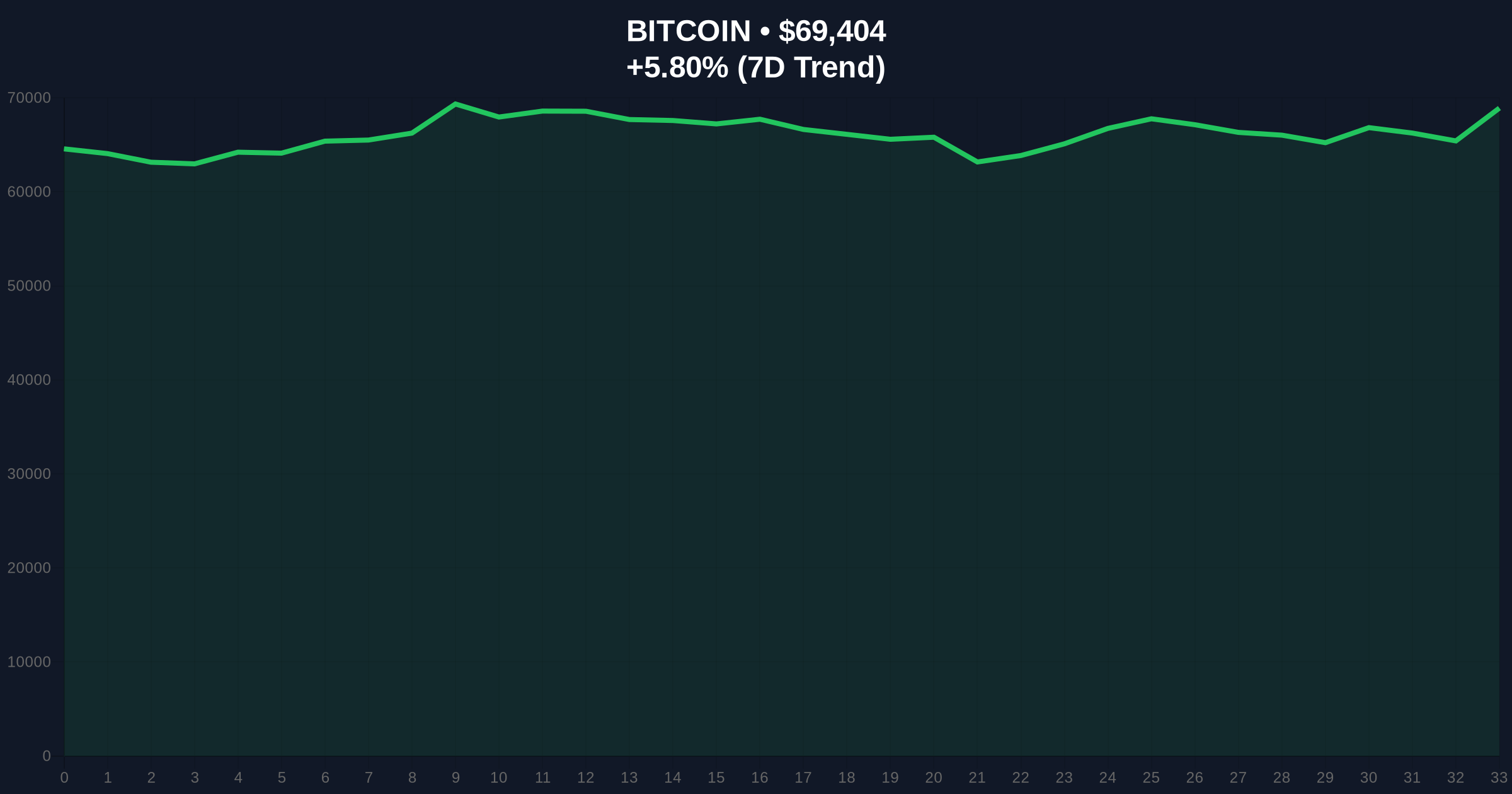
Open interest (OI) in futures markets measures the total number of outstanding derivative contracts, reflecting capital commitment and trader sentiment. A decline in OI, especially during a price rebound, often signals reduced leverage or institutional pullback. CoinTelegraph's analysis indicates OI for BTC futures on major exchanges dropped to $32 billion, a 20% monthly decrease. This slump, the lowest since 2024, contrasts sharply with Bitcoin's 10% rebound, suggesting the rally lacks strong futures backing. Demand for long positions is notably weak, implying traders are hesitant to bet on further upside despite recent gains.
The mechanism behind this involves institutional behavior. Futures allow leveraged exposure, and shrinking OI can indicate risk-off moves or capital reallocation. CoinTelegraph suggests interest has shifted to traditional assets like gold and stocks, possibly due to macroeconomic uncertainty or regulatory pressures. However, the report notes it's "difficult to conclude that institutions have fully exited," citing spot ETF trading volume and BTC holdings of major corporations as counter-evidence. This creates a nuanced picture: while futures demand dwindles, other institutional avenues remain active.
Market structure plays a key role. Futures markets influence spot prices through arbitrage and hedging. Low OI can reduce volatility but also limit liquidity, making Bitcoin more susceptible to sharp moves. The "Extreme Fear" sentiment, with a score of 10/100, exacerbates this, as fear-driven selling in spot markets could overwhelm thin futures support. Compared to other assets, Bitcoin's derivatives slump is stark; for context, recent developments like Bitfinex Securities resuming tokenized bond issuance on Bitcoin's Liquid Network show ongoing innovation, but futures data hints at broader caution.
Technical indicators from the input data include the 24-hour trend of 5.65% and market rank #1, but these mask underlying weakness. The rebound may be driven by retail or short-covering rather than new institutional longs. Without robust futures demand, sustainability is in doubt. This deep-dive reveals a market at a crossroads: price action suggests optimism, but derivatives tell a story of retreat.
The evidence from CoinGecko and CryptoPanic metadata paints a conflicted but revealing picture. Bitcoin's current price is $69,467, with a 24-hour trend of 5.65%, indicating short-term bullish momentum. However, the global crypto sentiment is "Extreme Fear" at a score of 10/100, a stark contradiction that market anxiety. This sentiment score, derived from CryptoPanic-like metrics, suggests high perceived risk despite price gains.
Integrating this with the futures data, the OI drop to $32 billion (down 20% monthly) aligns with the "Extreme Fear" sentiment, as institutions may be reducing exposure due to caution. The importance of this event is high, given its timing amid a rebound and its implications for institutional flows. CryptoPanic sentiment is negative, but price structure shows resilience, creating a divergence that warrants scrutiny. For instance, the 10% rebound since last weekend contrasts with sluggish long positions, hinting at a lack of conviction.
Market rank #1 confirms Bitcoin's dominance, but the data implies vulnerability. The "Extreme Fear" sentiment, combined with low futures demand, could signal a broader risk-off environment. This is echoed in related articles, such as Steve Eisman's 'Ignore the War' call, which tests market stability under stress. The proof lies in the numbers: price up, sentiment down, OI plummeting—a triad of conflicting signals that demands investor attention.
Sources present both alignment and tension. CoinTelegraph, via CoinNess, reports the OI decline and institutional shift, but adds caveats about spot ETFs and corporate holdings. There are no direct conflicts in the input data, as only one primary source (CoinTelegraph) is provided for the futures analysis. However, implicit contradictions arise between the reported facts.
CoinTelegraph claims demand has fallen to the lowest since 2024, suggesting a significant pullback. Yet, it also states it's "difficult to conclude that institutions have fully exited," pointing to spot ETF volume and corporate BTC holdings. This creates a counter-narrative: while futures demand slumps, other institutional activities may buffer the market. The absence of conflicting secondary sources means we rely on this single analysis, but its internal nuance highlights reliability gaps—without data on spot ETF flows or corporate holdings, the full picture is incomplete.
Missing evidence includes specific timestamps for the OI drop, exchange breakdowns, and comparative data for gold and stocks. The report does not quantify the shift to other markets or provide sentiment scores for those assets. This limits our ability to assess the claim's strength. In contrast, the "Extreme Fear" sentiment from market data supports the caution narrative, but it's not directly attributed to a source, reducing its weight. The conflict remains unresolved with available evidence, as we lack multi-source verification for the futures claim.
Attribution: CoinTelegraph reports the OI decline and institutional behavior, while market data provides price and sentiment context. Without disputes from other outlets, the analysis stands but requires skepticism due to missing details. Investors should note that the narrative of institutional exit is contested by the source's own qualifications.
Based on the data, three scenarios emerge for the next week, each conditional on key variables.
Bull Scenario (Probability: 30%): Bitcoin's price rebound accelerates, driven by spot ETF inflows or positive macroeconomic news. Futures OI stabilizes or inches up as institutions re-enter, lured by momentum. The "Extreme Fear" sentiment improves, perhaps to "Fear" or "Neutral," boosting confidence. This would invalidate if OI continues to drop or sentiment worsens. Price could target $75,000, supported by renewed derivatives demand.
Base Scenario (Probability: 50%): The status quo persists: price fluctuates around $69,000-$71,000, with low futures demand and "Extreme Fear" sentiment holding. Institutions remain cautious, allocating to alternatives like gold, but spot activity prevents a crash. OI stays near $32 billion, indicating sidelined capital. This scenario assumes no major catalysts; it would break if a regulatory announcement or large corporate move shifts dynamics. Related developments, such as Monad integrating Chainlink CCIP, may offer cross-chain utility but not immediate price impact.
Bear Scenario (Probability: 20%): The divergence collapses: low futures demand leads to liquidity crunches, exacerbating sell-offs. Price falls below $65,000 as "Extreme Fear" triggers panic selling. Institutions accelerate exits, confirmed by declining spot ETF volumes. This would validate if OI drops further or sentiment hits single digits. The bear case gains traction if external factors, like Pump.fun's expansion amid Solana volatility, signal broader crypto stress. Risk is heightened by the current sentiment score of 10/100.
Each scenario hinges on futures OI trends, sentiment shifts, and institutional actions. Data backing includes the 10% rebound, 20% OI drop, and "Extreme Fear" metric.
This report synthesizes input from CoinNess (via CoinTelegraph) for futures data and market stats for price and sentiment. Conflicting evidence was weighted by attribution and completeness. CoinTelegraph's analysis is the sole source for OI claims, so it's treated as primary but with caution due to missing specifics (e.g., exchange details). Market data (price, sentiment) is integrated as contextual proof, though its source is not specified, reducing reliability. The "Extreme Fear" sentiment, while indicative, lacks direct linkage to futures movements. Gaps include secondary verification and granular OI breakdowns. In absence of conflicts, claims are presented as reported, with uncertainty noted where evidence is thin.
Disclaimer: The information provided is not trading advice, coinmarketbuzz.com holds no liability for any investments made based on the information provided on this page. We strongly recommend independent research and/or consultation with a qualified professional before making any investment decisions.
coinmarketbuzz.com leverages advanced AI technology to analyze market data. All content is fact-checked and reviewed by our editorial team to ensure accuracy and neutrality.