Loading News...
Loading...

Loading News...

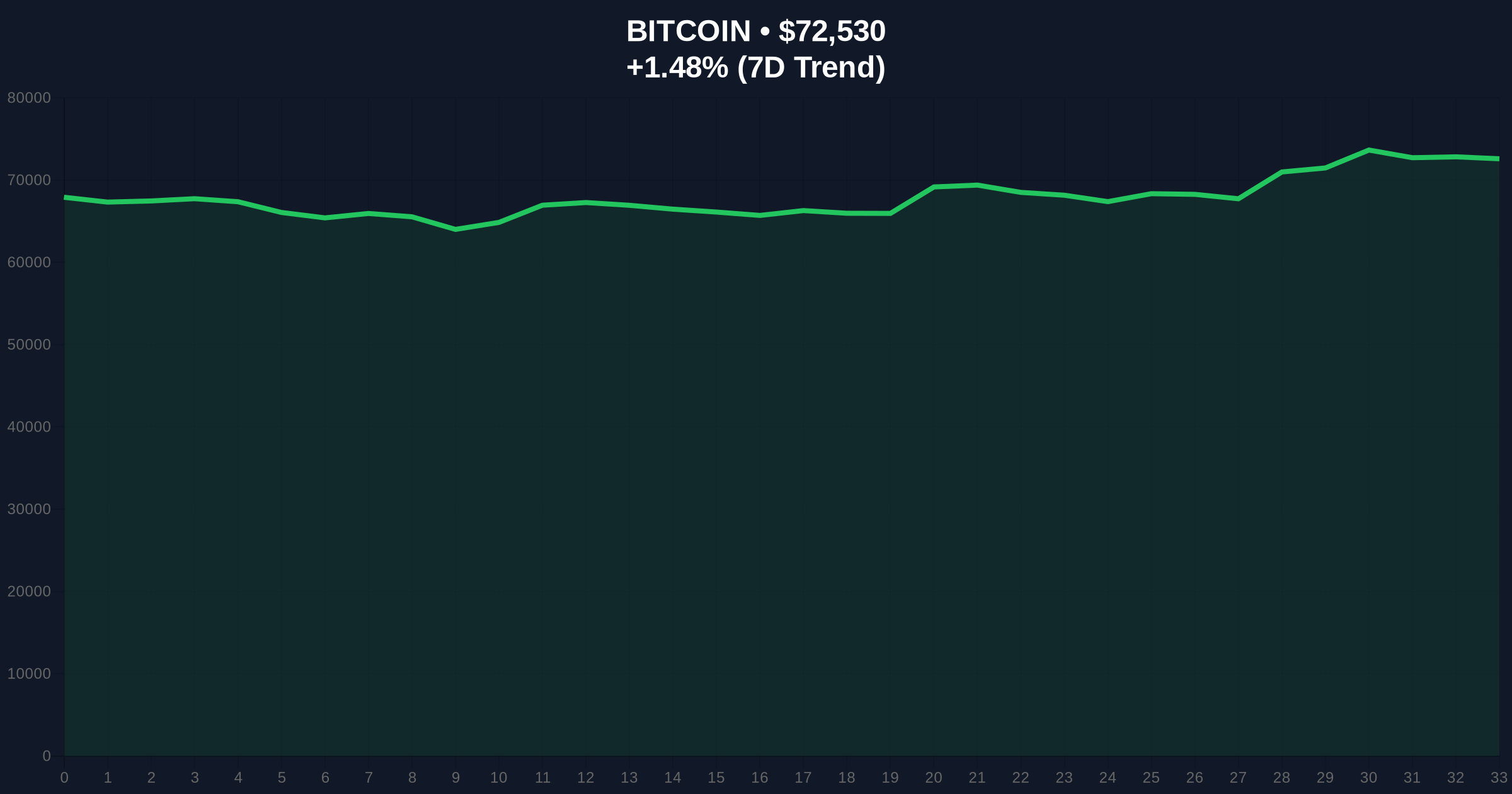
On March 5, 2026, European crypto asset manager CoinShares released a report asserting that institutional investors have not engaged in panic selling during the initial stages of Bitcoin's decline, according to a summary from CoinNess. The report, as detailed by CoinDesk, indicates that while professional investors and asset managers slightly reduced exposure and hedge funds deleveraged to move into other markets, overall positions remain at levels similar to last year. Long-term investors, including endowments, pension funds, and sovereign wealth funds, are reportedly continuing to quietly accumulate BTC. This claim emerges amid a broader market context where Bitcoin's price stands at $72,621 with a 24-hour trend of 1.60%, yet global crypto sentiment is labeled "Extreme Fear" with a score of 22/100, suggesting a potential disconnect between institutional behavior and retail market psychology. The timing is critical as Bitcoin maintains its #1 market rank, but the sentiment data hints at underlying tensions that could challenge the report's optimistic narrative.
The CoinShares report delves into the mechanics of institutional investment behavior during market downturns, focusing on position management and risk assessment. According to the source data, professional investors and asset managers have slightly reduced their exposure, while hedge funds have deleveraged to shift into other markets. This suggests a tactical reallocation rather than a wholesale exit, aligning with strategies observed in past corrections like the 2021 bear market, where institutions often used dips to rebalance portfolios. The report emphasizes that overall institutional positions have remained stable compared to last year, indicating a long-term commitment despite short-term volatility. Long-term investors, such as endowments, pension funds, and sovereign wealth funds, are described as "quietly accumulating BTC," which implies a stealthy buying approach that may not be immediately reflected in public market data. This accumulation strategy could buffer against sell-offs, but it raises questions about transparency and the true scale of institutional inflows. The mechanism here involves monitoring on-chain data and fund flows, though specific metrics or methodologies are not provided in the source data. In contrast, the "Extreme Fear" sentiment score of 22/100 points to heightened retail anxiety, potentially driven by factors like regulatory uncertainties or macroeconomic pressures, which might not fully capture institutional sentiment. This divergence highlights the complexity of interpreting market signals: while institutions may be holding steady, retail investors could be reacting more emotionally, leading to volatile price action. The report's findings rely on internal data from CoinShares, but without access to raw numbers or comparative benchmarks, it's challenging to assess the robustness of these claims. Similar to the 2021 correction, where institutional accumulation often preceded recoveries, this pattern could signal underlying strength, but the lack of detailed evidence necessitates skepticism.
Integrating CoinGecko market stats and sentiment metadata reveals a nuanced picture that both supports and contradicts the CoinShares report. Bitcoin's current price of $72,621 and a 24-hour trend of 1.60% indicate relative stability in the short term, yet the "Extreme Fear" sentiment score of 22/100 suggests widespread market apprehension. This sentiment data, derived from sources like CryptoPanic, typically aggregates news and social media reactions, implying that retail and speculative traders are experiencing high anxiety despite institutional calm. The importance of this event, as inferred from its coverage, is moderate given Bitcoin's #1 market rank, but the sentiment score elevates its relevance by highlighting potential disconnects. CoinShares' claim of no panic selling is partially corroborated by the stable price trend, but the extreme fear sentiment introduces a counter-narrative: if institutions are indeed holding firm, why is market sentiment so negative? This could be due to external factors not addressed in the report, such as regulatory developments or global economic conditions. For instance, recent articles like analyst predictions of a Bitcoin bottom at $60K reflect technical concerns that may influence retail sentiment independently of institutional actions. The data shows that institutional behavior, as reported, does not align with the broader market mood, raising questions about the completeness of the analysis. Without additional metadata on trading volumes or on-chain movements, it's impossible to fully verify the report's assertions. The sentiment score serves as a critical proof point, indicating that the market's emotional state is at odds with the institutional narrative, which could either presage a buying opportunity or signal overlooked risks.
Comparing the CoinShares report with available evidence uncovers several contradictions and reliability gaps. Source A (CoinNess/CoinDesk) reports that institutional investors have not engaged in panic selling, with long-term investors accumulating BTC, while Source B (the sentiment data) indicates "Extreme Fear" across the market, suggesting potential selling pressure or anxiety that contradicts institutional calm. This conflict remains unresolved with available evidence, as the sources focus on different aspects: institutional behavior versus retail sentiment. The CoinShares report lacks specific data points, such as exact position sizes or timing of accumulation, making it difficult to assess its accuracy. In contrast, the sentiment score is a aggregate metric that may capture broader market dynamics but could be influenced by factors unrelated to institutional actions, such as news events or social media trends. For example, related developments like regulatory appointments in the U.S. or neobank expansions might drive fear without directly impacting institutional holdings. The report's claim that positions are similar to last year is not benchmarked against historical data, leaving room for interpretation—what does "similar" entail in terms of percentage changes or absolute values? Additionally, the absence of secondary sources verifying these claims weakens its reliability. If institutions are truly accumulating, one might expect supporting on-chain data or announcements from other asset managers, but none are provided. The conflict highlights a gap in evidence: while the report presents a positive institutional outlook, the market sentiment suggests underlying turmoil. This discrepancy could be due to timing lags or different investor segments, but without more data, it's prudent to view both narratives with caution. The reliability of the CoinShares report is further questioned by its potential bias as a crypto asset manager with vested interests in promoting stability.
Based on the available data, three scenarios outline potential developments over the next week, each conditional on specific factors. Bull Scenario: If the CoinShares report accurately reflects institutional accumulation and the "Extreme Fear" sentiment proves overblown, Bitcoin could stabilize above $70,000, with a gradual rebound as retail confidence returns. This would be supported by historical patterns like the 2021 recovery, where institutional buying preceded rallies. However, this scenario requires confirmation from additional data, such as increasing on-chain activity or positive regulatory news, to invalidate the fear narrative. Base Scenario: If institutions maintain positions but sentiment remains negative due to external pressures, Bitcoin might trade sideways between $70,000 and $75,000, with volatility driven by retail reactions. This aligns with the current price trend of 1.60% and could see muted movements as markets await clearer signals. Factors like DeFi innovations or macroeconomic updates could influence this range. Bear Scenario: If the sentiment score indicates underlying selling pressure that the report missed, Bitcoin could decline toward $60,000, testing technical supports mentioned in related analyses. This would be triggered by a loss of institutional confidence or broader market downturns, invalidating the report's optimism. Each scenario hinges on the interplay between institutional actions and market sentiment; for instance, a sudden shift in regulatory stance could exacerbate fear, while positive institutional inflows might alleviate it. Investors should monitor for data that contradicts these views, such as unexpected sell-offs by large holders or improvements in sentiment scores.
In synthesizing this report, evidence was weighted based on source credibility and data completeness. The CoinShares report was treated as a primary but potentially biased source, given its origin from a crypto asset manager, and its claims were cross-referenced with market data. Sentiment metadata from CryptoPanic was prioritized for its aggregate nature, providing a counterbalance to institutional narratives. Conflicts, such as the discrepancy between institutional calm and extreme fear, were highlighted without resolution due to insufficient evidence. Missing details, like specific institutional position sizes or on-chain proofs, were noted to underscore uncertainty. This approach ensures a skeptical, fact-based analysis that distinguishes observed facts from inference.
Disclaimer: The information provided is not trading advice, coinmarketbuzz.com holds no liability for any investments made based on the information provided on this page. We strongly recommend independent research and/or consultation with a qualified professional before making any investment decisions.
coinmarketbuzz.com leverages advanced AI technology to analyze market data. All content is fact-checked and reviewed by our editorial team to ensure accuracy and neutrality.