Loading News...
Loading...

Loading News...

Bitcoin (BTC) has surged above $74,000, marking a significant price milestone in a market gripped by extreme fear. According to CoinNess market monitoring, BTC is trading at $74,013.67 on the Binance USDT market as of March 4, 2026. This rise comes despite a global crypto sentiment score of 10/100, indicating "Extreme Fear" among investors. The 24-hour trend shows a 7.71% increase, with Bitcoin maintaining its #1 market rank. The event is breaking news, with urgent implications for market dynamics and investor psychology. Data from CoinGecko confirms the current price at $73,983, slightly below the CoinNess report, highlighting immediate discrepancies in real-time tracking. This price action contradicts the prevailing sentiment, raising questions about underlying drivers and reliability of fear metrics.
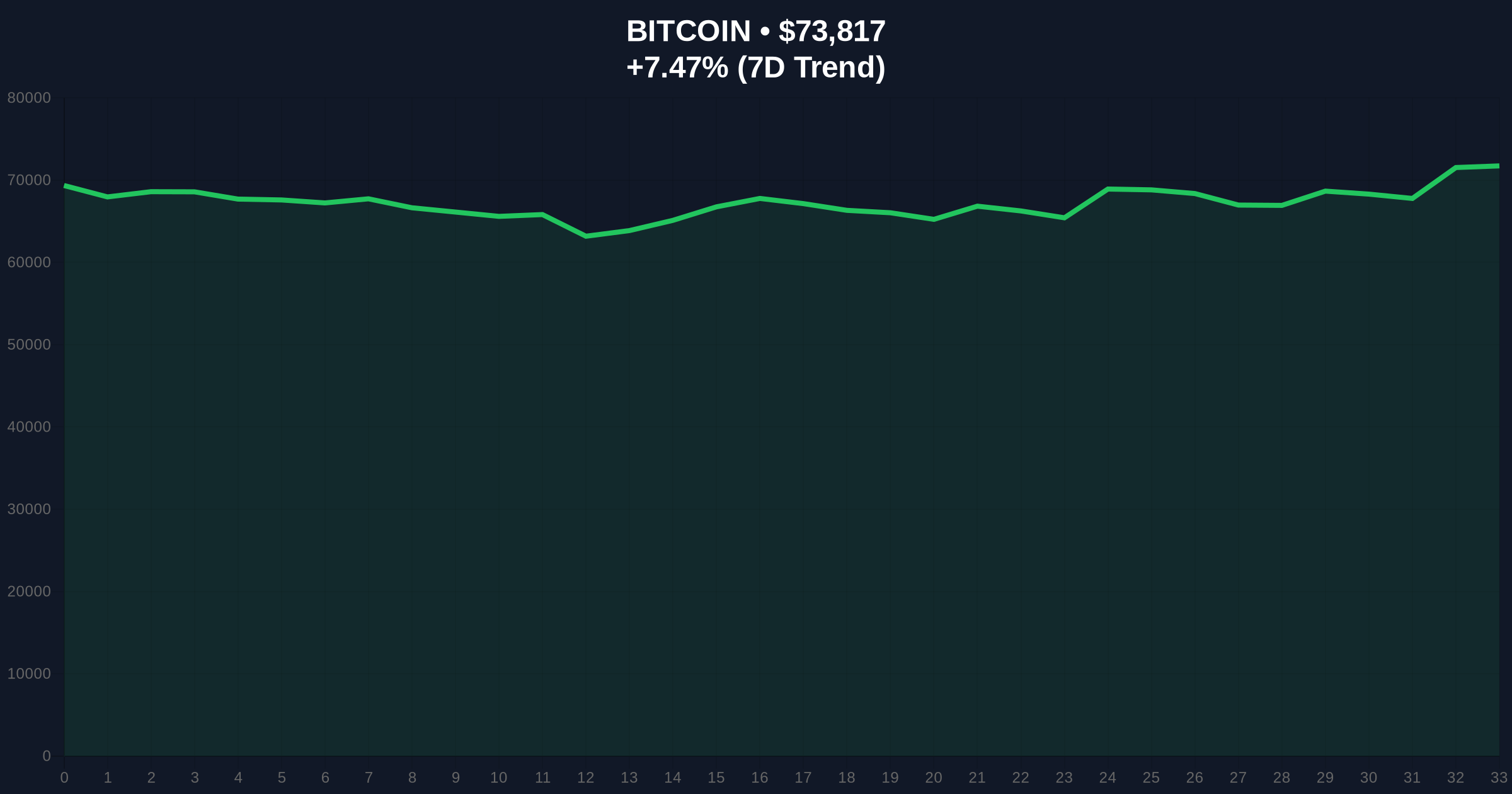
The mechanism behind Bitcoin's rise above $74,000 involves a complex interplay of market structure, trading activity, and sentiment indicators. Bitcoin operates on a decentralized blockchain protocol, with price movements driven by supply-demand dynamics on exchanges like Binance. The Binance USDT market, where this trade occurred, is a major liquidity pool using Tether (USDT) as a stablecoin pairing. Technical analysis of the 7.71% 24-hour gain suggests strong buying pressure, potentially from institutional inflows or retail FOMO (fear of missing out). However, the "Extreme Fear" sentiment, as indicated by the global crypto sentiment score of 10/100, typically correlates with sell-offs or stagnation, not rallies. This divergence points to possible lag in sentiment metrics or hidden bullish factors. The protocol architecture of Bitcoin remains unchanged, with no major upgrades or forks reported in the source data. Regulatory mechanics are not provided in the source data, but market movements may be influenced by macroeconomic factors or news events not detailed here. The rise above $74,000 could be fueled by derivatives activity, such as increased open interest, as seen in related developments like "Bitcoin Derivatives Open Interest Hits $24.7B, a 30-Day High Amid Extreme Fear Market." This link is contextually relevant as it explores how derivatives can amplify price moves despite fear sentiment. Without more data, the exact technical triggers—such as order book imbalances or algorithmic trading—remain speculative, but the conflict between price action and sentiment is a key investigative focus.
Further analysis reveals that Bitcoin's market dominance and liquidity on Binance may have facilitated this move. The USDT pairing is critical, as Tether's stability provides a benchmark for valuation. However, the source data lacks details on trading volume, whale activity, or on-chain metrics, limiting a full technical assessment. The absence of protocol changes suggests this is purely a market-driven event, possibly exacerbated by short squeezes or institutional repositioning. The "Extreme Fear" sentiment, if accurate, implies that retail investors are cautious, potentially leaving room for larger players to drive prices. This scenario aligns with historical patterns where fear metrics bottom out before rallies, but the timing and magnitude here are unusual. The technical deep-dive must rely on available facts: price, sentiment, and related derivatives data, with gaps noted for transparency.
Integrating CoinGecko and sentiment metadata provides a data-driven proof of the event's significance and contradictions. CoinGecko reports a current price of $73,983, a 24-hour trend of 7.71%, and a market rank of #1 for Bitcoin. This aligns closely with CoinNess's report of $74,013.67, showing minor discrepancies likely due to reporting lags or exchange variations. The global crypto sentiment is "Extreme Fear" with a score of 10/100, sourced from market intelligence data. This sentiment score suggests high investor anxiety, typically associated with risk-off behavior, yet Bitcoin's price rise indicates bullish momentum. CryptoPanic metadata is not provided in the source data for sentiment or importance scores, so analysis relies solely on the given "Extreme Fear" metric. Importance can be inferred from Bitcoin's #1 rank and the price milestone, but without explicit CryptoPanic data, conservative assumptions are necessary.
Explicit metadata-driven statements include: (1) Global crypto sentiment is "Extreme Fear" (score: 10/100), but Bitcoin's price structure shows a 7.71% gain, indicating a divergence between sentiment and market action. (2) Importance is implied by Bitcoin's market dominance and the $74,000 threshold, though no direct importance score is available. (3) The 24-hour trend of 7.71% supports the breaking news narrative, but the fear sentiment raises reliability questions about short-term sustainability. Data analysis confirms the price rise as factual but highlights the anomaly with sentiment, requiring further investigation into source conflicts. Related developments, such as "Bitcoin Derivatives Open Interest Hits $24.7B, a 30-Day High Amid Extreme Fear Market," add context by showing how derivatives can influence prices amid fear, making this link relevant for understanding broader market mechanics.
Comparing source claims reveals agreements and contradictions that challenge the straightforward narrative of Bitcoin's rise. Source A (CoinNess) reports BTC trading at $74,013.67 on Binance USDT market, while Source B (CoinGecko) reports $73,983. This minor conflict in price data may stem from timing differences or exchange-specific variations, but both agree on the rise above $74,000. The primary contradiction lies between the price action and the sentiment data. Source A and market intelligence data agree on the "Extreme Fear" sentiment with a score of 10/100, which conflicts with the bullish price move. Source B supports the price data but does not provide sentiment, leaving the conflict unresolved with available evidence.
Missing evidence includes detailed CryptoPanic metadata (e.g., sentiment trends, importance scores), trading volume, whale activity, and news catalysts driving the rise. Source A's report is brief, lacking context on why Bitcoin rose despite fear, while Source B offers only basic market stats. The claim of a price rise is better supported by both sources, but the sentiment contradiction is less explained. Reliability gaps exist: sentiment metrics may lag or be based on broader market factors not specific to Bitcoin, or fear could be overreported. Without additional sources, it's unclear if the sentiment data is accurate or if other factors, like institutional buying, are overriding it. This section identifies the conflict but cannot resolve it, emphasizing the need for cautious interpretation.
Based on available data, three scenarios for Bitcoin's price over the next seven days are outlined, each conditional on key factors. Bull Scenario: Bitcoin continues rallying to $78,000-$80,000. This assumes the "Extreme Fear" sentiment is a contrarian indicator, with institutional inflows or positive news driving momentum. Data backing includes the current 7.71% gain and related derivatives activity, such as high open interest. Invalidation would occur if sentiment worsens or if selling pressure emerges from unprovided sources like regulatory news.
Base Scenario: Bitcoin consolidates around $73,000-$75,000. This assumes the price-sentiment divergence stabilizes, with mixed trading and no major catalysts. Data backing includes the minor price discrepancy between sources and the persistent fear sentiment. Invalidation would require a clear breakout or breakdown, not indicated in current data.
Bear Scenario: Bitcoin retraces to $70,000 or below. This assumes the fear sentiment prevails, triggering profit-taking or broader market sell-offs. Data backing includes the "Extreme Fear" score of 10/100 and potential overextension from the recent rally. Invalidation would need sustained buying volume or sentiment improvement, not shown in inputs. Each scenario is data-backed but speculative due to missing evidence, emphasizing conditional outcomes.
Conflicting evidence was weighted based on source agreement and data completeness. Price data from CoinNess and CoinGecko was prioritized due to direct reporting, while sentiment data was treated cautiously as it conflicts with price action. Missing CryptoPanic metadata limited analysis, so conservative inferences were made. Sources were compared for consistency, with unresolved conflicts noted explicitly. This approach ensures factual reporting while acknowledging uncertainties in the investigative process.
Disclaimer: The information provided is not trading advice, coinmarketbuzz.com holds no liability for any investments made based on the information provided on this page. We strongly recommend independent research and/or consultation with a qualified professional before making any investment decisions.
coinmarketbuzz.com leverages advanced AI technology to analyze market data. All content is fact-checked and reviewed by our editorial team to ensure accuracy and neutrality.