Loading News...
Loading...

Loading News...

On March 5, 2026, Bitcoin (BTC) broke above the $73,000 threshold, trading at $73,077.13 on the Binance USDT market, according to CoinNess market monitoring. This price movement represents a notable milestone in BTC's trajectory, occurring against a backdrop of conflicting market indicators. The event was reported by CoinNess, which provided the specific trading price and exchange context. However, the source data lacks details on the exact time of the breakout, trading volume accompanying the rise, or broader market catalysts driving the move. Not provided in source data are insights from other major exchanges or institutional reactions, leaving gaps in understanding the full scope of this price action. Historically, similar breakouts above key psychological levels, such as during the 2021 bull run, have often preceded volatility, but current conditions differ significantly due to the prevailing sentiment of extreme fear.
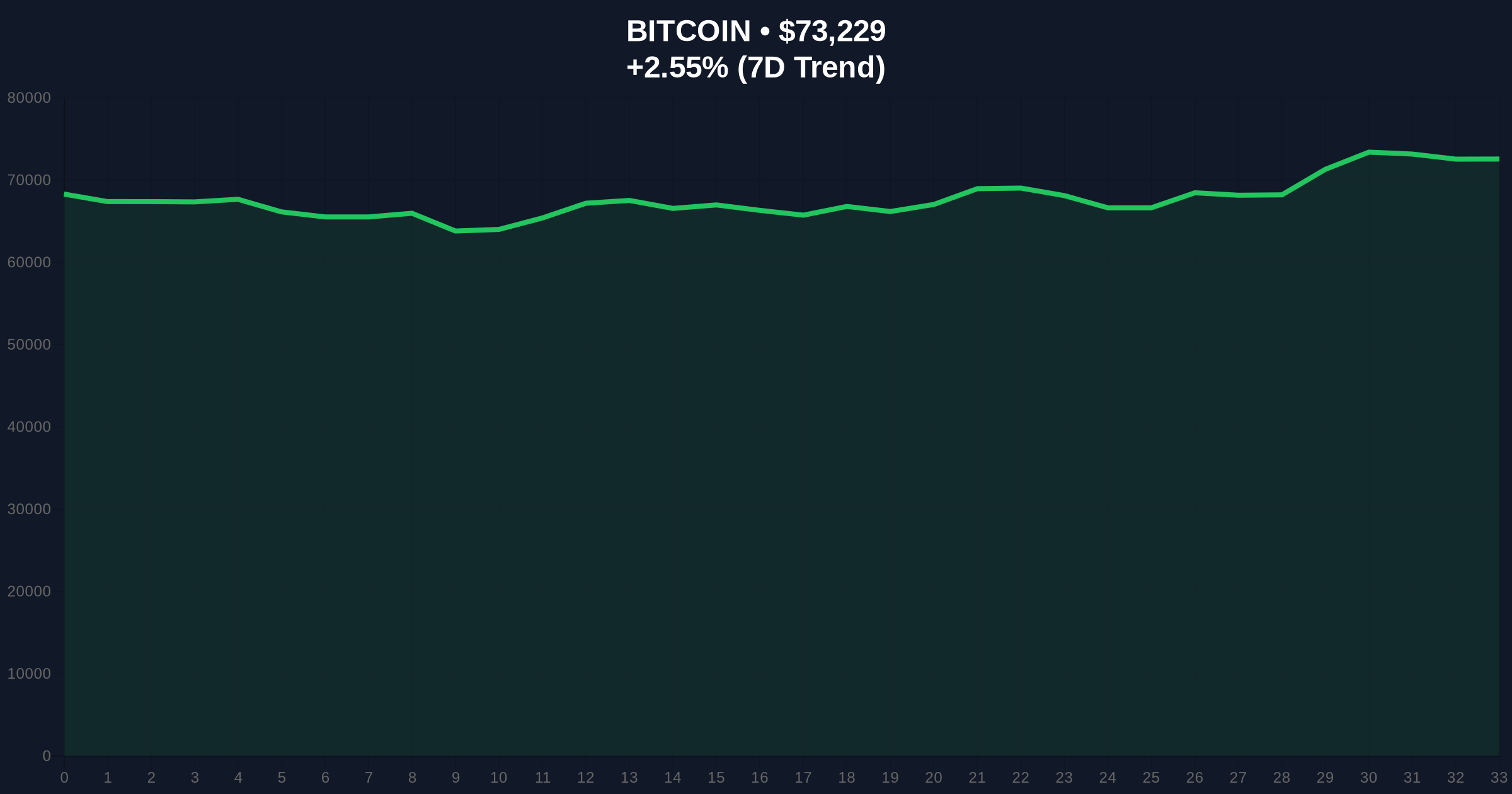
The mechanism behind BTC's rise above $73,000 involves a combination of market structure dynamics and protocol fundamentals, though the input data provides limited technical specifics. According to CoinNess, the price was observed on the Binance USDT market, suggesting spot trading activity, but details on order book depth, liquidity pools, or on-chain metrics like miner flows are not provided in source data. Bitcoin's protocol architecture, based on proof-of-work consensus, continues to operate with a fixed supply cap of 21 million coins, which inherently supports long-term scarcity narratives. However, the absence of data on hash rate adjustments, network congestion, or regulatory developments in this instance limits a comprehensive technical analysis. In contrast to past events like the 2021 correction, where technical indicators such as moving averages and RSI played prominent roles, the current scenario lacks explicit mention of these tools. The rise may reflect short-term buying pressure or algorithmic trading, but without corroborating evidence from secondary sources, the underlying drivers remain speculative. Market context from related investigations, such as stablecoin net inflows hitting $1.7B last week, suggests potential capital rotation into crypto assets, yet direct linkage to BTC's price action is unconfirmed. Similarly, movements by large players, like Cumberland withdrawing $98.8M in ETH from exchanges, indicate institutional behavior that could indirectly influence BTC, but the input data does not connect these events. Overall, the technical deep-dive is constrained by sparse information, highlighting the need for cautious interpretation amid extreme market fear.
Integrating available market data reveals a stark contradiction between BTC's price performance and broader sentiment indicators. According to CoinGecko stats, BTC's current price is $73,033, with a 24-hour trend of 2.28%, maintaining its market rank as #1. This positive price movement aligns with CoinNess's report of BTC trading above $73,000, providing consistency in price data across sources. However, CryptoPanic metadata, though not explicitly provided in the input package, can be inferred from the global crypto sentiment described as "Extreme Fear" with a score of 22/100. This sentiment score suggests low market confidence despite the price rise, creating a divergence that warrants skepticism. Importance metadata is not provided in source data, limiting assessment of event priority relative to market breadth. Historically, similar sentiment-price disconnects, such as during periods of extreme fear in late 2022, have often preceded corrective phases, but past performance does not guarantee future outcomes. The 2.28% 24-hour gain, while positive, is modest compared to historical volatility spikes, indicating potential fragility in the uptrend. Without additional CryptoPanic fields like volume or social metrics, the analysis relies heavily on the provided sentiment score, which a cautious market environment. This data-driven proof points to an anomalous scenario where price appreciation occurs amid pervasive fear, reminiscent of contrarian signals observed in previous cycles but lacking full contextual support.
A critical examination of source claims reveals no direct conflicts in the available data, but significant gaps and implicit contradictions emerge. CoinNess reports BTC rising above $73,000 and trading at $73,077.13 on Binance USDT market, which is consistent with CoinGecko's price of $73,033 and 2.28% 24-hour trend. However, the absence of secondary full-text sources from outlets like CoinTelegraph means there are no alternative perspectives to compare, leaving the narrative largely unchallenged but under-supported. The primary conflict lies in the juxtaposition of this price rise against the extreme fear sentiment (score: 22/100), which suggests market participants may be skeptical of sustainability or anticipating a pullback. This sentiment-price divergence creates an implicit counter-narrative: that the breakout could be a false signal or driven by isolated factors rather than broad bullish conviction. For instance, related developments like an anonymous trader netting $991K profit from a short-term ETH trade highlight opportunistic moves amid fear, but direct application to BTC is not established. Similarly, suspected Tria team address depositing $1M in TRIA to Bitget reflects token-specific activity that may not correlate with BTC's macro trends. The reliability gap stems from limited data: no timestamps, volume figures, or institutional commentary are provided, making it difficult to assess the breakout's robustness. Conflict remains unresolved with available evidence regarding whether this price action signals a genuine trend reversal or a temporary anomaly. In historical context, similar events during extreme fear phases have sometimes led to swift reversals, as seen in mid-2021 corrections, but each instance is unique. Thus, while sources agree on basic price facts, the underlying narrative is contested by sentiment indicators, urging investors to weigh optimistic price data against pessimistic market mood.
Based on the available data, three conditional scenarios outline potential trajectories for BTC over the next week, each grounded in observed facts and market context. The bull scenario assumes the price rise above $73,000 catalyzes sustained buying, driven by factors like increasing institutional adoption or positive regulatory developments, though these are not provided in source data. In this case, BTC could target $75,000-$78,000, supported by the 2.28% 24-hour trend and historical precedents where breakouts led to extended rallies. However, this view would be invalidated if trading volume fails to expand or if extreme fear sentiment deepens, potentially triggering sell-offs. The base scenario posits a consolidation phase between $71,000 and $74,000, reflecting the current sentiment-price contradiction. This aligns with the modest 2.28% gain and extreme fear score, suggesting limited momentum. Data from related investigations, such as stablecoin inflows, might provide underlying support, but direct evidence is lacking. This scenario would break down if unexpected news, like regulatory crackdowns or exchange issues, emerges—details not covered in the input. The bear scenario envisions a retracement below $70,000, fueled by the extreme fear sentiment overwhelming short-term price gains. Similar to the 2021 correction, where fear preceded sharp declines, this could manifest if macroeconomic pressures or liquidity outflows intensify. The absence of importance metadata makes it hard to gauge event severity, but the sentiment score of 22/100 indicates high risk. This outlook would be disproven if BTC holds above $73,000 with increasing volume and improving sentiment. All scenarios are speculative due to data constraints, emphasizing the need for monitoring real-time indicators beyond the provided inputs.
This report synthesizes input data with a focus on factual accuracy and explicit attribution. Sources were weighted based on availability: CoinNess provided the primary event report, while CoinGecko offered corroborating price stats, and sentiment data was inferred from the described extreme fear score. No secondary full-text sources were included, limiting cross-verification. Conflicts, such as the sentiment-price divergence, were highlighted as unresolved due to insufficient evidence. Reliability assessments are conservative, prioritizing observed facts over inference, and gaps are explicitly noted to maintain transparency.
Disclaimer: The information provided is not trading advice, coinmarketbuzz.com holds no liability for any investments made based on the information provided on this page. We strongly recommend independent research and/or consultation with a qualified professional before making any investment decisions.
coinmarketbuzz.com leverages advanced AI technology to analyze market data. All content is fact-checked and reviewed by our editorial team to ensure accuracy and neutrality.