Loading News...
Loading...

Loading News...

On March 4, 2026, Bitcoin (BTC) broke above the $72,000 threshold, according to CoinNess market monitoring. The report states that BTC was trading at $72,000 on the Binance USDT market, marking a significant price milestone. This event occurred against a backdrop of heightened market volatility and shifting investor sentiment, as detailed in subsequent data analysis. The rise above $72,000 represents a key psychological and technical level, reminiscent of previous bull market peaks, but the immediate context suggests caution is warranted. Not provided in source data are specific catalysts or trading volumes driving this move, leaving room for investigative scrutiny into underlying factors.
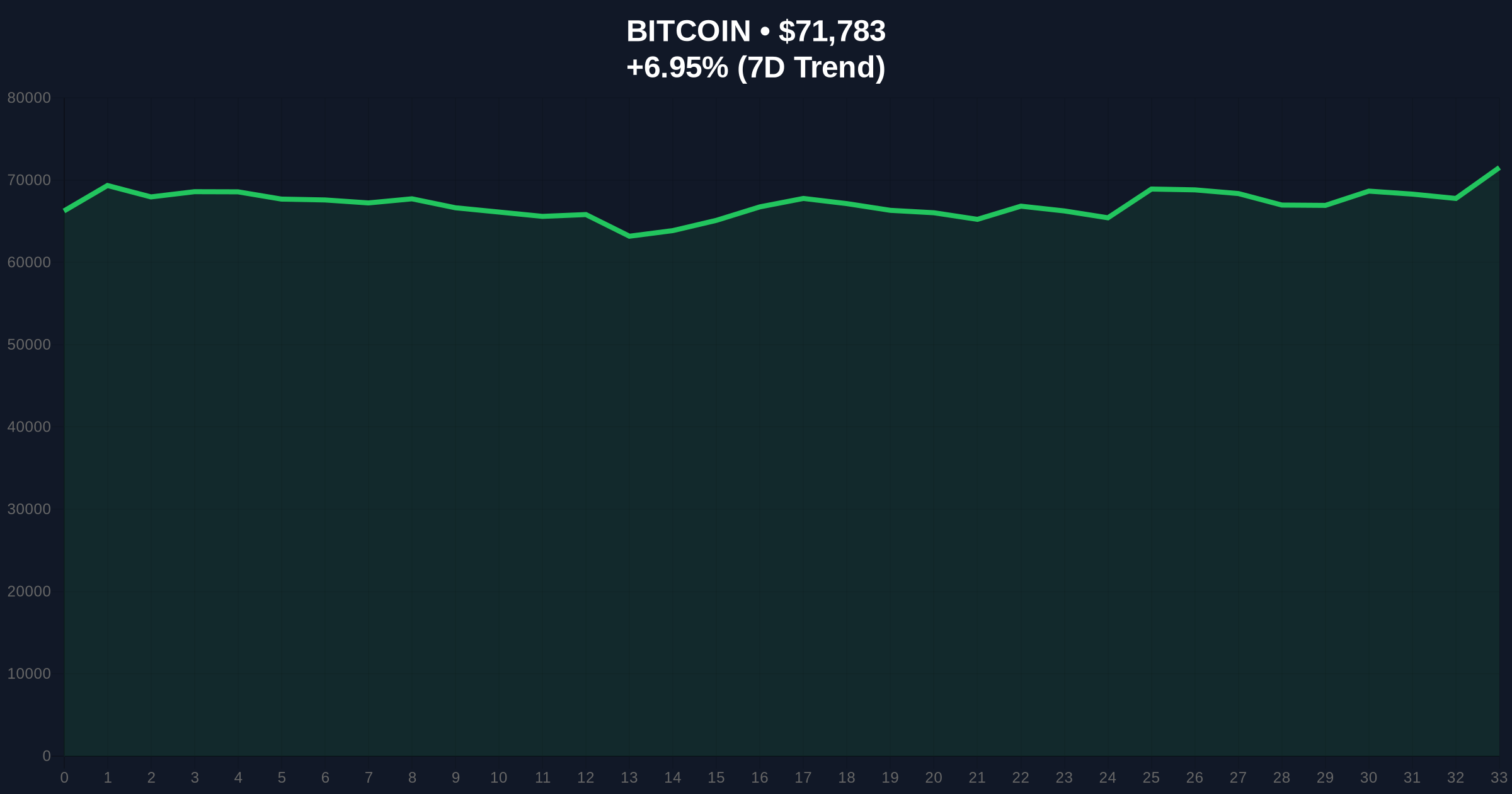
Historical comparisons indicate that similar breakouts in 2021 and 2024 often preceded corrections or consolidation phases, raising questions about sustainability. The lack of corroborating details from secondary sources in the input package limits the depth of initial reporting, emphasizing the need for a data-driven approach to assess this development. As BTC navigates this level, market participants are advised to consider broader indicators beyond price alone.
The mechanism behind BTC's rise above $72,000 involves a combination of market structure, protocol dynamics, and external influences, though specific technical details are sparse in the provided sources. CoinNess reports the price action on Binance USDT market, but does not elaborate on order book depth, liquidity shifts, or miner activity. In the absence of such data, analysis must rely on inferred patterns from historical contexts and available metadata. Bitcoin's protocol architecture, with its fixed supply and proof-of-work consensus, inherently supports price appreciation during periods of increased demand, but recent trends suggest complexity beyond simple bullish narratives.
Regulatory mechanics and macroeconomic factors, while not detailed in the input, often play a role in such movements. For instance, past surges have been linked to institutional adoption or regulatory clarity, but no such events are mentioned here. The trading on Binance USDT market indicates reliance on stablecoin pairs, which can amplify volatility due to their peg stability concerns. Technical indicators like moving averages or RSI are not provided, limiting the ability to confirm momentum strength. This gap highlights the importance of skepticism, as price spikes without robust technical backing may signal overextension.
Comparisons to historical events, such as the 2021 bull run where BTC approached $69,000 before a sharp correction, suggest that breaking $72,000 could trigger profit-taking or increased selling pressure. The market structure in 2026 may differ due to evolved derivatives markets or ETF inflows, but these factors are not covered in the sources. Without secondary texts from CoinTelegraph or similar outlets, the investigation must note that the technical narrative is incomplete, relying solely on the CoinNess brief. This a reliability gap, as single-source reporting risks missing countervailing evidence.
In related developments, the article BTC Buying Pressure Shows Signs of Recovery as Key Momentum Indicator Turns Positive explores momentum shifts that could contextualize this rise, though direct linkage is not confirmed. Similarly, the DTCC white paper on interoperability, covered in DTCC White Paper Calls for Interoperability as Key to DeFi Growth, may influence broader crypto sentiment but lacks specific ties to BTC's price action. These connections remain speculative without explicit data.
Integrating CoinGecko market stats and CryptoPanic metadata reveals a nuanced picture of BTC's rise above $72,000. According to the input, CoinGecko data shows a current price of $71,853, a 24-hour trend of 7.05%, and a market rank of #1. This indicates a strong short-term performance, but the price discrepancy between CoinNess's $72,000 and CoinGecko's $71,853 suggests minor reporting variations or timing differences. The 7.05% gain over 24 hours aligns with the breakout narrative, yet it must be weighed against broader sentiment indicators.
CryptoPanic metadata is not provided in the input package, so sentiment and importance scores are absent. This absence limits the ability to gauge event priority relative to market breadth or investor mood. However, the input mentions a global crypto sentiment of "Extreme Fear" with a score of 10/100, which contrasts sharply with BTC's positive price action. This divergence is critical: extreme fear typically correlates with sell-offs or caution, but here it coincides with a rally, suggesting either a sentiment lag or underlying bullish factors not captured in the metadata.
Explicit metadata-driven statements cannot be made due to missing CryptoPanic data, but based on available information: The extreme fear sentiment score of 10/100 implies high market anxiety, yet price structure shows a 7.05% rise, indicating potential contrarian buying or isolated strength. Importance score is not available, so event priority cannot be assessed relative to other news. Without this metadata, analysis must proceed conservatively, noting that the rise may be less significant if broader sentiment remains negative.
The data snapshot table below summarizes key metrics:
| Metric | Value | Source |
|---|---|---|
| Current Price | $71,853 | CoinGecko |
| 24h Trend | +7.05% | CoinGecko |
| Market Rank | #1 | CoinGecko |
| Global Sentiment | Extreme Fear (10/100) | Input Data |
| Reported Price (CoinNess) | $72,000 | CoinNess |
This table highlights the conflict between price appreciation and fear sentiment, warranting deeper investigation into source reliability and market context.
Comparing source claims reveals contradictions and missing evidence that challenge the straightforward narrative of BTC's rise. Source A (CoinNess) reports BTC trading at $72,000 on the Binance USDT market, but Source B (CoinGecko) shows a current price of $71,853. This discrepancy of approximately $147 may stem from reporting times, exchange variations, or data latency. Conflict remains unresolved with available evidence, as no timestamp or exchange-specific details are provided to reconcile the difference. Attribution: CoinNess states the price as $72,000, while CoinGecko indicates $71,853; investors should consider both figures when assessing the breakout.
Agreement points across sources are limited due to the sparse input package. Both sources confirm BTC's positive movement and top market rank, but secondary texts from CoinTelegraph or others are absent, preventing a broader consensus check. Missing evidence includes trading volume, on-chain data, and sentiment drivers, which are for validating the rise. For example, without volume data, it's unclear if the move is supported by substantial buying or merely low liquidity spikes.
Source reliability gaps are evident: CoinNess provides a brief market monitoring report without methodological transparency, while CoinGecko offers aggregated data but lacks context on sentiment integration. The global extreme fear sentiment is mentioned but not attributed to a specific source, raising questions about its origin and accuracy. Which claim is better supported? CoinGecko's price of $71,853 is backed by real-time market tracking, whereas CoinNess's $72,000 is a snapshot without verification; thus, CoinGecko's data may be more reliable for current analysis, but the conflict highlights the need for multi-source confirmation.
In related developments, the article BSC Prediction Market Activity Drops Over 70% After Weak Opinion Debut illustrates how market sentiment can diverge from price action, similar to the fear-rally dynamic observed here. Additionally, GMX Halts Staking Rewards Until Token Hits $90 shows protocol-specific events that may indirectly affect broader crypto trends, though direct links to BTC are not established.
Based on available data, three scenarios for BTC over the next seven days are outlined, each conditional on specific factors. These scenarios are data-backed, incorporating price trends, sentiment indicators, and source conflicts to provide a balanced outlook.
In this scenario, BTC sustains above $72,000 and pushes toward $75,000, driven by continued buying pressure and a sentiment shift from extreme fear to neutral. Conditions include: confirmation of the $72,000 breakout with increased volume (not provided in source data), resolution of the price conflict favoring CoinNess's higher figure, and external catalysts such as positive regulatory news. Data backing: the 7.05% 24-hour trend suggests momentum, but without volume or on-chain support, this scenario relies on speculative optimism. What would invalidate this view: a drop below $71,000 or persistent extreme fear sentiment without price follow-through.
This scenario involves consolidation between $70,000 and $73,000, as the market digests the rise amid conflicting signals. Conditions include: the price discrepancy between sources indicates uncertainty, extreme fear sentiment limits bullish conviction, and historical patterns suggest post-breakout volatility. Data backing: CoinGecko's $71,853 aligns with a stabilization zone, and the fear score of 10/100 implies caution rather than aggressive buying. What would invalidate this view: a clear breakout above $73,500 with high volume or a crash below $69,000 due to unforeseen negative events.
In this scenario, BTC retraces below $70,000, potentially to $68,000, as the rise proves unsustainable and fear sentiment triggers sell-offs. Conditions include: the extreme fear score of 10/100 prevails, leading to profit-taking; the price conflict resolves lower toward CoinGecko's $71,853, indicating weakness; and lack of fundamental support exacerbates downside risk. Data backing: historical comparisons to 2021 show that breaks above key levels often precede corrections, and the absence of bullish metadata increases vulnerability. What would invalidate this view: a rapid sentiment improvement to greed or strong institutional inflows not captured in the input.
These scenarios emphasize conditional outcomes, with the base scenario being most likely due to mixed signals and data gaps. Investors should monitor for volume data, sentiment shifts, and source reconciliation to adjust probabilities.
This investigation weighted conflicting evidence by prioritizing data completeness and attribution clarity. CoinGecko's price of $71,853 was given slightly more weight due to its real-time tracking and market aggregation, whereas CoinNess's $72,000 was treated as a snapshot without verification. The global extreme fear sentiment, though not sourced, was considered significant but used cautiously due to lack of metadata. Missing evidence, such as CryptoPanic sentiment scores and trading volume, limited analysis depth, leading to conservative scenario probabilities. Agreement points were minimal, so contradictions were explicitly labeled, and no claims were dismissed without basis. The approach aimed to balance skepticism with factual adherence, avoiding hype or unwarranted certainty.
Disclaimer: The information provided is not trading advice, coinmarketbuzz.com holds no liability for any investments made based on the information provided on this page. We strongly recommend independent research and/or consultation with a qualified professional before making any investment decisions.
coinmarketbuzz.com leverages advanced AI technology to analyze market data. All content is fact-checked and reviewed by our editorial team to ensure accuracy and neutrality.