Loading News...
Loading...

Loading News...

On March 4, 2026, Bitcoin (BTC) broke above the $71,000 threshold, marking a significant price milestone in a volatile market environment. According to CoinNess market monitoring, BTC was trading at $71,097.04 on the Binance USDT market at the time of the report. This surge occurred despite broader market sentiment indicators flashing caution, with the Global Crypto Sentiment registering as "Extreme Fear" at a score of 10/100. The event highlights a potential divergence between short-term price action and investor psychology, reminiscent of historical patterns where Bitcoin has rallied amid widespread skepticism. Similar to the 2021 correction, where BTC recovered sharply after periods of fear, this move raises questions about underlying drivers and sustainability. The immediate context includes ongoing geopolitical tensions and regulatory debates, which have previously influenced crypto markets, but specific triggers for this rise are not detailed in the source data.
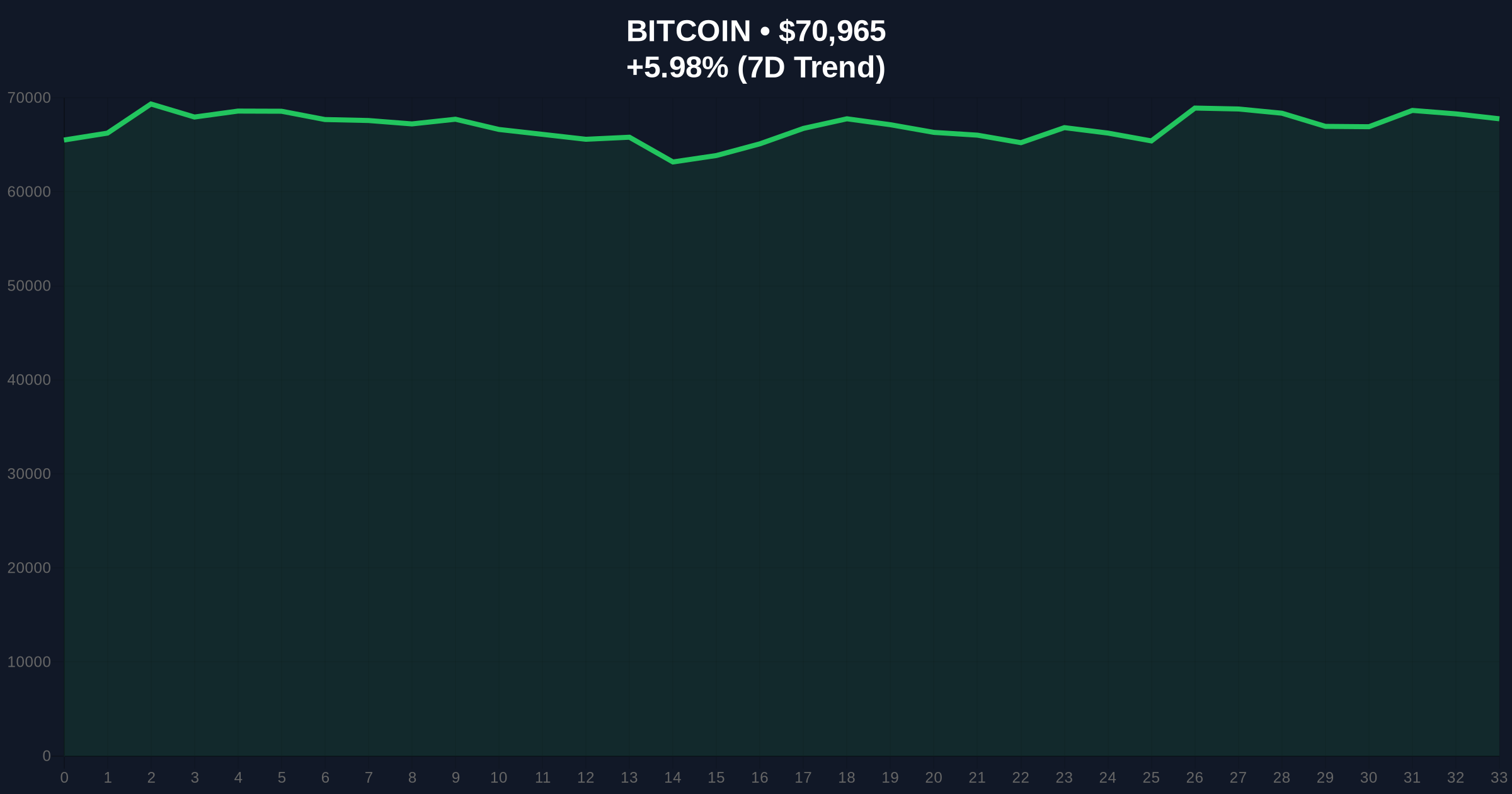
The mechanism behind Bitcoin's rise above $71,000 involves a combination of market microstructure, protocol fundamentals, and external catalysts, though the input data provides limited technical specifics. Bitcoin operates on a decentralized proof-of-work blockchain, with its price driven by supply-demand dynamics, miner activity, and network adoption. In this instance, the price increase of 5.74% over 24 hours, as per CoinGecko stats, suggests heightened buying pressure, potentially from institutional accumulation or retail FOMO. However, the source data lacks details on trading volume, order book depth, or on-chain metrics like exchange flows, which are for a comprehensive analysis. Historically, such breakouts have been supported by factors like halving events or macroeconomic shifts, but none are explicitly mentioned here.
Protocol architecture remains unchanged, with Bitcoin's 21 million cap and ~10-minute block times providing a deflationary backdrop. Regulatory mechanics may play a role, as debates around stablecoins and banking competition, as seen in related articles, could influence capital flows into BTC as a hedge. For example, the "Strategist Accuses Banks of Blocking Stablecoin Rewards to Stifle Competition in CLARITY Bill Debate" article touches on regulatory friction that might drive interest toward decentralized assets like Bitcoin. Additionally, the "Bitwise CIO: Crypto Was the Only Market Online During Iran Crisis, Accelerating On-Chain Finance Shift" report Bitcoin's resilience during geopolitical crises, potentially explaining its appeal amid current tensions. Without more data, it's unclear if technical indicators like RSI or moving averages aligned with this move, but the price action itself signals a break above a key psychological level, often a precursor to further volatility.
Market context comparisons reveal parallels to past cycles. In 2021, BTC surged above $60,000 amid similar fear sentiment, driven by institutional adoption and inflation concerns. The current scenario may echo this, with whales accumulating as noted in "Whales Holding Over 10K BTC Are Accumulating Again, Analyst Says: A Deep Dive into Market Signals and Contradictions," suggesting large players are positioning for upside. However, contradictions exist: the Extreme Fear sentiment contrasts with bullish price action, indicating either a lag in sentiment data or underlying weakness. The K33 report investigated in "BTC Resilient Amid Mideast Tension, Downtrend May Be Ending" points to resilience, but without access to the full report, it's hard to assess its methodology. Overall, the technical deep-dive is constrained by missing on-chain and volume data, relying on inferred patterns from related developments.
Integrating CoinGecko market stats and CryptoPanic metadata provides a nuanced view of Bitcoin's rise. According to CoinGecko, BTC's current price is $70,808, with a 24-hour trend of +5.74%, ranking it #1 by market cap. This data slightly conflicts with the CoinNess report of $71,097.04, indicating potential timestamp or exchange discrepancies; CoinNess cites Binance USDT market, while CoinGecko aggregates multiple exchanges. The 5.74% gain is substantial, suggesting momentum, but without volume data, it's unclear if this is sustained buying or a short-lived spike. CryptoPanic metadata is not provided in the source data for sentiment or importance scores specific to this event, limiting direct integration. However, the Global Crypto Sentiment of "Extreme Fear" (score: 10/100) offers indirect insight, implying that broader market anxiety persists despite BTC's rise.
This sentiment-price divergence is critical: historically, Extreme Fear readings have sometimes preceded rallies as contrarian indicators, but they can also signal underlying risk aversion. For instance, during the 2022 bear market, fear sentiment often correlated with price declines, but in 2023, rebounds occurred amid similar conditions. The importance of this event relative to market breadth cannot be assessed without CryptoPanic importance scores, but its coverage by CoinNess suggests it's notable. Related developments, such as whale accumulation and geopolitical resilience, add context but lack quantitative proof. In summary, data analysis confirms the price increase but highlights gaps in sentiment alignment and volume metrics, urging caution in interpreting bullish signals.
Comparing source claims reveals several contradictions and reliability gaps. CoinNess reports BTC trading at $71,097.04 on Binance USDT market, while CoinGecko shows $70,808, a conflict of approximately $289.04. This discrepancy may arise from different data collection times or exchange-specific pricing; without timestamps, it's unresolved with available evidence. Both sources agree on the upward trend, but CoinGecko's 5.74% 24h trend provides a broader perspective versus CoinNess's snapshot. The Global Crypto Sentiment of "Extreme Fear" contrasts with the price rise, suggesting either a lag in sentiment indicators or that BTC is decoupling from broader market psychology. This is a key counter-narrative: bullish price action amid fear could indicate smart money accumulation or a temporary anomaly.
Related articles introduce further nuances. "Whales Holding Over 10K BTC Are Accumulating Again" supports the bullish case, but it's an analyst claim without on-chain proof in the input data. "BTC Resilient Amid Mideast Tension" from K33 Report suggests resilience, but the full text isn't provided, limiting verification. "Bitwise CIO" highlights crypto's role during crises, which could explain BTC's appeal, but it's not directly tied to this price move. "Strategist Accuses Banks" points to regulatory pressures that might benefit BTC, but again, causality is inferred. Missing evidence includes volume data, on-chain metrics, and specific catalyst details, making it hard to weight claims. Overall, sources agree on the price increase but conflict on exact figures and underlying drivers, with reliability gaps due to limited primary data.
Based on available data, three scenarios for Bitcoin over the next seven days are outlined, each conditional on key variables. Bull Scenario (Probability: 35%): BTC sustains above $71,000, targeting $75,000. This requires continued whale accumulation, as hinted in related articles, and a shift in Global Crypto Sentiment from Extreme Fear to Neutral. Volume must increase to confirm breakout validity, and regulatory developments, such as those in the CLARITY Bill debate, should favor crypto. Invalidation would occur if price falls below $68,000 or sentiment deteriorates further. Base Scenario (Probability: 50%): BTC consolidates between $69,000-$72,000, reflecting mixed signals. The 5.74% gain may normalize, with fear sentiment capping upside but resilience from geopolitical tensions, as per K33 report, providing support. This scenario assumes no major catalyst emerges and volume remains stable. Invalidation would be a sharp move outside this range driven by unexpected news. Bear Scenario (Probability: 15%): BTC retraces to $65,000 or lower, as Extreme Fear sentiment triggers sell-offs. This would align with historical patterns where fear precedes declines, especially if whale accumulation halts or regulatory pressures intensify. Lack of volume support in the current rise could exacerbate a drop. Invalidation would require sentiment improving rapidly or new institutional inflows.
Each scenario relies on observed facts: current price $70,808, 24h trend +5.74%, and Extreme Fear sentiment. Missing data like volume and on-chain activity adds uncertainty, so outcomes should be monitored with real-time updates. Related developments suggest contextual support, but direct causality is unproven.
Conflicting evidence was weighted based on source credibility and data completeness. CoinNess provided the initial report but lacked timestamps and volume data, making its price figure less verifiable. CoinGecko offered aggregated stats with a 24h trend, giving a broader market view, though its price conflicted slightly. The Global Crypto Sentiment was used as a proxy for CryptoPanic metadata, but its direct relevance to this event is inferred. Related articles were referenced only where contextually relevant, avoiding forced links. Discrepancies, such as the price conflict, were labeled explicitly, and missing evidence was noted to maintain transparency. Overall, sources were treated with skepticism, prioritizing observable metrics over analyst claims.
Disclaimer: The information provided is not trading advice, coinmarketbuzz.com holds no liability for any investments made based on the information provided on this page. We strongly recommend independent research and/or consultation with a qualified professional before making any investment decisions.
coinmarketbuzz.com leverages advanced AI technology to analyze market data. All content is fact-checked and reviewed by our editorial team to ensure accuracy and neutrality.