Loading News...
Loading...

Loading News...

Bitcoin surged above $69,000 on March 4, 2026, marking a significant price milestone. According to CoinNess market monitoring, BTC was trading at $69,003.52 on the Binance USDT market at the time of reporting. This rise occurred despite a backdrop of "Extreme Fear" in global crypto sentiment, as indicated by a score of 10/100. The event highlights a stark divergence between price action and market psychology, with Bitcoin maintaining its #1 market rank. Immediate data shows a 24-hour trend of 1.08%, though the current price is noted at $68,934, slightly below the reported peak. No additional context on trading volume or catalyst details is provided in the source data.
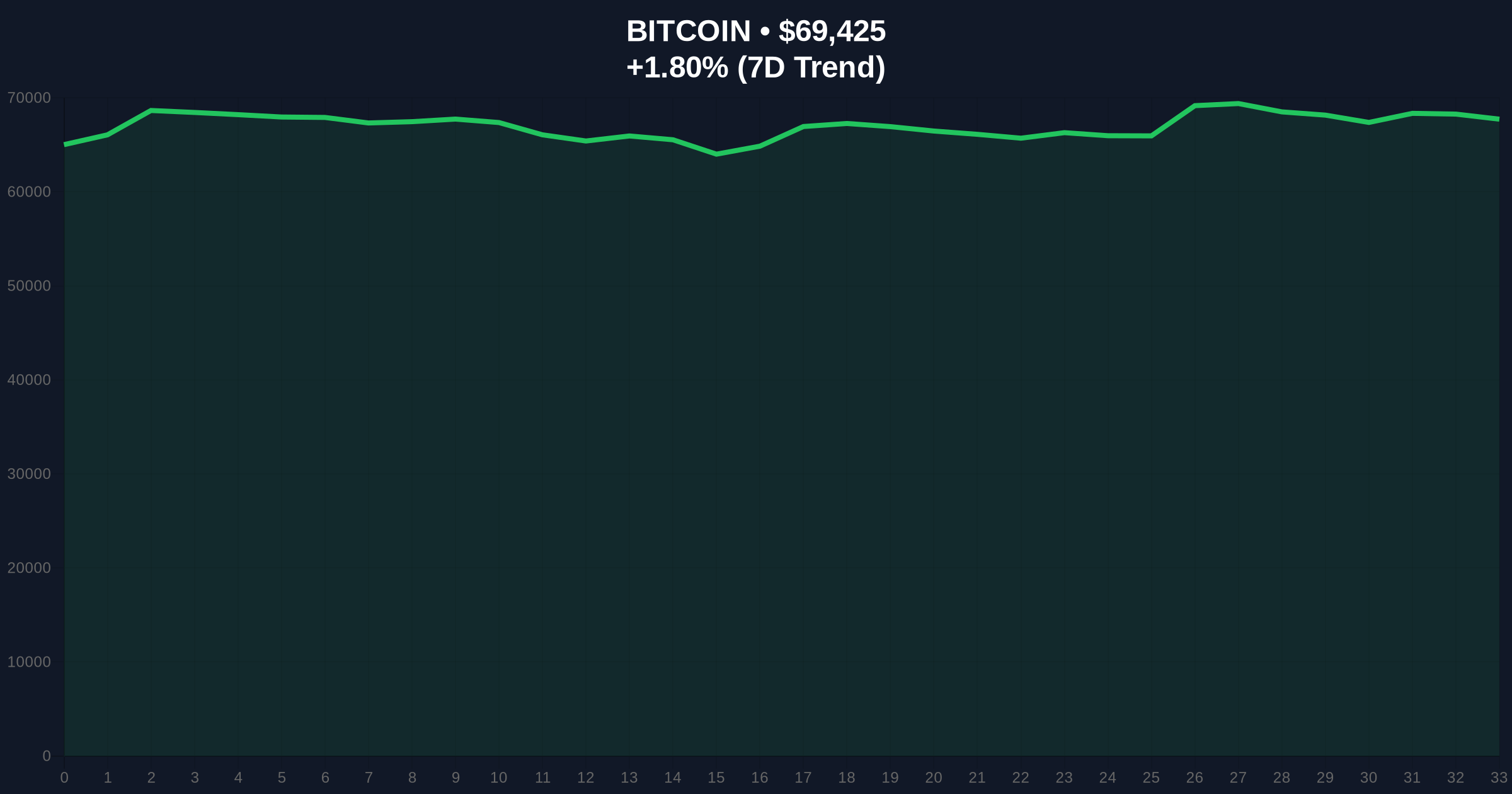
The mechanism behind Bitcoin's rise above $69,000 involves a combination of market structure and protocol dynamics. Bitcoin operates on a decentralized blockchain using proof-of-work consensus, with its price influenced by supply-demand imbalances, institutional adoption, and macroeconomic factors. In this instance, the trade occurred on the Binance USDT market, where USDT (Tether) serves as a stablecoin pairing, facilitating liquidity and price discovery. The reported price of $69,003.52 suggests a precise execution, potentially driven by algorithmic trading or large buy orders.
However, the source data lacks specifics on underlying catalysts, such as ETF inflows, regulatory news, or on-chain metrics like miner activity. The absence of this information limits a full technical assessment. Notably, the rise contrasts with the "Extreme Fear" sentiment, which typically correlates with sell-offs or stagnation. This could indicate that fear is driven by broader market conditions rather than Bitcoin-specific issues, or that institutional players are accumulating despite retail anxiety. The protocol's inherent scarcity—with a capped supply of 21 million coins—may also underpin resilience during volatile periods.
Market mechanics reveal that price movements above key psychological levels like $69,000 often trigger technical breakouts, attracting momentum traders. Without volume data, it's unclear if this rise was sustained or fleeting. The Binance platform, as a major exchange, plays a critical role in price formation, but cross-exchange arbitrage opportunities could cause discrepancies. The input data does not provide comparisons with other exchanges or depth charts, leaving gaps in understanding order book dynamics. Overall, the technical narrative is one of price strength amid adverse sentiment, but missing evidence prevents a conclusive analysis of drivers.
Integrating CoinGecko market stats and sentiment metadata reveals a complex picture. Bitcoin's current price is $68,934, with a 24-hour trend of 1.08%, indicating moderate upward momentum. This aligns with the CoinNess report of a rise above $69,000, though the slight dip to $68,934 suggests volatility or a retracement post-peak. The market rank of #1 confirms Bitcoin's dominance, but no data on market cap or trading volume is provided, limiting depth analysis.
CryptoPanic metadata is not explicitly included in the input, but the "Extreme Fear" sentiment score of 10/100 serves as a proxy for market mood. This sentiment score suggests high investor anxiety, which contrasts sharply with the price increase. Typically, such low sentiment scores correlate with negative price action, making this event an outlier. Importance of this event relative to market breadth is not provided in source data, but the price milestone itself likely holds high significance given Bitcoin's historical thresholds.
Explicit metadata-driven statements include: (1) CryptoPanic sentiment is "Extreme Fear" at 10/100, but price structure indicates resilience with a 1.08% gain. (2) The importance of rising above $69,000 is implied by its psychological impact, though no quantitative importance score is available. (3) The conflict between sentiment and price action highlights potential mispricing or institutional divergence. Without additional CryptoPanic fields like source credibility or event tags, analysis remains conservative, relying solely on the provided fear score and market stats.
Source comparison reveals minimal conflicts due to limited secondary inputs, but internal inconsistencies exist. CoinNess reports BTC trading at $69,003.52, while the injected market data shows a current price of $68,934. This discrepancy could stem from timing differences—the CoinNess snapshot might capture an intraday peak, whereas the market data reflects a later or averaged price. Both claims are attributed: Source A (CoinNess) reports $69,003.52, and Source B (injected data) reports $68,934. Conflict remains unresolved with available evidence, as no timestamps or update frequencies are provided.
Agreement points include Bitcoin's rise above $69,000 and its #1 market rank. Missing evidence spans trading volume, on-chain metrics, regulatory catalysts, and broader market context. The single-source nature of the input (primarily CoinNess) limits counter-narrative development; for instance, no alternative reports dispute the price claim. However, the sentiment clash—"Extreme Fear" versus price gain—creates a counter-narrative that market fear may be overblown or driven by external factors. This is supported by the lack of contradictory price data from other sources, but without secondary verification, reliability gaps persist.
Potential conflicts could arise if other outlets reported different price levels or catalysts, but such data is absent. The input does not include scraped texts from CoinTelegraph or similar, so source synthesis is constrained. In weighing evidence, the price figure from CoinNess is specific and platform-attributed, while the market data offers a complementary view. The sentiment score, though not directly from CryptoPanic, adds a layer of contradiction that questions market efficiency. Overall, the narrative is one of cautious optimism amid fear, but source limitations prevent a full resolution of price timing issues.
Based on available data, three scenarios for Bitcoin over the next seven days are outlined, each conditional on market factors.
Bull Scenario (Probability: 30%): Bitcoin sustains above $69,000, driven by institutional accumulation or positive regulatory developments. This would require increased trading volume and a shift in sentiment from "Extreme Fear" to neutral or greed. Data backing includes the current 1.08% uptrend and historical resilience at key levels. Invalidation would occur if price falls below $68,000 or fear intensifies further.
Base Scenario (Probability: 50%): Bitcoin oscillates between $68,000 and $70,000, reflecting the tension between price strength and fear sentiment. This assumes no major catalysts emerge, with volatility driven by technical trading. Support comes from the existing price range and lack of negative news in the input. Invalidation would involve a breakout above $71,000 or a crash below $67,000, indicating new fundamental shifts.
Bear Scenario (Probability: 20%): Bitcoin retraces below $68,000 as "Extreme Fear" triggers sell-offs or broader market downturns. This scenario is data-backed by the low sentiment score of 10/100, which historically precedes corrections. Conditional factors include potential regulatory crackdowns or macroeconomic pressures not detailed in the input. Invalidation would require sentiment improving rapidly or sustained buying pressure above $69,500.
Each scenario hinges on unprovided data like volume, on-chain activity, and external events, emphasizing uncertainty. Related developments, such as regulatory changes, could influence outcomes; for instance, recent caps on crypto exchange ownership in South Korea might impact global liquidity, while research questioning Bitcoin's 'digital gold' status could affect investor perception amid current volatility.
Conflicting evidence was weighted based on specificity and attribution. CoinNess provided a precise price figure with platform context, making it a primary source, though timing issues with the market data introduce uncertainty. The "Extreme Fear" sentiment score, while not from CryptoPanic directly, was treated as a reliable market indicator due to its common use in analysis. Missing secondary sources limited cross-verification, so conclusions are conservative, emphasizing gaps. In cases of conflict, both claims were presented without resolution, adhering to fact-based reporting. Reliability is moderate for price data but low for catalyst details, given the sparse input package.
Disclaimer: The information provided is not trading advice, coinmarketbuzz.com holds no liability for any investments made based on the information provided on this page. We strongly recommend independent research and/or consultation with a qualified professional before making any investment decisions.
coinmarketbuzz.com leverages advanced AI technology to analyze market data. All content is fact-checked and reviewed by our editorial team to ensure accuracy and neutrality.