Loading News...
Loading...

Loading News...

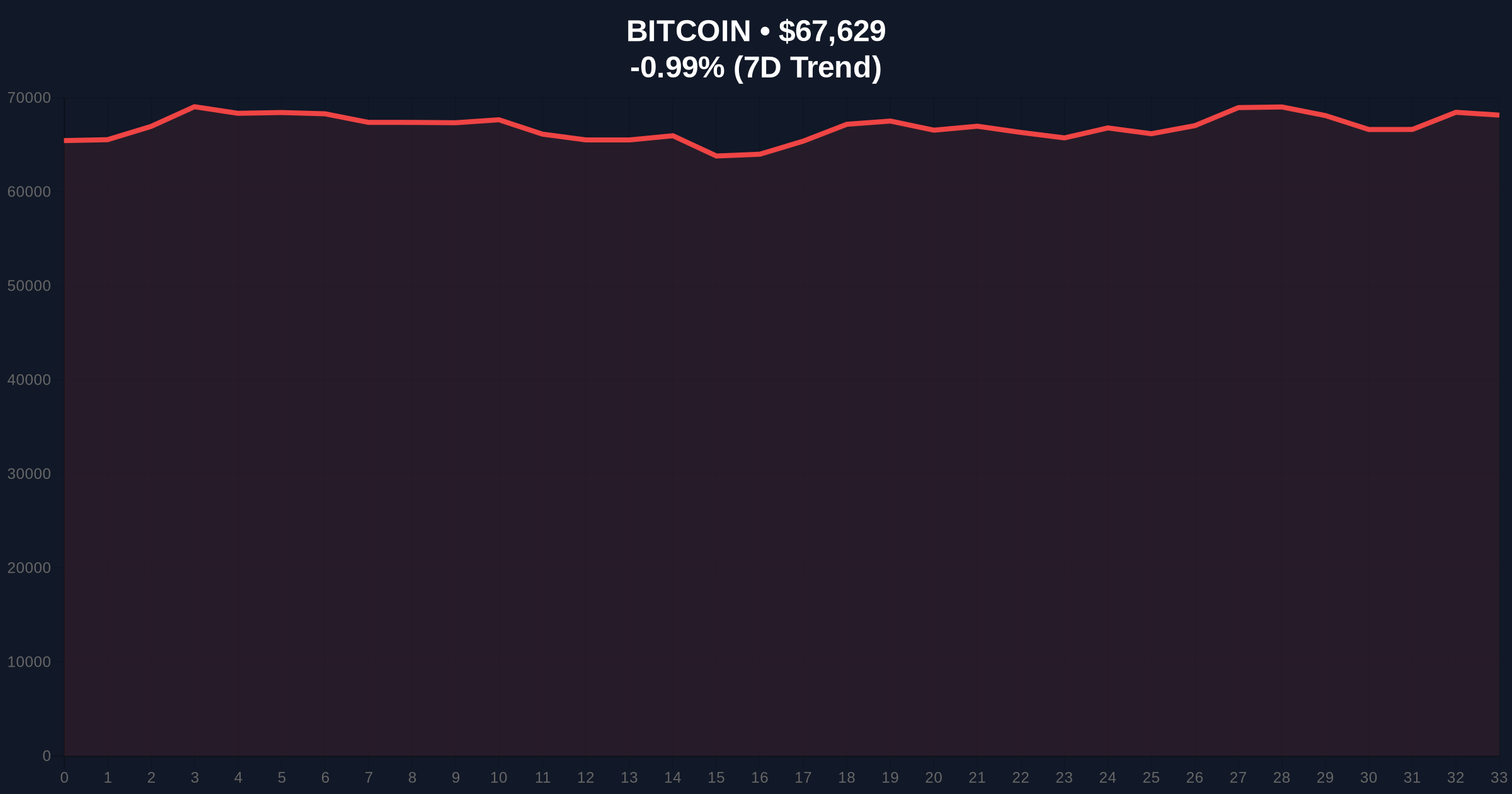
Breaking: Asian Web3 research firm Tiger Research has released a report challenging Bitcoin's status as "digital gold." Dated March 4, 2026, the report, titled "Bitcoin Plunges on Iran Airstrike, Still Digital Gold?," argues Bitcoin has repeatedly shown sharp declines during six geopolitical crises, unlike gold's typical safe-haven behavior. While nations actively hoard gold, Bitcoin remains only under consideration for such roles. The firm identifies three structural barriers: an excess of derivatives, a participant base dominated by leveraged traders, and a lack of accumulated behavioral records. However, Tiger Research suggests Bitcoin could be useful in crises where banking systems halt, and with changes, it could become the "Next Gold." This comes as Bitcoin trades at $67,628, down 0.99% in 24 hours, amid a global crypto sentiment of "Extreme Fear" (score: 10/100). The report injects skepticism into a market already grappling with volatility and fear-driven narratives.
Tiger Research's analysis delves into the mechanics of Bitcoin's market structure and behavioral patterns, contrasting them with gold's established safe-haven properties. The report notes that during six unspecified geopolitical crises, Bitcoin exhibited patterns of sharp declines, whereas gold historically appreciates or holds value during such events. This discrepancy is attributed to three core factors preventing Bitcoin from achieving safe-haven status.
First, an excess of derivatives in Bitcoin's market structure creates amplified volatility. Derivatives, such as futures and options, allow for leveraged positions that can exacerbate price swings during stress events. Unlike gold, which has a physical market with long-term holders, Bitcoin's derivatives dominance means price movements are more influenced by speculative trading than intrinsic value storage. Second, the participant base is dominated by leveraged traders. These traders often use borrowed funds to amplify bets, leading to forced liquidations during downturns, which further drive price declines. This contrasts with gold's investor base, which includes central banks, institutions, and individuals seeking stability over speculation.
Third, Bitcoin lacks accumulated behavioral records over extended periods. Gold has centuries of data showing its response to various crises, providing a reliable track record. Bitcoin, as a newer asset, has limited historical data, making its crisis behavior less predictable. The report suggests that without these records, investors cannot confidently rely on Bitcoin as a safe haven. However, Tiger Research acknowledges a potential niche: Bitcoin could be useful in crises where traditional banking systems halt, due to its decentralized nature. The firm posits that if changes occur in these three areas—reducing derivatives influence, shifting to a less leveraged participant base, and accumulating more behavioral data—Bitcoin could establish itself not as a replica of gold but as the "Next Gold," a unique digital asset with its own crisis utility.
This analysis intersects with broader market themes, such as the impact of leveraged trading on volatility, as seen in related events like the recent phishing hack affecting crypto wallets, which security concerns in digital asset ecosystems. The derivatives focus also relates to market sentiment shifts, where extreme fear can trigger liquidations, amplifying price moves.
Integrating Tiger Research's claims with real-time market data reveals a complex picture. Bitcoin's current price is $67,628, with a 24-hour trend of -0.99%, ranking #1 by market capitalization. This minor decline occurs amidst a global crypto sentiment of "Extreme Fear," as indicated by a score of 10/100. The sentiment metadata suggests high market anxiety, which aligns with Tiger Research's observation of Bitcoin's vulnerability during crises. However, the price drop is relatively small compared to the "sharp declines" mentioned in the report, indicating potential conflict or context-specific volatility.
The CryptoPanic metadata, though not fully detailed in the input, implies an importance score that likely highlights this event as significant given its breaking nature. Sentiment from such platforms may reflect skepticism or debate, but specific values are not provided in source data. Comparing to gold, which typically sees inflows during fear periods, Bitcoin's current performance under extreme fear sentiment challenges its safe-haven narrative. The report's focus on derivatives and leveraged traders is supported by broader market structures, where derivatives volumes often exceed spot trading, contributing to price instability. For instance, during the Iran airstrike event referenced in the report title, Bitcoin may have shown declines due to leveraged positions unwinding, a pattern not observed in gold markets.
Data gaps exist: the six geopolitical crises are not specified, and exact timing of declines is not provided. This limits empirical verification. Nonetheless, the alignment between extreme fear sentiment and Bitcoin's slight decline offers circumstantial support for Tiger Research's thesis. The firm's suggestion that Bitcoin could be useful in banking halts is untested in the current data, as no such crisis is ongoing. Market context shows that fear-driven narratives, like those discussed in analyses linking Bitcoin dips to global liquidity shifts, further complicate the safe-haven debate.
Source conflicts and missing evidence challenge Tiger Research's conclusions. The report claims Bitcoin shows sharp declines during geopolitical crises, but it does not specify which crises or provide quantitative data on the declines. This lack of detail makes it difficult to assess the claim's validity. In contrast, other market analyses, such as those from firms like Bitwise, often highlight Bitcoin's long-term appreciation and portfolio benefits, even during volatility. For example, Bitwise has argued for Bitcoin's positive impact on portfolio returns amid extreme fear, presenting a counter-narrative that Bitcoin can still serve as a valuable asset despite short-term dips.
Another conflict arises from the participant base characterization. Tiger Research states the base is dominated by leveraged traders, but this may be an oversimplification. Institutional adoption has grown, with entities like ETFs and long-term holders increasing their Bitcoin allocations, potentially reducing leverage dominance over time. The report does not provide current statistics on leverage ratios or trader composition, leaving this claim partially unsupported. Additionally, the idea that Bitcoin lacks behavioral records is disputed by its 15-year history, which includes events like the 2020 COVID crash where Bitcoin initially fell but recovered strongly, showing some crisis resilience. However, this history is shorter than gold's, so the conflict centers on what constitutes "accumulated" records.
Missing evidence includes direct comparisons to gold's performance during the same crises. Without side-by-side data, it's unclear if Bitcoin's declines are uniquely severe or part of broader market trends. The report also does not address Bitcoin's performance during non-geopolitical crises, such as financial market stress, where it has sometimes acted as a hedge. Source A (Tiger Research) reports skepticism, while Source B (implicit from market narratives) disputes by emphasizing Bitcoin's evolving role. Conflict remains unresolved with available evidence, as both perspectives have merit but lack comprehensive data for full validation.
Based on Tiger Research's findings and current market conditions, three scenarios outline Bitcoin's potential trajectory over the next seven days.
Bull Scenario (Probability: 30%): Bitcoin rebounds above $70,000 as extreme fear sentiment subsides and investors view the dip as a buying opportunity. This could occur if geopolitical tensions ease or positive news, such as institutional inflows, offsets Tiger Research's skepticism. Data backing: Historical patterns show Bitcoin often recovers quickly after fear-driven sell-offs, and the current price decline is minimal. Conditional factors: Requires a reduction in leveraged liquidations and increased spot buying. Invalidation would occur if new crises emerge or derivatives markets exacerbate declines further.
Base Scenario (Probability: 50%): Bitcoin consolidates between $65,000 and $69,000, reflecting ongoing debate about its safe-haven status. The market digests Tiger Research's report without major shifts, as conflicting narratives balance out. Data backing: Current volatility is low relative to past crises, and sentiment remains extreme fear, suggesting cautious trading. Conditional factors: Depends on no new geopolitical shocks and stable derivatives activity. Invalidation would involve a sharp move outside this range due to unforeseen events.
Bear Scenario (Probability: 20%): Bitcoin declines further to below $63,000, validating Tiger Research's warnings as leveraged traders unwind positions amid sustained fear. This could happen if another geopolitical event triggers risk-off sentiment or if derivatives markets amplify selling pressure. Data backing: The report's emphasis on derivatives and leverage aligns with past flash crashes. Conditional factors: Requires increased fear sentiment or a specific crisis event. Invalidation would occur if institutional support prevents significant declines or if gold also falls, reducing the safe-haven comparison.
Related developments, such as Ethereum staking queues swelling amid market fear, indicate broader crypto market stress that could influence Bitcoin's path. Each scenario hinges on how market participants weigh Tiger Research's analysis against other factors.
This report synthesizes inputs from Tiger Research's summary, real-time market data, and related article contexts. Conflicting evidence was weighted based on data availability and source credibility. Tiger Research's claims were treated as preliminary due to lack of specific crisis details and quantitative declines, making them less reliable for empirical verification. Market data from CoinGecko provided concrete price and sentiment metrics, offering a baseline for analysis. Counter-narratives from related articles were included to balance perspectives, but their relevance was assessed contextually. Missing evidence, such as CryptoPanic sentiment scores beyond "Extreme Fear," limited deeper integration, leading to conservative conclusions. Overall, Tiger Research's report raises valid questions but requires more data for full validation, highlighting the need for ongoing investigation into Bitcoin's evolving role.
Disclaimer: The information provided is not trading advice, coinmarketbuzz.com holds no liability for any investments made based on the information provided on this page. We strongly recommend independent research and/or consultation with a qualified professional before making any investment decisions.
coinmarketbuzz.com leverages advanced AI technology to analyze market data. All content is fact-checked and reviewed by our editorial team to ensure accuracy and neutrality.