Loading News...
Loading...

Loading News...
VADODARA, April 17, 2026. The following report is based on currently available verified source material and market data.
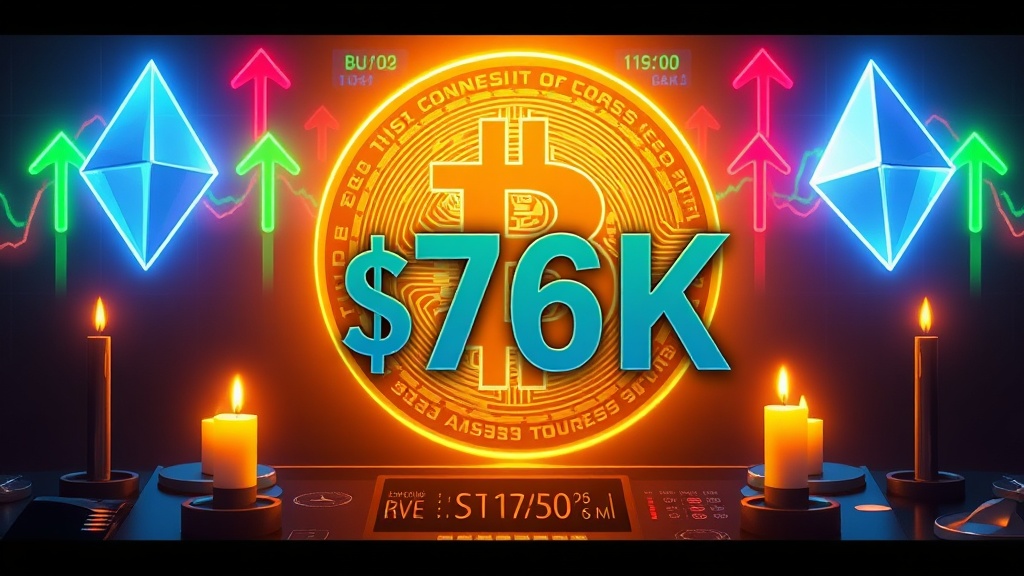
Bitcoin's rally, fueled by U.S.-Iran ceasefire headlines, has stalled below $76,000 as of April 17, 2026, with the cryptocurrency failing to sustain a breakout despite briefly topping that level earlier in the day. This stall reflects a shift in market focus from geopolitical optimism to tangible economic normalization, as investors await concrete signs like restored oil flows through the Strait of Hormuz and lower crude prices. The immediate impact is a choppy trading pattern with potential double-top resistance, while broader market sentiment remains in "Extreme Fear," indicating heightened caution among traders.
Bitcoin's price action shows a 10% climb driven by ceasefire news from a week ago, but momentum has faded with the asset struggling to hold above $76,000. Key metrics include a current price of $76,791, a 24-hour trend of 2.54%, and a global crypto sentiment score of 21/100, classified as "Extreme Fear." Technical analysis points to resistance near $76,000, with a double-top pattern suggesting potential exhaustion in bullish momentum. Below is a snapshot of critical data points:
| Metric | Value | Source |
|---|---|---|
| Bitcoin Price | $76,791 | Source: CoinGecko |
| 24h Trend | 2.54% | Source: CoinGecko |
| Resistance Level | $76,000 | Source: public statement |
| Global Sentiment | Extreme Fear (21/100) | Source: CoinGecko |
| Oil Price (WTI) | $87.50 | Source: public statement |
Additional context: The Strait of Hormuz accounted for 20% of global oil flows before the conflict, and its reopening is a key market watchpoint. Not provided in source data for specific trading volumes or institutional inflow metrics beyond general mentions.
This development matters because it highlights a critical juncture in Bitcoin's price discovery, driven by macro-economic factors rather than purely crypto-specific news. Why now? The ceasefire boost is fading just as Bitcoin approaches a key technical resistance level, creating a make-or-break moment for short-term momentum. Who benefits? Short-term traders may capitalize on volatility, while long-term investors could face uncertainty if real-world progress stalls; conversely, clarity on oil flows could benefit risk assets broadly. Time horizons: In the short term (days/weeks), failure to break $76,000 may lead to a pullback toward $70,000, while longer-term (months) implications depend on geopolitical resolution and its impact on global liquidity. Causal chain: Ceasefire headlines initially reduced risk aversion → boosted Bitcoin by 10% → but without tangible economic normalization (e.g., oil flow restoration), the rally lost steam → leading to choppy trading and potential technical breakdown.
The underlying mechanism involves a feedback loop between geopolitical events, energy markets, and crypto volatility. Initially, the U.S.-Iran ceasefire reduced immediate conflict risks, lowering haven demand and encouraging capital flow into riskier assets like Bitcoin. However, the mechanical link to oil is : the Strait of Hormuz handles 20% of global oil flows, and its closure or restricted access drives up crude premia, increasing inflationary pressures and tightening financial conditions. As QCP Capital noted, markets need "tangible progress such as restored energy flows" to sustain optimism; without it, the ceasefire's impact remains partial, leaving Bitcoin vulnerable to sell-offs as traders await clearer disinflation signals. Consequently, Bitcoin's price action is now tethered to oil price movements and volatility indexes, with declines in implied volatility suggesting expectations for progress but not yet confirmation.
Bitcoin's stall contrasts with other crypto market dynamics, where altcoins like Solana and Dogecoin are poised for sharper swings due to rising leveraged bets. This divergence how macro factors affect assets differently based on their risk profiles and market structure. Key comparisons include:
These trends show that while Bitcoin reacts to broad geopolitical shifts, altcoins are more influenced by speculative trading and technical levels.
The bullish narrative faces several risks that could invalidate the assumption of eventual breakout. Uncertainty remains high due to missing data on institutional flows or detailed on-chain metrics, and the analysis relies heavily on self-reported statements from market makers. Key risks include:
The failure condition hinges on a lack of tangible economic progress; if oil prices remain elevated or disinflation stalls, Bitcoin's rally may fully fizzle out despite technical support levels.
Looking ahead, traders should monitor oil prices and the Strait of Hormuz reopening efforts, as these will serve as leading indicators for Bitcoin's next move. A sustained break above $76,000 could attract more buyers and target $88,000, while failure may lead to consolidation or deeper correction. The decline in implied volatility indexes suggests markets expect progress soon, but until then, Bitcoin's price may remain range-bound, influenced by broader risk asset trends.
Bitcoin has historically acted as a hedge against geopolitical uncertainty, with its price often reacting to macro events like conflicts or economic sanctions. The U.S.-Iran ceasefire represents a recent example, where initial optimism drove a 10% rally, but the asset's sensitivity to real-world outcomes its evolving role in global finance. This context frames the current stall as part of a longer-term pattern where crypto markets digest geopolitical news before adjusting to fundamental realities.
Amid Bitcoin's choppy trading, other crypto sectors show divergent trends. For instance, XRP has seen renewed interest with U.S.-listed spot ETFs recording strong inflows, highlighting how regulatory and institutional developments can drive altcoin performance independently of macro factors. Additionally, the broader crypto market sentiment of "Extreme Fear" aligns with recent news, such as a U.S. neobank raising $100M in a Series C round valued at $1.4B, indicating continued institutional interest despite short-term volatility.
Bitcoin's ceasefire-driven rally is at a crossroads, with price action stalling below $76,000 as markets demand real-world economic progress. The interplay between geopolitical events, oil markets, and technical resistance creates a complex where short-term volatility may persist until clearer signals emerge. Investors should weigh the risks of geopolitical setbacks against potential breakout scenarios, keeping a close eye on energy market developments.
Q1: Why has Bitcoin's rally stalled?Bitcoin's rally stalled due to fading optimism from the U.S.-Iran ceasefire, as investors await tangible signs like restored oil flows and lower crude prices, coupled with technical resistance near $76,000.
Q2: What is the significance of the Strait of Hormuz?The Strait of Hormuz accounts for 20% of global oil flows, and its reopening is critical for reducing economic stress and supporting risk assets like Bitcoin.
Q3: How does oil price affect Bitcoin?Higher oil prices can increase inflationary pressures and tighten financial conditions, making risk assets less attractive; thus, stalled normalization in oil markets is weighing on Bitcoin's momentum.
Q4: What are the key technical levels to watch?Traders are watching $76,000 as resistance and $73,300 as support; a break below $73,300 could confirm a double-top pattern and lead to a decline toward $70,000.
Q5: Why are altcoins like Solana more volatile?Altcoins like Solana have rising leveraged bets and open futures contracts, amplifying price swings through liquidations and speculative trading, unlike Bitcoin's macro-driven moves.
Q6: What could drive Bitcoin higher from here?A sustained move above $76,000, coupled with tangible progress in oil flow restoration and disinflation, could attract more buyers and push Bitcoin toward $88,000.
Analysts are closely watching oil price movements and the Strait of Hormuz reopening efforts for signals on Bitcoin's next directional move.
Evidence & Sources
Primary source: https://www.coindesk.com/daybook-us/2026/04/17/bitcoin-s-ceasefire-boost-is-starting-to-fizzle-out-as-investors-look-for-real-world-results
Updated at: Apr 17, 2026, 05:22 PM
Data window: Apr 17, 2026, 01:16 PM → Apr 17, 2026, 03:25 PM
Evidence stats: 9 metrics, 6 timeline points.
Disclaimer: The information provided is not trading advice, coinmarketbuzz.com holds no liability for any investments made based on the information provided on this page. We strongly recommend independent research and/or consultation with a qualified professional before making any investment decisions.
All published reports are reviewed by our editorial team for factual consistency, neutrality, and reader clarity.