Loading News...
Loading...

Loading News...

VADODARA, April 8, 2026. The following report is based on currently available verified source material and market data.
Bitcoin Shorts Wiped Out in $427 Million Liquidation as US-Iran Ceasefire Sparks Market Reversal developed into a market-moving story within the reported window. The initial source indicates immediate relevance for crypto sentiment, while fuller validation is still tied to cited datasets and official statements.
On April 8, 2026, a surprise two-week ceasefire announcement between the US and Iran triggered a violent market reversal, wiping out $427 million in short positions as Bitcoin surged past $72,000. The geopolitical shift abruptly ended days of bearish positioning, causing $595 million in total crypto liquidations across 118,489 traders in a 24-hour period. This marks the most aggressive short squeeze since early March, with Bitcoin now testing the upper boundary of its $65,000-$73,000 war-range as risk assets repriced the removal of conflict premium.
The ceasefire announcement triggered immediate market repricing across multiple asset classes. According to CoinGlass data, the 24-hour liquidation event totaled $595 million, with short positions accounting for $427 million versus $168 million in longs, a ratio exceeding 2.5-to-1 that reveals extreme bearish positioning heading into the deadline. The largest single liquidation was an $11.79 million BTC-USDT short on Binance. Bitcoin accounted for $245 million in liquidations, ether followed at $126 million, and tokenized Brent oil futures on Hyperliquid added $33 million as crude collapsed over 10%. The damage concentrated in a 12-hour window where $508 million of the total liquidations occurred, with shorts taking $398 million of that hit.
| Metric | Value | Source |
|---|---|---|
| Short Position Liquidations | $427 million | Source: public statement |
| Bitcoin Price Peak | $72,700 | Source: public statement |
| Total Crypto Liquidations | $595 million | Source: public statement |
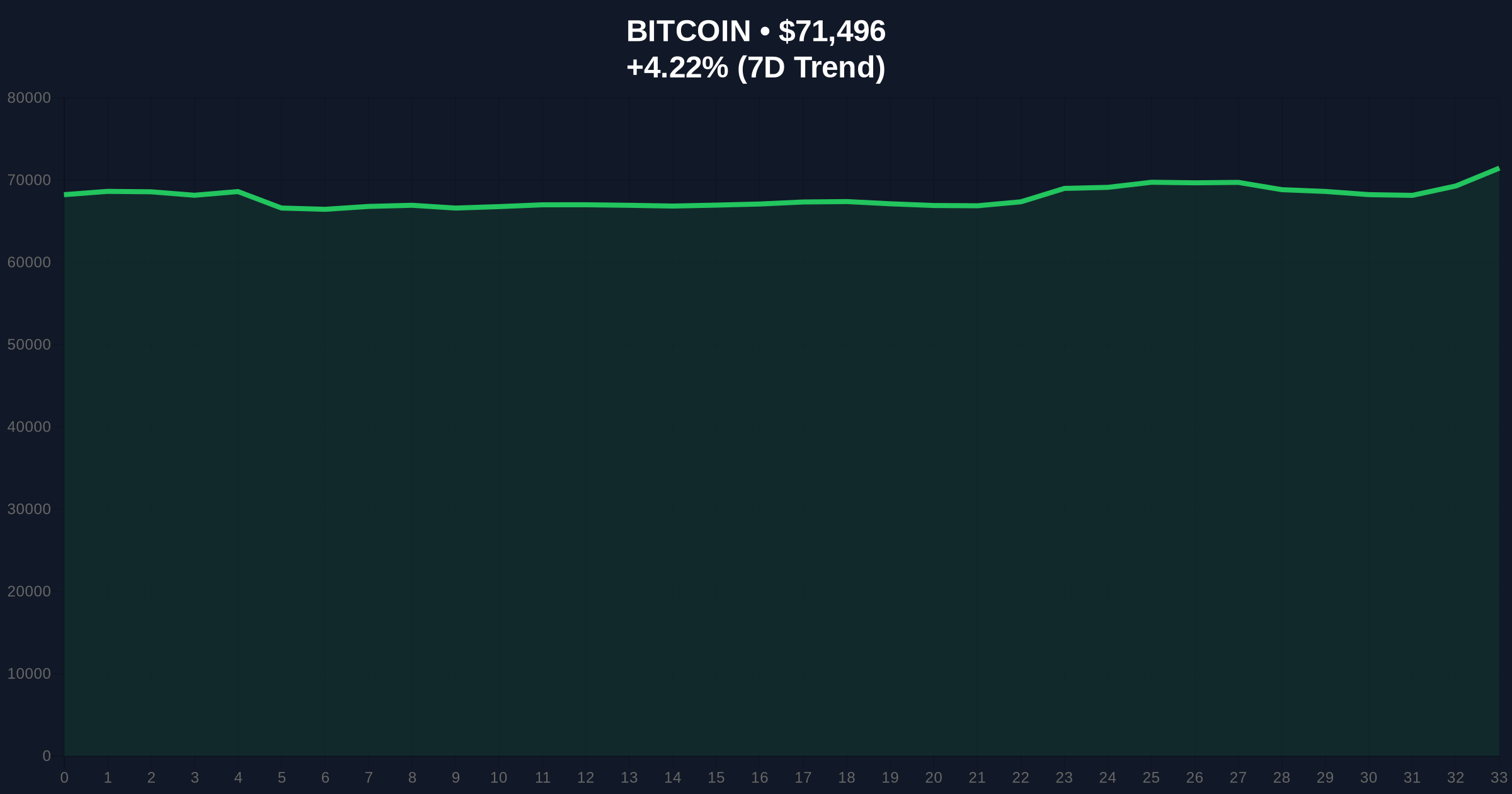
| Current Bitcoin Price | $71,494 | Source: CoinGecko |
| Bitcoin 24h Trend | 4.22% | Source: CoinGecko |
Why now? The ceasefire announcement arrived at a critical technical juncture with Bitcoin trapped in a $65,000-$73,000 range throughout the conflict and sentiment indicators showing extreme bearishness. The Fear and Greed Index sat at 8 on Sunday, continuing readings under 10 throughout the entire war, while Santiment data showed five bearish social media posts for every four bullish ones. Every positioning indicator pointed toward further downside, creating perfect conditions for a violent reversal when the geopolitical catalyst emerged.
Who benefits? Long-position holders and contrarian traders who maintained exposure through the bearish sentiment captured immediate gains. Market makers and liquidity providers benefited from increased volatility and trading volume. Short sellers betting on continued war escalation suffered the $427 million wipeout, with the most concentrated losses occurring among highly leveraged positions.
Time horizons: In the short-term (days/weeks), the ceasefire removes immediate war premium from oil and risk assets, potentially supporting further crypto gains if the truce holds. Longer-term (months), the outcome depends entirely on whether the two-week ceasefire extends or collapses, which will determine if Bitcoin breaks its $73,000 resistance or retreats back into the established range.
Causal chain: Ceasefire announcement → immediate repricing of war risk → oil price collapse over 10% → Bitcoin surge past $72,000 → leveraged short positions liquidated → $427 million in short losses → momentum cascade as liquidations trigger further buying pressure → Bitcoin tests range resistance at $73,000.
The liquidation event operated through a classic short squeeze mechanism amplified by extreme positioning. Days of bearish sentiment had pushed the Fear and Greed Index to extreme fear levels (8/100), while social media sentiment showed 5 bearish posts for every 4 bullish ones. This created asymmetric positioning with shorts outnumbering longs by more than 2.5-to-1 heading into the geopolitical deadline. When the ceasefire announcement triggered a rapid Bitcoin price surge, highly leveraged short positions hit their liquidation thresholds, forcing automated platform closures that created additional buying pressure. This feedback loop, where liquidations beget more liquidations, concentrated 85% of the total damage ($508 million of $595 million) in just 12 hours. The mechanism extended beyond crypto to tokenized commodities, with Brent oil futures on Hyperliquid seeing $33 million in liquidations as crude collapsed, and even tokenized silver and gold positions caught in the unwind as the commodity complex repriced the removal of war premium.
The ceasefire impact extended across multiple asset classes, revealing interconnected risk repricing:
Despite the dramatic reversal, several uncertainties threaten the sustainability of the move:
Failure condition: The bullish narrative breaks if the two-week ceasefire collapses before expiration or if Bitcoin fails to sustain above $73,000 resistance, suggesting the move was merely a short-term squeeze rather than a fundamental repricing.
Practically, traders will monitor whether Bitcoin can break and hold above $73,000, a level that has contained every rally since the conflict began. The next two weeks will test whether the ceasefire holds and whether risk assets can maintain their gains beyond the initial squeeze. Market structure suggests reduced leverage may emerge as participants recalibrate risk models to account for sudden geopolitical pivots. The event also highlights the growing correlation between tokenized commodities (oil futures on Hyperliquid) and traditional crypto assets during geopolitical shocks.
Since the US-Iran conflict began, Bitcoin has traded within a $65,000-$73,000 range, with each rally attempt meeting resistance at the upper boundary. The war created persistent risk-off sentiment across crypto markets, with the Fear and Greed Index remaining below 10 throughout the conflict. This established the technical and sentiment backdrop that made the ceasefire announcement particularly potent as a reversal catalyst.
The ceasefire-driven volatility occurs alongside several market developments:
The $427 million short liquidation event demonstrates how extreme positioning combined with geopolitical catalysts can trigger violent market reversals. While the ceasefire has provided immediate relief to risk assets, the conditional nature of the truce and Bitcoin's position at range resistance create significant uncertainty about sustainability. The event serves as a reminder that leveraged positions in volatile markets carry asymmetric risk when unexpected catalysts emerge.
Q1: What triggered the $427 million liquidation event?A surprise two-week ceasefire announcement between the US and Iran on April 8, 2026, caused Bitcoin to surge past $72,000, liquidating heavily leveraged short positions that had built up during days of bearish war positioning.
Q2: How does the short squeeze mechanism work?When Bitcoin's price rose rapidly on the ceasefire news, short positions hit their liquidation thresholds, forcing automated platform closures that created additional buying pressure, which in turn liquidated more shorts, creating a feedback loop that concentrated 85% of the damage in just 12 hours.
Q3: What was the market sentiment before the ceasefire?Extreme bearishness prevailed, with the Fear and Greed Index at 8/100 and social media sentiment showing five bearish posts for every four bullish ones, creating perfect conditions for a violent reversal when the catalyst emerged.
Q4: How did other assets besides Bitcoin get affected?Ether saw $126 million in liquidations, tokenized Brent oil futures on Hyperliquid added $33 million as crude collapsed over 10%, and even tokenized silver and gold positions got caught in the unwind as commodities repriced war premium removal.
Q5: What happens if the ceasefire breaks down?A breakdown would likely reverse the gains and potentially retest the lower end of Bitcoin's $65,000-$73,000 range, as war premium would return to oil and risk assets would face renewed selling pressure.
Q6: What are traders watching next?The key technical level is Bitcoin's ability to break and hold above $73,000 resistance, while the fundamental focus remains on whether the two-week ceasefire holds and extends beyond its initial timeframe.
Traders and analysts are now closely monitoring whether Bitcoin can sustain above $73,000 resistance and how the conditional ceasefire evolves over the next two weeks, with failure at either front likely triggering renewed volatility.
Evidence & Sources
Primary source: https://www.coindesk.com/markets/2026/04/08/bitcoin-ether-oil-shorts-lead-usd427-million-wipeout-on-us-iran-ceasefire
Updated at: Apr 08, 2026, 06:28 AM
Data window: Apr 08, 2026, 06:25 AM → Apr 08, 2026, 06:27 AM
Evidence stats: 9 metrics, 2 timeline points.
Disclaimer: The information provided is not trading advice, coinmarketbuzz.com holds no liability for any investments made based on the information provided on this page. We strongly recommend independent research and/or consultation with a qualified professional before making any investment decisions.
All published reports are reviewed by our editorial team for factual consistency, neutrality, and reader clarity.