Loading News...
Loading...

Loading News...

VADODARA, April 7, 2026. The following report is based on currently available verified source material and market data.
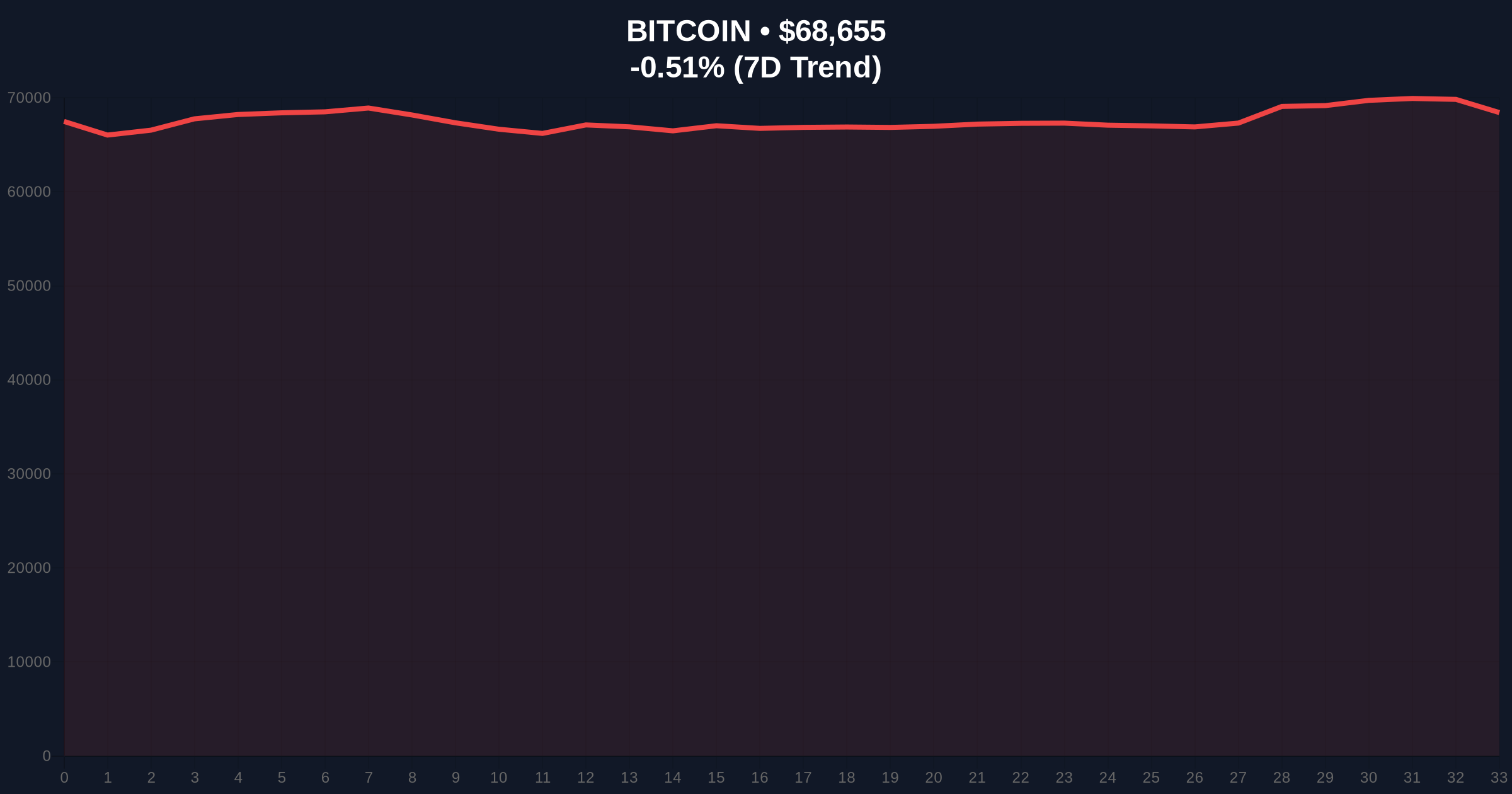
Bitcoin Holds Steady Amid Trump's Iran Deadline, But Market Sentiment Shows 'Extreme Fear' developed into a market-moving story within the reported window. The initial source indicates immediate relevance for crypto sentiment, while fuller validation is still tied to cited datasets and official statements.
On April 7, 2026, Bitcoin and major altcoins held steady within a tight trading range as U.S. President Donald Trump set a Tuesday night deadline for Iran to accept a deal, threatening severe military action if no agreement is reached. This geopolitical tension, combined with rising oil prices above $112 and mixed U.S. economic data, has created a macro uncertainty cloud that crypto markets are navigating with caution. The immediate impact has been a retracement of Monday's ceasefire-driven rally, with Bitcoin slipping back toward $68,600, extending a six-week pattern of short-lived price moves driven by headlines.
Concrete metrics reveal a market in a holding pattern. Bitcoin's price pulled back to $68,589 in Asian hours on Tuesday, down 0.6% over 24 hours after briefly touching $69,350 on Monday. Source: public statement. According to CoinGecko data, Bitcoin's current price is $68,612 with a 24-hour trend of -0.57%. Source: CoinGecko. The cryptocurrency has been trading within a $65,000 to $73,000 range for the entirety of the recent conflict, with every rally failing at the upper bound and every selloff holding the lower. Monday's bounce, fueled by reports of a potential 45-day ceasefire, triggered nearly $200 million in short liquidations before prices retreated as Iran reportedly rejected the proposal. Source: public statement.
| Metric | Value | Source |
|---|---|---|
| Bitcoin Price | $68,612 | CoinGecko |
| 24h Trend | -0.57% | CoinGecko |
| Trading Range | $65,000 - $73,000 | Public statement |
| Short Liquidations (Monday) | $200 million | Public statement |
| Oil Price | Above $112 | Public statement |
Why now? The significance lies in the convergence of geopolitical risk with an already uncertain macro backdrop. The Tuesday night deadline creates a binary event that could test the lower or upper bounds of Bitcoin's established range, depending on the outcome. This occurs amid mixed U.S. economic data and unclear Federal Reserve policy signals, leaving traders with few clear directional cues.
Who benefits? Short-term traders and volatility seekers may capitalize on the whipsaw movements, as evidenced by the $200 million in short liquidations on Monday. However, bearish traders who positioned ahead of the weekend initially benefited from the ceasefire report's unwinding. Long-term holders and institutions face increased uncertainty, potentially delaying larger allocations until clarity emerges.
Time horizons: In the short-term (days/weeks), the market is likely to remain range-bound and reactive to headlines, with the Tuesday deadline serving as a key catalyst. Longer-term (months/years), the impact depends on whether geopolitical tensions escalate into broader market stress or subside, affecting risk asset correlations.
Causal chain: The mechanism is straightforward: geopolitical headlines (ceasefire report) trigger algorithmic and leveraged trading responses (short liquidations), but without fundamental shifts, prices quickly revert as new information emerges (Iran rejection). This creates a pattern of brief rallies and retreats within a defined range, driven by positioning rather than organic demand.
The market's reaction operates through a clear mechanical process. First, geopolitical news acts as a catalyst, triggering automated trading systems and leveraged positions. For instance, the ceasefire report caused a rapid price spike above $69,000, leading to $200 million in short liquidations as bearish traders were forced to cover. However, this move lacked sustained buying pressure, making it vulnerable to reversal. When Iran rejected the proposal, selling pressure resumed, pushing prices back toward the range's lower end. This pattern highlights how thin liquidity and high leverage amplify headline-driven volatility, with prices snapping back to equilibrium once the news flow subsides.
While cryptocurrencies exhibit heightened sensitivity to geopolitical events, other asset classes show mixed reactions. Oil prices jumped above $112 on threats to destroy Iranian infrastructure, indicating direct commodity exposure to the conflict. In contrast, the S&P 500 posted its longest advance since January, managing to hold small gains through the volatility. This divergence suggests crypto is acting as a risk-on/risk-off barometer in this instance, more reactive than traditional equities. Key developments in adjacent sectors include:
The bearish scenario questions whether the current stability is sustainable. Several risks could invalidate the range-bound narrative:
Uncertainty remains high: The data does not confirm whether current prices reflect fair value or are merely suspended by temporary factors. The failure condition for the range would be a sustained break below $65,000 or above $73,000 on high volume, indicating a shift in market structure.
Practically, traders should prepare for increased volatility around the Tuesday night deadline. A resolution could see a test of the range's upper bound, while escalation might pressure support levels. Beyond the immediate event, the pattern of short-lived rallies suggests that until fundamental catalysts emerge, such as clearer Fed policy or sustained institutional inflows, Bitcoin may remain trapped in its range. This environment favors tactical trading over long-term positioning.
Bitcoin has traded between $65,000 and $73,000 for six weeks, a period coinciding with heightened geopolitical tensions. This range reflects a market in equilibrium, where bullish and bearish forces are balanced. Each rally has failed at resistance, and each dip has found support, indicating a lack of conviction from both sides. The recent ceasefire-driven rally and subsequent pullback fit this textbook pattern, underscoring the market's sensitivity to external shocks.
Cross-market reactions provide additional context. The S&P 500's resilience contrasts with crypto's whipsaw, suggesting equities may be discounting geopolitical risk differently. In crypto-specific news, regulatory developments and exchange actions, such as Bithumb's temporary suspension of TON deposits for network upgrades, occur against a backdrop of extreme market fear, highlighting the sector's fragility.
Bitcoin's steadiness amid Trump's Iran deadline masks underlying volatility and extreme fear sentiment. The market remains range-bound, driven by geopolitical headlines and leveraged positioning rather than fundamental shifts. Traders should watch the Tuesday deadline for a potential range test, but the longer-term outlook depends on macro clarity and organic demand.
Evidence & Sources
Primary source: https://www.coindesk.com/markets/2026/04/07/bitcoin-ether-solana-hold-steady-as-trump-sets-tuesday-night-deadline-for-iran-deal
Updated at: Apr 07, 2026, 06:34 AM
Data window: Apr 07, 2026, 06:30 AM → Apr 07, 2026, 06:33 AM
Evidence stats: 9 metrics, 2 timeline points.
Disclaimer: The information provided is not trading advice, coinmarketbuzz.com holds no liability for any investments made based on the information provided on this page. We strongly recommend independent research and/or consultation with a qualified professional before making any investment decisions.
All published reports are reviewed by our editorial team for factual consistency, neutrality, and reader clarity.