Loading News...
Loading...

Loading News...

VADODARA, April 2, 2026. The following report is based on currently available verified source material and market data.
Bitcoin Hits Weekly Low on Oil Fears as Analyst Teases $10K Price Target developed into a market-moving story within the reported window. The initial source indicates immediate relevance for crypto sentiment, while fuller validation is still tied to cited datasets and official statements.
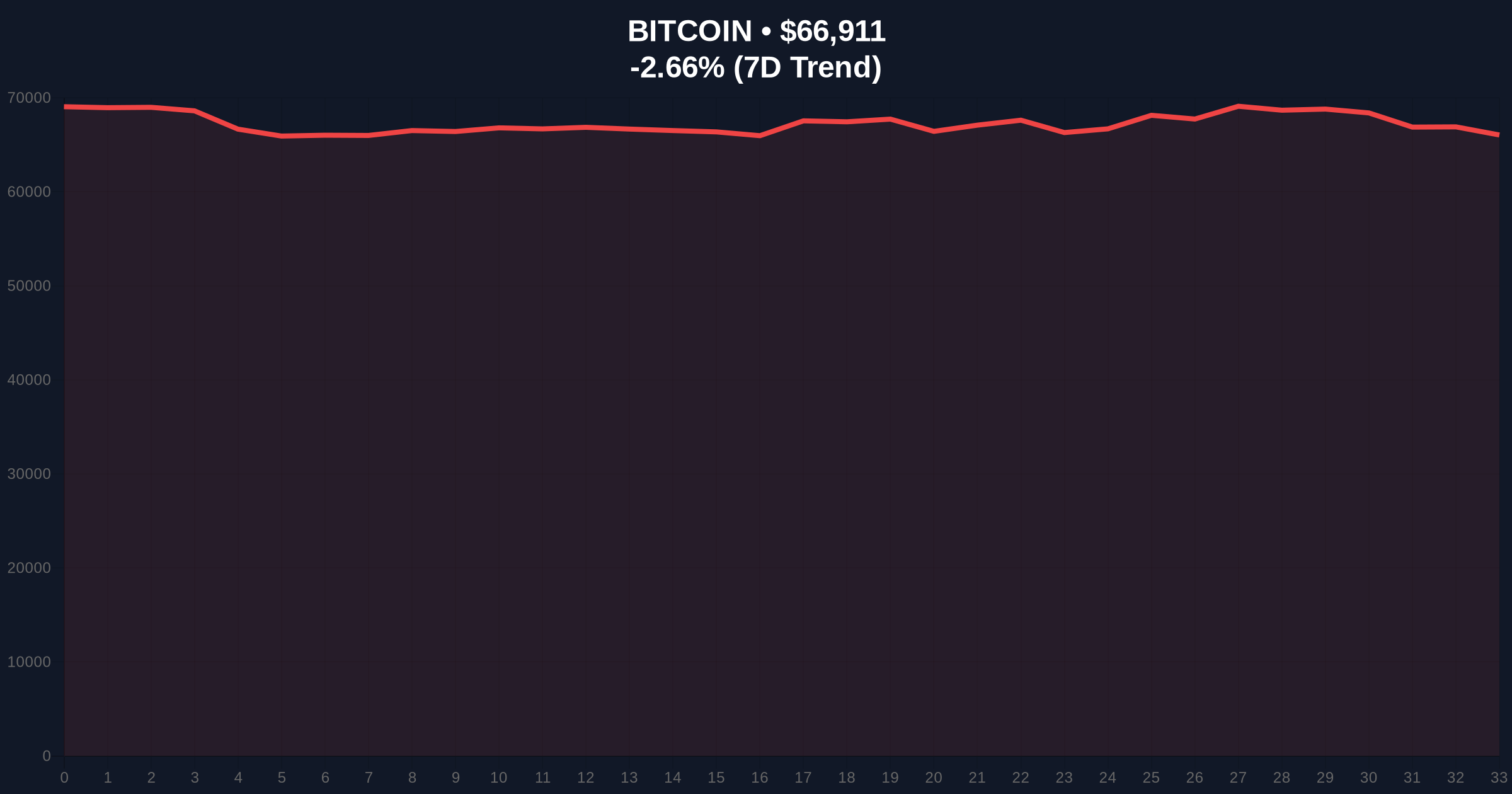
On April 2, 2026, Bitcoin (BTC) fell to a week-to-date low below $66,000, driven by oil-supply concerns and a broader market sell-off in US equities. The decline coincided with a warning from Bloomberg Intelligence senior commodity strategist Mike McGlone that BTC could revert to $10,000 in the long term. This matters because it highlights Bitcoin's vulnerability to macroeconomic shocks and raises questions about its decoupling narrative, with the crypto market now in "Extreme Fear" sentiment.
Key metrics from the event show a sharp downturn. Bitcoin's price dipped below $66,000, hitting a weekly low, while WTI crude oil spiked to $114 per barrel amid supply fears. The Nasdaq Composite Index fell over 2%, and 24-hour crypto liquidations exceeded $400 million. Current market data from CoinGecko indicates Bitcoin is trading at $66,890, down 2.69% in 24 hours, with global crypto sentiment at "Extreme Fear" (score: 12/100).
| Metric | Value | Source |
|---|---|---|
| Bitcoin Weekly Low | Below $66,000 | Source: public statement |
| WTI Crude Oil Price | $114 per barrel | Source: public statement |
| Nasdaq Composite Drop | Over 2% | Source: public statement |
| Crypto Liquidations (24h) | Over $400 million | Source: public statement |
| Current Bitcoin Price | $66,890 | Source: CoinGecko |
| 24h Price Trend | -2.69% | Source: CoinGecko |
Why now? The timing is critical as geopolitical tensions around the Strait of Hormuz disrupt oil supplies, triggering inflation fears and risk-off sentiment across markets. Bitcoin, often touted as a hedge, is instead correlating with traditional assets, undermining its safe-haven narrative.
Who benefits? Short-term bears and traders capitalizing on volatility may gain, while long-term holders and retail investors face losses. Institutions monitoring macro trends could use this to reassess Bitcoin's role in portfolios.
Time horizons: In the short term (days/weeks), continued oil volatility and equity sell-offs could pressure BTC further. Long-term (months/years), if McGlone's $10,000 scenario materializes, it would signal a severe bear market, though this remains speculative.
Causal chain: Oil supply fears → inflation concerns → equity market sell-off → risk aversion → Bitcoin price drop → increased liquidations → sentiment shift to "Extreme Fear".
The mechanism hinges on macroeconomic linkages. Oil price spikes, driven by supply disruptions in the Strait of Hormuz, raise inflation expectations. This pressures central bank policies and equity markets, leading to a risk-off environment. Bitcoin, despite its digital nature, is still treated as a risk asset by many investors, causing sell-offs as liquidity tightens. The over $400 million in crypto liquidations exacerbates the drop by forcing margin calls, creating a feedback loop of selling pressure.
Bitcoin's drop contrasts with mixed performances in other sectors. While oil and equities fell, gold saw a modest rebound, suggesting traditional safe-havens are being favored. In crypto, altcoins often follow Bitcoin's lead, but specific events like regulatory shifts or project developments can diverge.
The bearish scenario questions the analysis's validity. What if oil prices stabilize quickly or Bitcoin decouples from equities? Missing data includes detailed on-chain metrics or institutional flow patterns that could clarify selling pressure.
Practically, traders should watch oil prices and equity market reactions for near-term Bitcoin direction. If inflation fears persist, regulatory scrutiny on crypto as a risk asset might increase. Long-term, this event could test Bitcoin's resilience and its correlation with traditional markets.
Bitcoin has historically shown volatility tied to macro events, but its role as "digital gold" is often debated. The $10,000 level referenced by McGlone marks where Bitcoin futures began trading, adding psychological weight. Previous oil shocks, like those in 2020, have impacted crypto, but the current geopolitical context is unique.
Cross-market reactions include gold's rebound and ongoing crypto projects, but the primary driver remains oil and equities. For context, other articles cover topics like tokenized IPOs and cross-chain bridges, but these are less relevant to the immediate oil-Bitcoin linkage.
Bitcoin's weekly low amid oil fears its sensitivity to macroeconomic forces, challenging decoupling hopes. While analyst warnings of $10,000 are speculative, the current "Extreme Fear" sentiment and market mechanics suggest caution is warranted.
What to watch next: Gold found cause for a modest rebound after its own comedown earlier, with oil supplies through the Strait of Hormuz in the spotlight.; exchange-level volume and liquidity data.
Evidence & Sources
Primary source: https://cointelegraph.com/markets/bitcoin-weekly-low-oil-fears-analyst-teases-10k-btc-price-target
Updated at: Apr 02, 2026, 05:53 PM
Data window: Apr 02, 2026, 04:40 PM → Apr 02, 2026, 05:40 PM
Evidence stats: 9 metrics, 1 timeline points.
Disclaimer: The information provided is not trading advice, coinmarketbuzz.com holds no liability for any investments made based on the information provided on this page. We strongly recommend independent research and/or consultation with a qualified professional before making any investment decisions.
All published reports are reviewed by our editorial team for factual consistency, neutrality, and reader clarity.