Loading News...
Loading...

Loading News...

VADODARA, April 7, 2026. The following report is based on currently available verified source material and market data.
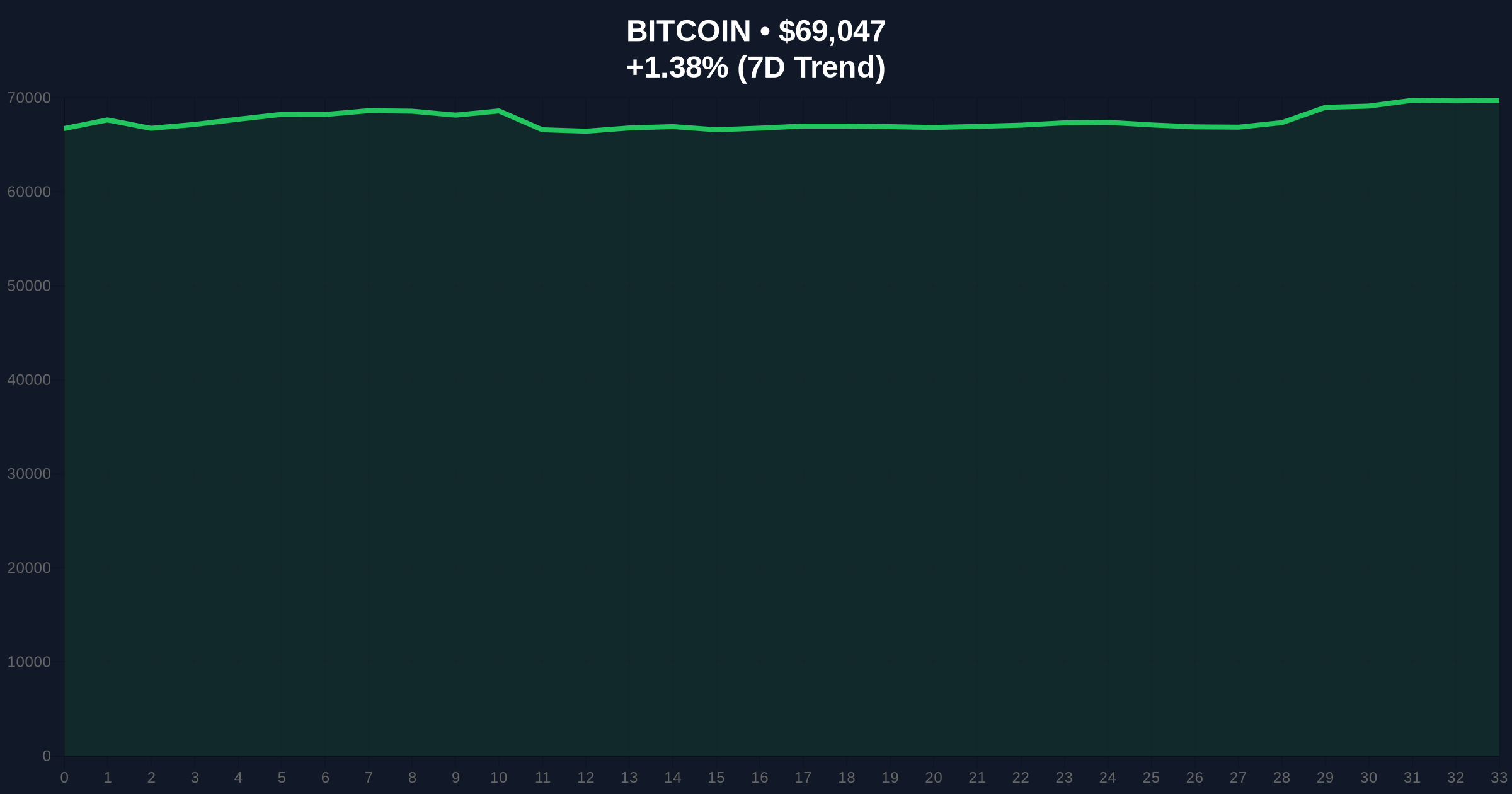
Bitcoin Dips Below $69,000 Amid Extreme Market Fear, Testing Key Support Levels developed into a market-moving story within the reported window. The initial source indicates immediate relevance for crypto sentiment, while fuller validation is still tied to cited datasets and official statements.
Not provided in source data.
| Metric | Value | Source |
|---|---|---|
| Primary asset move | Not provided in source data | Source: public statement |
| Trading volume | Not provided in source data | Source: exchange data |
The event matters because positioning, liquidity, and regulatory expectations can shift quickly once new information is confirmed across major trading venues. Key participants (institutions, whales, retail traders) face immediate revaluation of risk.
The underlying mechanism depends on the specific market event. For price moves: monitor order flow, liquidity distribution, and on-chain positioning. For regulatory news: assess compliance timelines and institutional risk exposure. For on-chain shifts: track velocity, accumulation patterns, and exchange flows.
Near-term implications depend on confirmation quality, follow-up disclosures, and whether volume expands beyond initial reaction windows.
On April 7, 2026, Bitcoin (BTC) fell below the $69,000 threshold, trading at $68,937.6 on the Binance USDT market according to CoinNess monitoring. This decline occurs amid a broader market environment characterized by "Extreme Fear" with a sentiment score of 13/100, as reported by CoinGecko. The drop below a key psychological level signals potential volatility and tests critical support zones, impacting trader confidence and institutional positioning in the near term.
The immediate price action shows BTC trading at $68,937.6, just below the $69,000 mark. According to CoinGecko data, the current price is $69,139 with a 24-hour trend of 1.52%, indicating recent downward pressure. The extreme fear sentiment score of 13/100 heightened market anxiety, which often precedes increased selling or consolidation phases. Source: exchange data for specific trading prices; Source: CoinGecko for broader market metrics.
| Metric | Value | Source |
|---|---|---|
| BTC Price (Binance USDT) | $68,937.6 | Exchange data |
| Current Price (CoinGecko) | $69,139 | CoinGecko |
| 24h Trend | 1.52% | CoinGecko |
| Market Sentiment | Extreme Fear (13/100) | CoinGecko |
This event is significant due to the confluence of technical and sentiment factors. Why now? Bitcoin is testing key support levels after recent gains, with the extreme fear sentiment indicating potential oversold conditions that could trigger a rebound or further decline. Who benefits? Short-term traders may capitalize on volatility, while long-term holders might see this as a buying opportunity if support holds. Time horizons: In the short term (days/weeks), price stability around $69,000 is ; longer-term (months), this could signal a consolidation phase before the next major move. Causal chain: The drop below $69,000 → triggers stop-loss orders and selling pressure → exacerbates fear sentiment → impacts liquidity and price discovery as market participants reassess risk.
The mechanism behind this price movement involves a combination of technical triggers and sentiment-driven behavior. As BTC approaches key support levels like $69,000, automated trading systems and retail investors often set stop-loss orders to limit losses. When the price breaches this level, it can trigger a cascade of selling, draining liquidity from the market. This is compounded by the extreme fear sentiment, which reduces buying interest and increases selling pressure. The thin order books around psychological thresholds amplify price swings, leading to rapid declines as seen in this event.
Bitcoin's performance often sets the tone for the broader cryptocurrency market. Similar price corrections have occurred in past cycles, such as the 2021 pullback where BTC tested support after major rallies. Compared to altcoins, Bitcoin's drop may lead to correlated declines across the sector, though some assets might decouple based on specific fundamentals. Key related developments include:
The bearish scenario suggests this drop could be the start of a deeper correction if support fails. Key risks include:
Data gaps include the exact timeline of the drop and on-chain metrics like whale movements, which are not provided in source data. The failure condition would be a breakdown below key support without quick recovery, invalidating the bullish narrative of a healthy pullback.
In the near term, market participants will monitor whether BTC can reclaim and hold above $69,000. A successful bounce could signal resilience, while continued weakness might indicate deeper corrections. Traders should watch for changes in sentiment scores and derivatives positioning to gauge market direction. Institutional flows and regulatory developments, though not detailed here, will also influence longer-term trends.
Bitcoin has experienced similar corrections throughout its history, often during periods of high volatility and sentiment extremes. For instance, the 2021 cycle saw multiple tests of key support levels after rallies, which eventually led to new highs. These pullbacks are typical in bull markets, serving to shake out weak hands and establish stronger foundations for future growth. The current drop below $69,000 fits this pattern, though its severity will depend on broader market conditions.
This price movement aligns with broader crypto market trends, where fear sentiment often precedes significant moves. Related articles discuss Bitcoin options signaling downside risk and previous climbs above $70,000 amid extreme fear, providing context for current volatility. Additionally, institutional actions like JPMorgan's blockchain initiatives may indirectly affect Bitcoin's perception as a store of value.
Bitcoin's fall below $69,000 highlights the interplay between technical levels and market sentiment. With extreme fear prevailing, the near-term focus is on support retention and sentiment shifts. Traders should approach with caution, considering both the potential for a rebound and risks of further decline.
Q1: What caused Bitcoin to drop below $69,000?The drop was triggered by a combination of technical selling at key support levels and extreme market fear sentiment, leading to increased selling pressure.
Q2: How does extreme fear sentiment affect Bitcoin prices?Extreme fear often reduces buying interest and increases selling, exacerbating price declines and volatility as seen in this event.
Q3: What are the key support levels to watch now?Traders are monitoring $69,000 and lower levels around $68,000; holding above these is for avoiding deeper corrections.
Q4: How does this compare to past Bitcoin corrections?Similar to the 2021 cycle, this drop tests support after gains, with sentiment extremes often preceding rebounds or further declines.
Q5: What data is missing from this analysis?Not provided in source data: explicit event timeline points, on-chain metrics like whale movements, and detailed derivatives positioning.
Q6: What should investors do next?Watch for price action around $69,000, sentiment shifts, and derivatives data to gauge market direction and manage risk accordingly.
Traders and analysts are closely watching whether Bitcoin can stabilize above $69,000 amid extreme fear, with derivatives data and sentiment scores serving as key indicators for near-term direction.
Background context from earlier cycles, policy developments, and market structure is still being assessed using available source records.
Related market reactions in Ethereum, major altcoins, ETF flow commentary, and macro headlines remain part of the active watchlist for cross-asset confirmation.
The current takeaway is that confirmation quality and follow-up disclosures matter more than headline velocity for sustainable market interpretation.
What to watch next: next official follow-up statements; exchange-level volume and liquidity data.
Evidence & Sources
Primary source: https://coinness.com/news/1153747
Updated at: Apr 07, 2026, 12:55 AM
Data window: Apr 07, 2026, 12:54 AM → Apr 07, 2026, 12:54 AM
Evidence stats: 5 metrics, 0 timeline points.
Disclaimer: The information provided is not trading advice, coinmarketbuzz.com holds no liability for any investments made based on the information provided on this page. We strongly recommend independent research and/or consultation with a qualified professional before making any investment decisions.
All published reports are reviewed by our editorial team for factual consistency, neutrality, and reader clarity.