Loading News...
Loading...

Loading News...

VADODARA, April 7, 2026. The following report is based on currently available verified source material and market data.
Bitcoin Decouples from Software Stocks as Geopolitical Tensions and AI Fears Reshape Market Correlations developed into a market-moving story within the reported window. The initial source indicates immediate relevance for crypto sentiment, while fuller validation is still tied to cited datasets and official statements.
On April 7, 2026, Bitcoin's correlation with software stocks collapsed from near-perfect alignment to near-zero following the outbreak of the Iran war, signaling a significant shift in market dynamics. The cryptocurrency gained over 5% since February 28, while the iShares Expanded Tech-Software Sector ETF (IGV) fell more than 2%, marking a clear divergence after months of tight correlation. This breakdown suggests investors are treating Bitcoin as a distinct macro asset amid geopolitical uncertainty and AI-driven fears in the tech sector, with immediate implications for portfolio strategies and risk assessment.
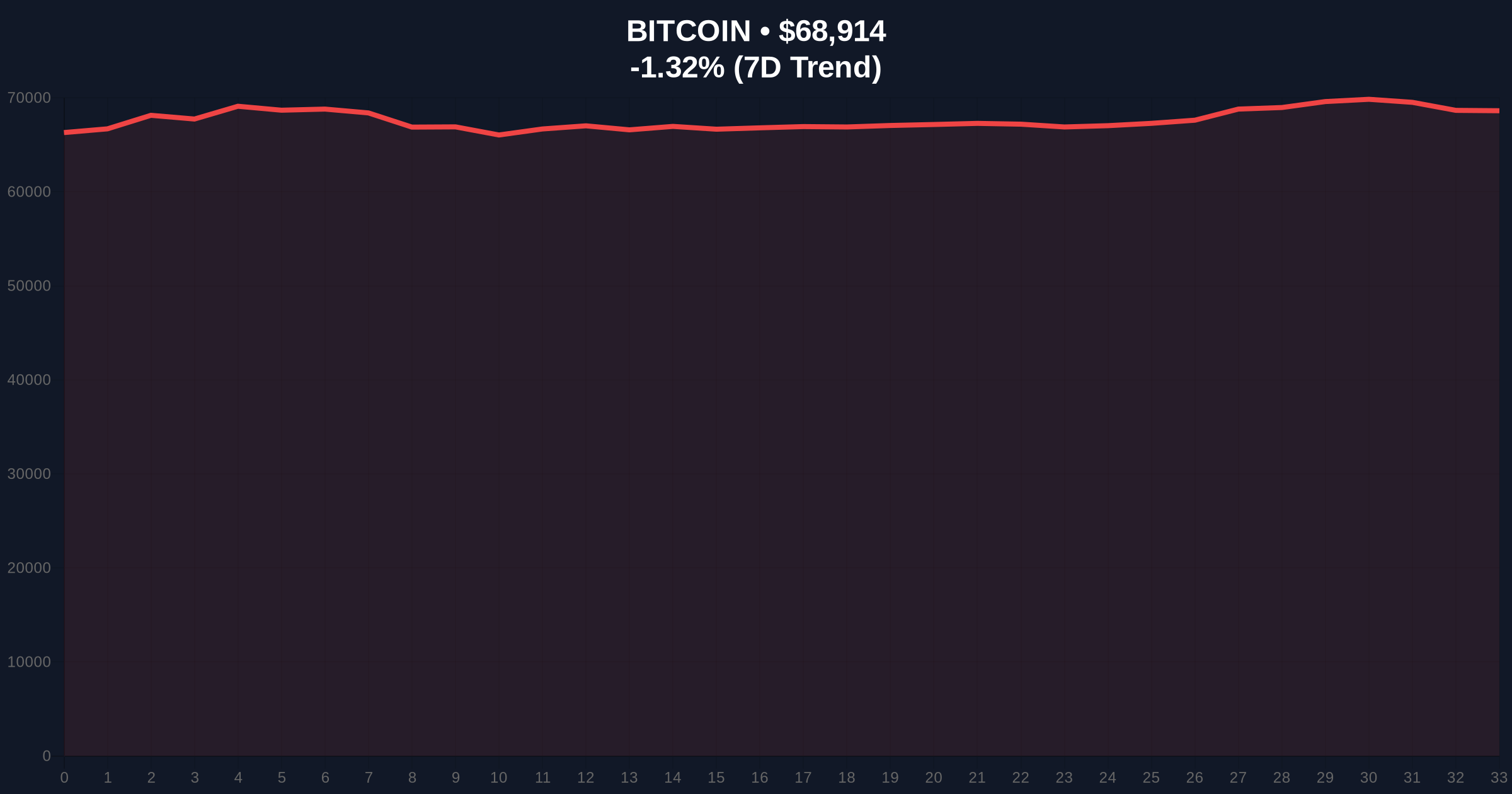
The data reveals a stark performance gap and correlation collapse. Bitcoin's price was $68,952.46 at the time of reporting, having risen more than 5% since the conflict began on February 28, 2026, and trading back above $69,000 with a 0.5% gain over the past 24 hours. In contrast, IGV fell more than 2% during the same period. Correlation between Bitcoin and IGV dropped from near 1.0 in early February to 0.13 after the war started, before partially recovering to around 0.7. Over the past three months, Bitcoin fell 26% and IGV lost 23%, with both down about 21% year-to-date, but Bitcoin showed greater volatility, falling roughly 50% from its October all-time high compared to IGV's 35% drop from its peak. Source: public statement. Current market data shows Bitcoin at $68,919 with a 24-hour trend of -1.24% amid "Extreme Fear" sentiment (score: 11/100). Source: CoinGecko.
| Metric | Bitcoin (BTC) | iShares Expanded Tech-Software ETF (IGV) |
|---|---|---|
| Performance Since Feb 28 | +5% | -2% |
| Correlation (Pre-war) | Near 1.0 | Near 1.0 |
| Correlation (Post-war) | 0.13 (recovered to ~0.7) | 0.13 (recovered to ~0.7) |
| 3-Month Change | -26% | -23% |
| Year-to-Date Change | -21% | -21% |
| 5-Year Gain | 18% | 10% |
This divergence matters now because it coincides with heightened geopolitical risk from the Iran war and growing AI-related anxieties in software, creating a perfect storm for asset reclassification. Investors benefit by gaining a potential hedge: Bitcoin holders may see relative safety as a macro asset, while software stock investors face compression risks. In the short term (days/weeks), the decoupling offers tactical opportunities for traders to rebalance portfolios away from correlated tech exposure. Over the longer term (months/years), if sustained, it could redefine Bitcoin's role in institutional portfolios as less tied to tech equities. The causal chain is clear: geopolitical conflict triggers flight to perceived safe-haven or inflation-hedge assets like Bitcoin, while AI fears compress software valuations due to margin and competition concerns, mechanically breaking the prior correlation.
The mechanism involves two parallel market reactions. For Bitcoin, the Iran war acts as a geopolitical shock, increasing demand for assets perceived as uncorrelated to traditional equities or as stores of value during uncertainty. This buying pressure, potentially amplified by institutional flows, supports prices despite broader market fear. For software stocks, represented by IGV (heavily weighted in Microsoft, Oracle, and Salesforce), the fear is structural: AI advancements threaten to lower barriers to entry and compress profit margins in Software as a Service (SaaS), leading to sell-offs. The correlation breakdown occurs because these drivers are distinct, Bitcoin responds to macro/geopolitical cues, while software stocks react to sector-specific tech disruption. The partial recovery to ~0.7 correlation suggests some re-coupling as initial panic subsides, but the shift from near 1.0 indicates a fundamental reassessment.
This event mirrors broader trends where cryptocurrencies are increasingly evaluated on macro merits rather than purely as risk-on tech assets. Similar to the 2021 correction, where Bitcoin initially fell with tech stocks but later diverged on inflation concerns, the current decoupling highlights evolving market narratives. Key adjacent developments include:
The bearish scenario hinges on several uncertainties. First, the correlation recovery to ~0.7 indicates the decoupling may be temporary; a full reversion could erase divergence gains. Second, Bitcoin's outperformance relies on sustained geopolitical tension or inflation fears, if the Iran conflict de-escalates, the macro tailwind could fade. Third, software stock woes may be overstated if AI integration boosts productivity rather than crushing margins. Key risks include:
Practically, traders should monitor correlation metrics and geopolitical developments for rebalancing signals. If the decoupling holds, Bitcoin may attract more institutional allocation as a diversifier away from tech-heavy portfolios. Regulatory attention could increase if Bitcoin's macro role expands, affecting ETF approvals and custody rules. In the near term, watch for sustained ETF inflows and software earnings reports to test the divergence's durability.
Historically, Bitcoin and tech stocks have shown periods of high correlation, especially during risk-on/risk-off market cycles. Over the past five years, Bitcoin gained 18% versus IGV's 10%, but with higher volatility, indicating a persistent but noisy relationship. The recent tight alignment until February 2026 reflected shared investor sentiment during market downturns, making the sudden break notable.
Amid this shift, Bitcoin ETF inflows have surged, with $471 million recorded on April 6, 2026, the highest since late February, suggesting institutional demand may be anchoring prices independently. Additionally, other cryptocurrencies like XRP have faced challenges, posting losses as liquidity dries up, highlighting varied responses within the crypto sector.
The decoupling of Bitcoin from software stocks a market in flux, where geopolitical and technological forces are reshaping asset correlations. While Bitcoin shows resilience as a macro hedge, risks of reversion and broader market fear remain critical watchpoints.
What to watch next: By James Van Straten|Edited by Sheldon Reback Apr 7, 2026, 10:15 a.m.; Bitcoin had fallen roughly 50% from its October all-time high, while IGV, which peaked slightly earlier, fell about 35% from its own top..
Evidence & Sources
Primary source: https://www.coindesk.com/markets/2026/04/07/bitcoin-pulls-away-from-software-stocks-as-iran-war-ai-reshape-market-dynamic
Updated at: Apr 07, 2026, 12:31 PM
Data window: Apr 07, 2026, 12:15 PM → Apr 07, 2026, 12:21 PM
Evidence stats: 9 metrics, 3 timeline points.
Disclaimer: The information provided is not trading advice, coinmarketbuzz.com holds no liability for any investments made based on the information provided on this page. We strongly recommend independent research and/or consultation with a qualified professional before making any investment decisions.
All published reports are reviewed by our editorial team for factual consistency, neutrality, and reader clarity.