Loading News...
Loading...

Loading News...

VADODARA, April 16, 2026. The following report is based on currently available verified source material and market data.
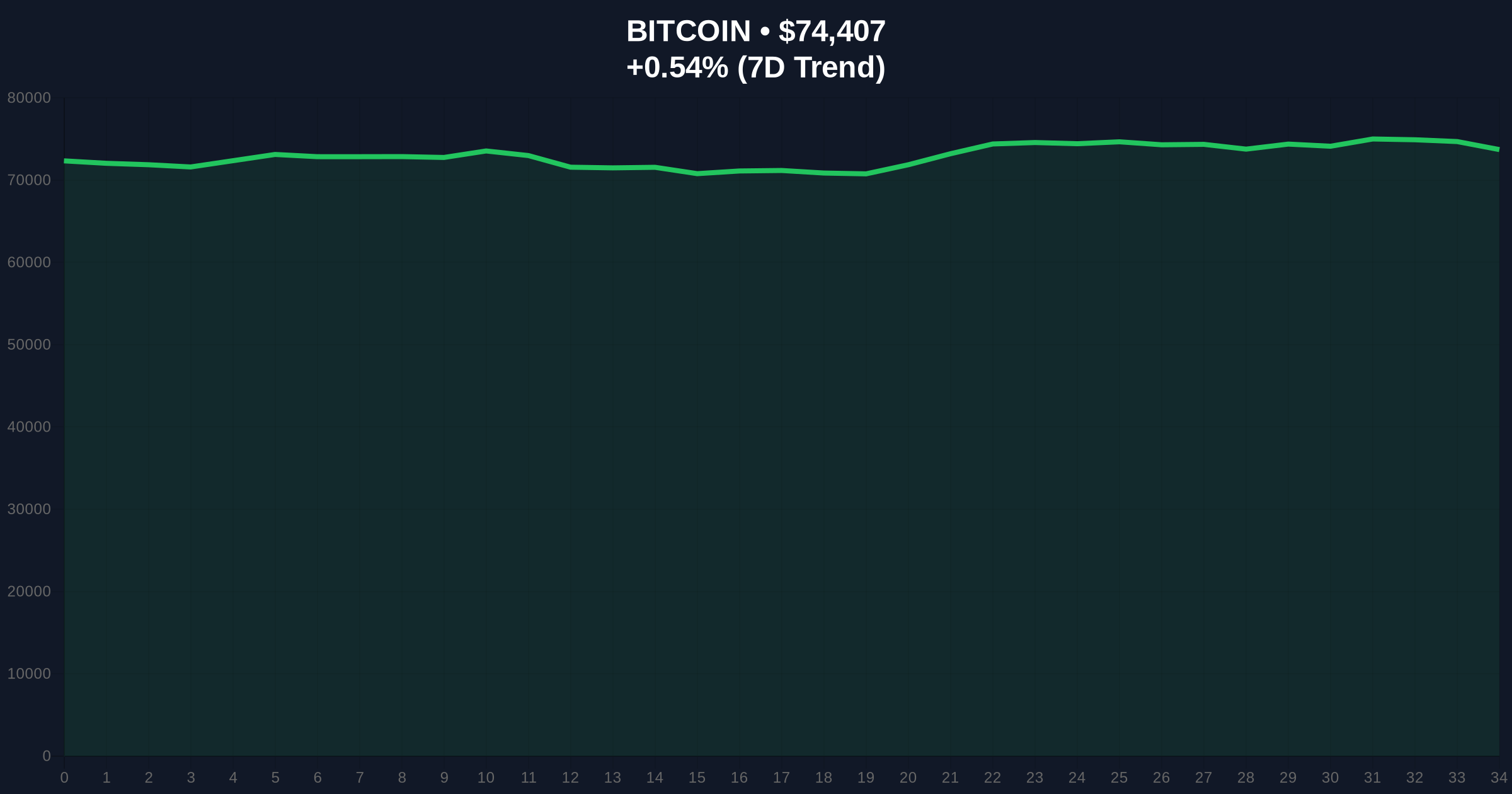
On April 16, 2026, Bitcoin traded near $76,000 but Glassnode analysts cautioned that calling a new bull market is premature due to weak capital inflows and persistent outflows. The true market mean (TMM) indicator shows active holders remain at a loss, with Bitcoin's growth rate negative for all 105 trading days in 2026, highlighting a critical gap between price stability and insufficient new demand that could cap upside momentum.
Key metrics reveal a disconnect between Bitcoin's price action and underlying demand fundamentals. The true market mean (TMM), which estimates the average cost basis of active investors, sits at $78,013, above the current price of $74,373 (Source: CoinGecko). This places the average active holder at a 5% loss, with a peak drawdown of 20% since Bitcoin crossed below the TMM on January 31. Meanwhile, the 365-day growth rate of market cap relative to realized cap has remained negative throughout 2026, with the latest reading at -0.000652, indicating sustained capital outflows. The 30-day realized cap change has improved slightly to -0.32% from early April lows near -0.54%, but only seven days in 2026 saw positive inflows, all during a brief mid-January period.
| Metric | Value | Source |
|---|---|---|
| Current Bitcoin Price | $74,373 | CoinGecko |
| True Market Mean (TMM) | $78,013 | Glassnode/X |
| Active Holder Loss Gap | 5% | blockchain analytics |
| 365-Day Growth Rate | -0.000652 | Axel Adler Jr. |
| 30-Day Realized Cap Change | -0.32% | public statement |
This analysis matters now because Bitcoin has shown resilience with prices near range highs, yet underlying metrics suggest fragility. Why now? The market is at a potential inflection point where price stability masks weak demand, creating risk of a deeper correction if outflows persist. Who benefits? Short-term traders may capitalize on volatility, while long-term investors face uncertainty; whales and institutions monitoring these metrics could adjust positions ahead of retail. Time horizons: In the short-term (days/weeks), the TMM resistance at $78,013 acts as a ceiling, while longer-term (months/years), historical patterns show similar breaks lasting up to 11 months with drawdowns reaching 57%. Causal chain: Persistent capital outflows → reduced buying pressure → price struggles to reclaim key levels like TMM → active holders remain underwater → negative sentiment reinforces outflow cycle, creating a feedback loop that delays bull market confirmation.
The mechanism hinges on two core metrics: the true market mean (TMM) and capital flow indicators. The TMM divides investor capitalization by liveliness-adjusted circulating supply, filtering out inactive and lost coins to estimate the average cost basis of active holders. When price falls below TMM, as it has since January 31, the average active investor is at a loss, creating selling pressure as holders seek to minimize losses. Concurrently, the negative growth rate of market cap relative to realized cap measures net capital flows; a sustained negative value indicates more money is exiting than entering the Bitcoin ecosystem. This dual pressure, loss positioning and capital outflows, mechanically suppresses price appreciation by thinning buy-side liquidity and increasing sell-side urgency, making rallies unsustainable without a fundamental shift in inflows.
Bitcoin's demand lag contrasts with broader crypto developments where regulatory and institutional advancements are progressing. For instance, the CFTC chairman recently defended AI use amid staff cuts as crypto and prediction markets see demand surge, highlighting regulatory adaptation to technological trends. Similarly, tokenization evolution is redefining portfolio allocation through compliance architecture and institutional capital, suggesting growth in adjacent sectors. However, Bitcoin-specific metrics like the TMM drawdown echo past cycles; the 2018, 2019 and 2022, 2023 episodes saw 57% declines, indicating that current conditions may align more with corrective phases than bullish breakouts. Key comparisons include:
The bearish scenario hinges on several risks that could invalidate any nascent bullish narrative. First, the improvement in 30-day realized cap change to -0.32% may signal only a slowdown in outflows, not a reversal; a meaningful shift requires both metrics to turn positive and sustain above zero. Second, historical data shows TMM breaks can last over 11 months with deep drawdowns, suggesting the current 75-day period is early and further declines are possible. Third, global crypto sentiment is at "Extreme Fear" with a score of 23/100, indicating broader market pessimism that could exacerbate outflows. Uncertainty stems from missing data on whale accumulation patterns and institutional inflow triggers. The failure condition would be a breakdown below key support levels, coupled with accelerated capital outflows, breaking the assumed mechanism of gradual improvement.
Practically, traders should monitor the TMM at $78,013 as a critical resistance level; reclaiming it is essential for active investors to return to profit and could signal momentum reset. In the near term, sustained negative growth rates may limit upside to range-bound action between $74,373 and $78,013, with volatility spikes likely around these levels. Institutions may delay large allocations until metrics show consistent positive inflows, potentially extending the consolidation phase. Additionally, as Cardano's Charles Hoskinson commented on Bitcoin's quantum defense plan, technological advancements like hard forks could influence long-term holder behavior, but short-term price mechanics remain driven by capital flows and cost basis metrics.
Bitcoin's true market mean (TMM) has been used since 2016 to gauge active investor profitability, with 10 similar breaks below this level historically. These events often align with cycle transitions, where capital reallocation and sentiment shifts redefine market structure. The current scenario follows a period of institutional adoption via ETFs, but post-approval flows have not offset broader capital exits, highlighting a maturation phase where price discovery is increasingly tied to on-chain metrics rather than speculative hype.
Cross-market reactions include regulatory developments, such as the CFTC chairman defending AI use amid crypto demand surges, which may influence institutional sentiment. Meanwhile, discussions on Bitcoin's quantum defense plan, as noted by Cardano's Hoskinson, reflect ongoing technological debates that could impact long-term holder confidence. In adjacent sectors, tokenization evolution is attracting institutional capital, potentially diverting funds from Bitcoin if demand metrics remain weak.
Glassnode's analysis that Bitcoin's price resilience belies underlying demand weakness, with active holders at a loss and capital outflows persisting. While slight improvements in metrics offer hope, historical patterns and negative growth rates caution against premature bull market calls, emphasizing the need for sustained positive inflows to drive a meaningful reversal.
What to watch next: The signal isn't "all clear", it's watch closely.” Reclaiming the TMM, currently at $78,013, is key for active investors to return to profit, and it has aligned with momentum resets in earlier cycles.; exchange-level volume and liquidity data.
Evidence & Sources
Primary source: https://cointelegraph.com/markets/bitcoin-bull-run-still-too-early-to-call-as-demand-lags-exiting-capital-analyst
Updated at: Apr 16, 2026, 07:50 PM
Data window: Apr 16, 2026, 06:55 PM → Apr 16, 2026, 07:49 PM
Evidence stats: 9 metrics, 1 timeline points.
Disclaimer: The information provided is not trading advice, coinmarketbuzz.com holds no liability for any investments made based on the information provided on this page. We strongly recommend independent research and/or consultation with a qualified professional before making any investment decisions.
All published reports are reviewed by our editorial team for factual consistency, neutrality, and reader clarity.