Loading News...
Loading...

Loading News...

VADODARA, April 3, 2026. The following report is based on currently available verified source material and market data.
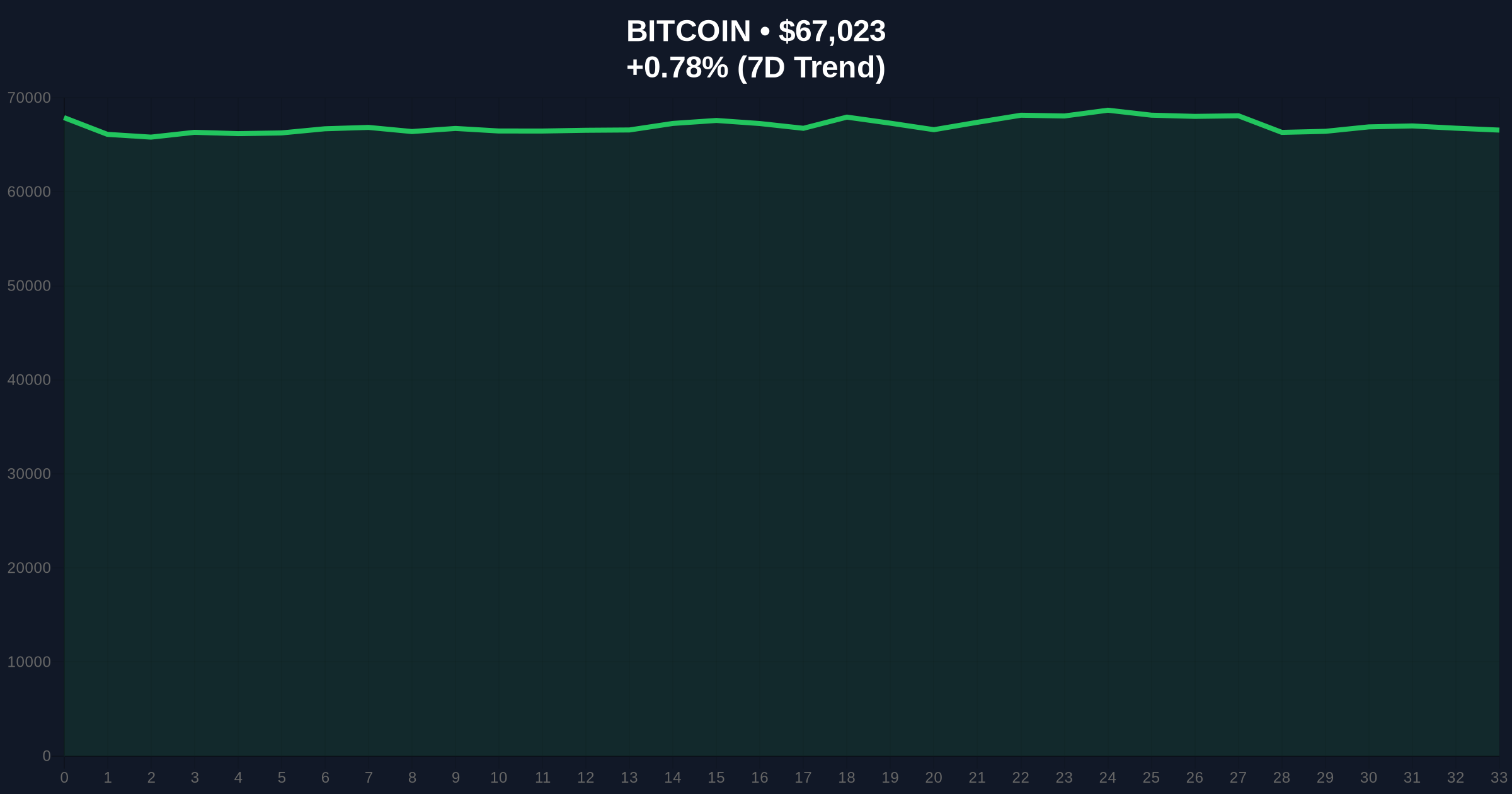
On April 3, 2026, Bitcoin and Ethereum prices dropped sharply after a U.S. address in Iran triggered a global risk-off reaction, with Bitcoin falling nearly 6% within hours. This move pushed BTC below the $69,000 mark, failing to break the $72,500, $73,000 resistance zone, and comes as markets face a potential liquidity gap over the Good Friday weekend. The escalation in geopolitical tensions has heightened volatility, leaving crypto vulnerable to sudden moves amid broader market uncertainty.
Bitcoin's price decline of nearly 6% occurred rapidly, with the asset struggling under $69,000 and unable to surpass the $72,500, $73,000 range. According to CoinGecko data, Bitcoin's current price is $67,054, with a 24-hour trend of 0.71%, while global crypto sentiment is at "Extreme Fear" with a score of 9/100. Analyst Aaron Dishner has outlined downside targets at $60,000, $49,000, and $38,555 if selling accelerates, suggesting a broader reset may be underway. Ethereum has slightly outperformed Bitcoin recently but remains fragile, forming a bear flag pattern with bearish divergence on RSI.
| Metric | Value | Source |
|---|---|---|
| Bitcoin Price Drop | ~6% | Source: public statement |
| Current Bitcoin Price | $67,054 | Source: CoinGecko |
| 24h Trend | 0.71% | Source: CoinGecko |
| Sentiment Score | 9/100 (Extreme Fear) | Source: public statement |
| Resistance Zone | $72,500, $73,000 | Source: public statement |
This event matters now due to the convergence of geopolitical escalation and market structural vulnerabilities. The timing coincides with the Good Friday weekend, when CME futures and ETF flows pause, creating a liquidity gap that amplifies price swings. Who benefits? Short-term traders and risk-averse investors moving to stablecoins may gain, while long-term holders and leveraged positions face losses. In terms of time horizons, short-term impacts include increased volatility and potential further declines, while longer-term implications hinge on whether this triggers a sustained bearish trend or a temporary correction. The causal chain is: geopolitical event → global risk-off sentiment → crypto sell-off → liquidity gap exacerbates moves → technical breakdowns reinforce bearish outlook.
The mechanism behind this drop involves a classic risk-off cascade. Initially, the U.S. address in Iran acted as a trigger, spooking global markets and prompting investors to flee risky assets like cryptocurrencies. This led to a liquidity drain as sell orders overwhelmed buy-side support, particularly in thin weekend trading conditions. The immediate effect was Bitcoin breaking below key resistance levels, with technical indicators like the TBO Cloud and RSI divergences signaling further downside. The outcome is a market now more susceptible to panic selling, with stablecoin dominance rising as capital seeks safety.
Across the crypto industry, the reaction has been broadly negative but uneven. Ethereum has shown relative strength but remains in a bearish setup, while altcoins like XRP and Solana are slipping toward February lows. This contrasts with traditional markets, where equities closed green but below resistance, and oil prices climbed toward $110, indicating divergent safe-haven flows. Key comparisons include:
The bearish scenario could be invalidated if geopolitical tensions ease quickly or if institutional inflows resume post-weekend. However, several risks and uncertainties persist:
Practically, traders should expect heightened volatility in the coming week, with critical support levels at $60,000 and below being tested. The market's direction will likely depend on whether the weekend liquidity gap leads to a capitulation event or a stabilization. Institutions may delay large moves until after the holiday, while retail investors could face margin calls if prices drop further.
Bitcoin has been struggling to break above key resistance levels in recent months, with the $72,500, $73,000 zone acting as a persistent barrier. The current drop echoes patterns seen in January, where similar geopolitical and liquidity concerns triggered a broader reset. Historically, crypto markets have shown sensitivity to macro events, but the added layer of ETF and futures market closures amplifies these effects during holidays.
Amid this volatility, platforms like MEXC are launching features such as 'Trailing Stop' for spot trading to help manage risk. Additionally, gold and silver ranking among top 5 in Binance futures volume suggests some investors are diversifying away from crypto, though whether this signals a retreat or mere hedging remains unclear. Not provided in source data for specific price predictions on tokens like TRON or Near Protocol in this context.
The sharp drop in Bitcoin and Ethereum prices crypto's vulnerability to geopolitical shocks and structural liquidity gaps. With extreme fear sentiment dominating and key technical levels broken, the market faces a critical test in the days ahead. Traders should monitor support zones and broader market reactions for clues on the next move.
Evidence & Sources
Primary source: https://coinpedia.org/news/crypto-market-today-bitcoin-and-ethereum-price-drop-as-us-israel-iran-war-escalates
Updated at: Apr 03, 2026, 10:42 AM
Data window: Apr 03, 2026, 10:14 AM → Apr 03, 2026, 10:41 AM
Evidence stats: 9 metrics, 2 timeline points.
Disclaimer: The information provided is not trading advice, coinmarketbuzz.com holds no liability for any investments made based on the information provided on this page. We strongly recommend independent research and/or consultation with a qualified professional before making any investment decisions.
All published reports are reviewed by our editorial team for factual consistency, neutrality, and reader clarity.