Loading News...
Loading...

Loading News...

VADODARA, April 7, 2026. The following report is based on currently available verified source material and market data.
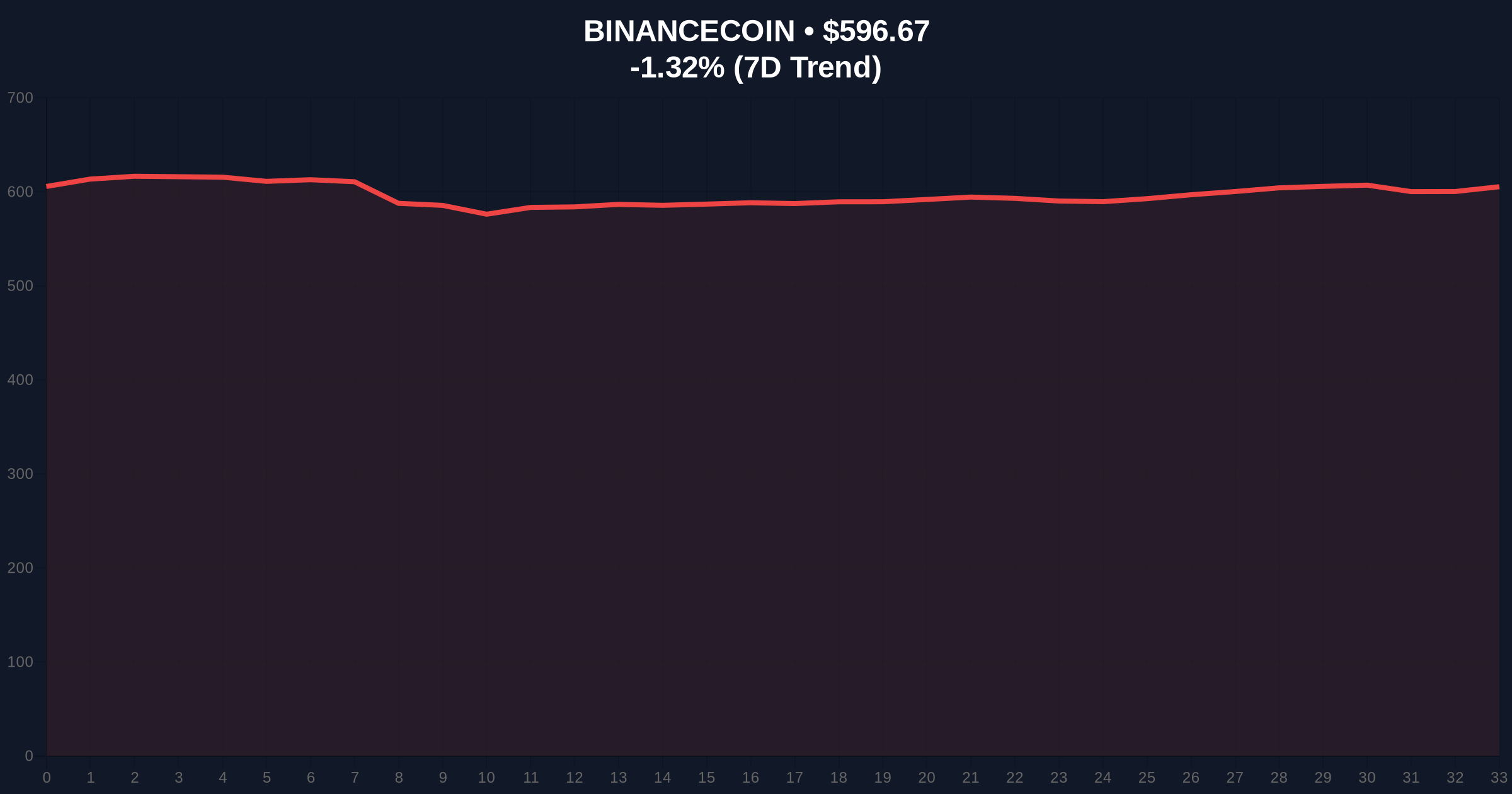
On April 7, 2026, cryptocurrency exchange Binance announced it will roll out a new spot trading rule on April 14, restricting executions outside a dynamic price range during periods of volatility and thin liquidity. This move, dubbed the Spot Price Range Execution Rule (PRER), aims to address abnormal executions that can distort markets during stress. It comes amid a global crypto sentiment of "Extreme Fear" (Score: 11/100) and a slight decline in BNB price, raising questions about its timing and effectiveness in a jittery market environment.
The announcement specifies that PRER will be implemented on April 14, 2026, applying to taker orders during order matching. According to Binance, the rule uses a reference price derived from recent trades, with percentage-based bands set above and below, to restrict executions only within this range. Key market metrics show BNB trading at $596.68 with a 24-hour trend of -1.32%, ranking #4 by market cap. Source: CoinGecko. The global crypto sentiment is "Extreme Fear," indicating heightened market anxiety. Source: exchange data.
| Metric | Value | Source |
|---|---|---|
| BNB Price | $596.68 | CoinGecko |
| 24h Trend | -1.32% | CoinGecko |
| Market Rank | #4 | CoinGecko |
| Global Sentiment | Extreme Fear (11/100) | Market Intelligence |
Why now? This rule emerges months after an October 2025 market dislocation where liquidity thinned rapidly, though Binance has not explicitly linked it to that event. In a climate of extreme fear, such guardrails could be seen as a proactive measure to prevent flash crashes, but skeptics might view it as a reaction to past scrutiny. Who benefits? Potentially, retail traders gain protection from extreme slippage, while Binance aims to bolster its reputation for market stability. However, institutional traders might face constraints on large orders during volatility. Time horizons: Short-term, it could reduce panic selling spikes; long-term, it may set a precedent for exchange-level interventions. Causal chain: During stress, thin liquidity → trades execute far from recent prices → PRER restricts executions to a dynamic range → aims to maintain orderly markets, but could also limit price discovery.
The Spot PRER works by tying execution to a dynamic reference price based on recent trades, with percentage-based bands set above and below. Orders only fill within this range, and any portion that would execute outside it is canceled. This is an exchange-level market protection mechanism applied during order matching, distinct from user-set orders like stop-loss or limit orders. Mechanically, during periods of volatility, the system calculates a reference price and adjusts bands per trading pair, intending to prevent trades that deviate excessively from recent activity. However, Binance notes PRER may not be available for all pairs when a reliable reference price cannot be determined, introducing operational gaps.
This move aligns with broader industry trends toward enhanced security and regulatory compliance, as seen in recent developments:
Unlike these reactive measures, Binance's PRER is preemptive, but it raises questions about whether such guardrails could become standard across exchanges or if they might stifle market efficiency compared to more decentralized platforms.
The bearish scenario questions the rule's efficacy and timing. Key risks include:
Failure conditions include if market volatility exceeds the dynamic bands, rendering the rule ineffective, or if it leads to increased order cancellations that frustrate users. The analysis is limited by missing data on historical slippage incidents and exact band percentages.
Practically, near-term implications involve traders adjusting strategies to account for potential execution restrictions during high volatility. If successful, PRER could reduce extreme price swings, but if flawed, it might trigger user backlash or regulatory scrutiny. Exchanges may monitor Binance's rollout to consider similar features, potentially shifting industry norms toward more controlled trading environments.
Historically, Binance has faced scrutiny during market downturns, such as the October 2025 sell-off where technical glitches and depegging issues occurred. Co-founder Changpeng Zhao previously pushed back on claims that Binance contributed to that event. This context frames PRER as part of ongoing efforts to improve market integrity, but skeptics may see it as a defensive move to preempt future criticism.
Cross-market reactions include increased focus on exchange security, as seen with Solana's recent overhaul, and regulatory pressures exemplified by South Korea's verification mandates. These developments highlight a broader industry shift toward risk mitigation amid persistent volatility.
Binance's Spot PRER represents a significant step in exchange-level market protection, aiming to curb abnormal executions during volatility. However, its rollout amid extreme fear and past controversies invites skepticism about its timing and effectiveness. Traders should watch for parameter details on April 14 to assess real-world impact.
Evidence & Sources
Primary source: https://cointelegraph.com/news/binance-adds-spot-trading-guardrails-to-limit-abnormal-executions
Updated at: Apr 07, 2026, 03:13 PM
Data window: Apr 07, 2026, 01:52 PM → Apr 07, 2026, 02:45 PM
Evidence stats: 2 metrics, 1 timeline points.
Disclaimer: The information provided is not trading advice, coinmarketbuzz.com holds no liability for any investments made based on the information provided on this page. We strongly recommend independent research and/or consultation with a qualified professional before making any investment decisions.
All published reports are reviewed by our editorial team for factual consistency, neutrality, and reader clarity.