Loading News...
Loading...

Loading News...

VADODARA, April 6, 2026. The following report is based on currently available verified source material and market data.
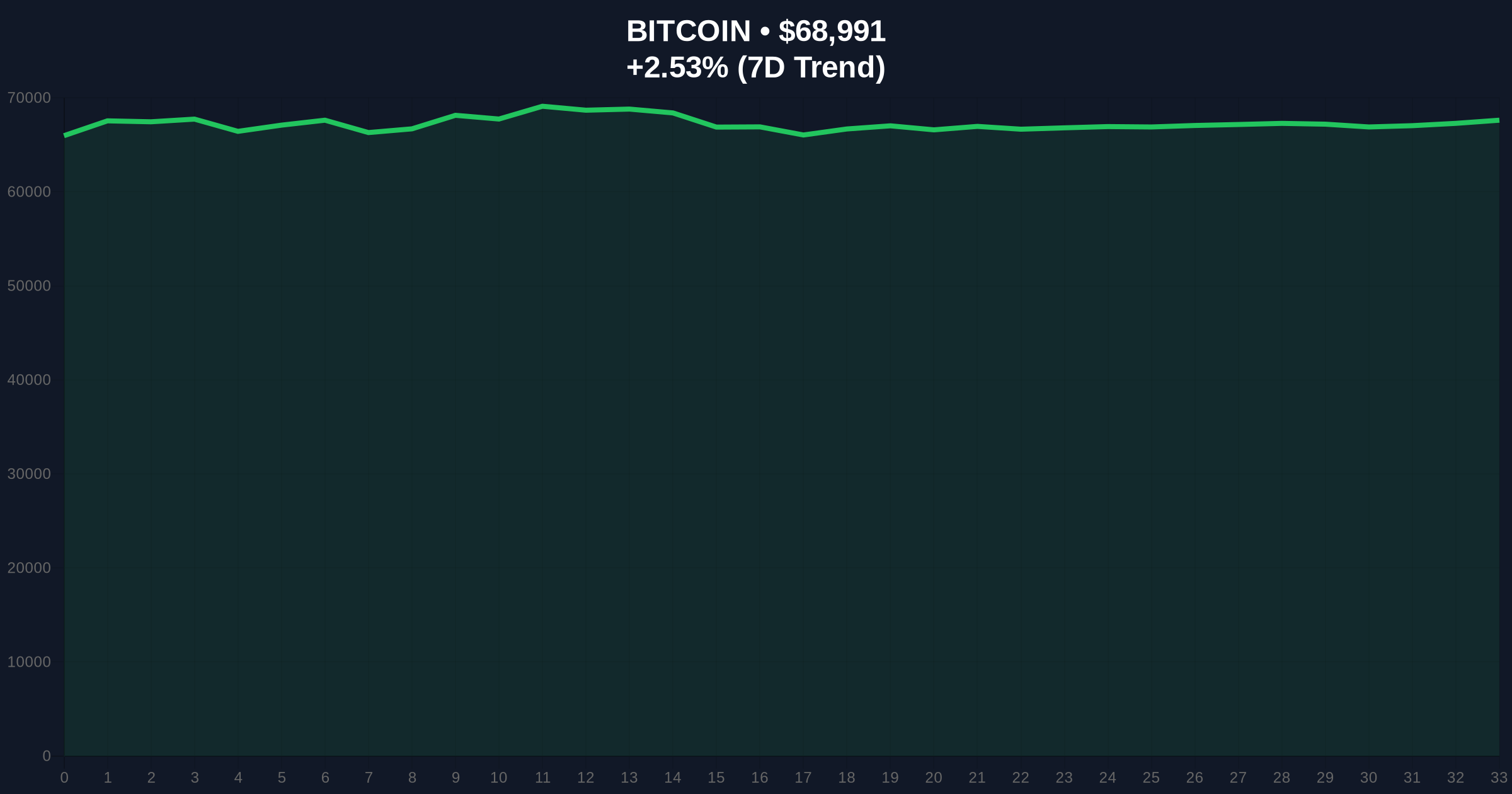
On April 6, 2026, crypto analyst Murphy (@Murphychen888) stated on X that Bitcoin is unlikely to fall to $46,800, a price level historically associated with bear market bottoms. This analysis challenges traditional market cycle patterns, suggesting the current phase may diverge from past downturns. With Bitcoin trading at $68,973 amid "Extreme Fear" sentiment, the report raises questions about whether this cycle will be the least painful bear market on record, impacting investor expectations and risk assessments.
The analyst's assessment hinges on two key metrics: the average cost basis for Bitcoin addresses currently holding at a loss is $93,600, and the price needed to match bottoming conditions from the last three bear markets is $46,800. However, Murphy believes this cycle will break from historical patterns, potentially avoiding such a steep decline. Current market data shows Bitcoin at $68,973 with a 24-hour trend of 2.49%, while global crypto sentiment scores 12/100, indicating "Extreme Fear."
| Metric | Value | Source |
|---|---|---|
| Average Cost Basis (Loss-Holding Addresses) | $93,600 | Source: public statement |
| Historical Bottom Price Target | $46,800 | Source: public statement |
| Current Bitcoin Price | $68,973 | Source: CoinGecko |
| 24-Hour Trend | 2.49% | Source: CoinGecko |
| Global Crypto Sentiment Score | 12/100 (Extreme Fear) | Source: CoinGecko |
This analysis matters because it challenges entrenched market narratives during a period of heightened uncertainty. Why now? With Bitcoin trading well above historical bottom levels and sentiment in "Extreme Fear," investors are grappling with whether traditional cycle models still apply. Who benefits? If Murphy's view holds, long-term holders and institutions avoiding panic selling could benefit, while traders betting on a deep downturn may face losses. Time horizons: In the short term, this could reduce selling pressure as investors reassess downside risks; longer-term, it may signal a structural shift in Bitcoin's market behavior. The causal chain is: analyst's divergence claim → reduced expectation of $46.8K drop → potential stabilization in investor psychology → less aggressive selling → price support above historical lows.
The mechanism underlying this analysis involves on-chain cost basis dynamics and market psychology. Murphy notes that the average cost basis for loss-holding addresses dropped to $93,600 due to sell-offs during downturns in late last year and early this year. This mechanical reduction occurred as some addresses realized losses, lowering the aggregate cost basis for remaining holders. Consequently, the threshold for extreme pain, historically around $46,800, may no longer be necessary to flush out weak hands, as many have already exited. This changes the supply-demand balance, potentially creating a higher floor for Bitcoin prices.
Bitcoin's potential divergence from past bear markets contrasts with broader crypto trends. While Murphy focuses on Bitcoin's unique cycle, other assets face distinct pressures:
This comparison that Bitcoin's trajectory may increasingly decouple from altcoins and external shocks.
Despite Murphy's optimistic outlook, several risks could invalidate this narrative. The analysis relies on a single analyst's perspective without broader consensus or extensive data validation. Key uncertainties include:
The failure condition would be Bitcoin breaking below key support levels and approaching $46,800, contradicting Murphy's prediction and reigniting bearish sentiment.
If Bitcoin avoids the $46,800 drop, this could redefine bear market benchmarks, leading to adjusted risk models for traders and institutions. In the near term, watch for whether on-chain data confirms reduced selling pressure and if sentiment shifts from "Extreme Fear." This scenario might encourage more accumulation at current levels, setting the stage for a less volatile recovery phase.
Historically, Bitcoin bear markets have seen prices fall to levels that test the average cost basis of loss-holding addresses, often around 50-70% below cycle highs. The last three bottoms established $46,800 as a psychological and technical benchmark. Murphy's analysis suggests that structural changes, including earlier sell-offs and evolving holder demographics, may have altered this pattern, making past comparisons less reliable.
Amid this analysis, other market developments provide context. For instance, Ant Digital launched a crypto payment platform for AI agents, reflecting continued innovation despite fear sentiment. Additionally, Cambodia's proposed crackdown on crypto scammers signals regulatory maturation that could influence market stability. These events highlight a complex where Bitcoin's cycle may be influenced by both internal dynamics and external factors.
Murphy's report challenges conventional wisdom by suggesting Bitcoin may not revisit historical bear market lows. While this offers hope for a less painful downturn, it requires cautious interpretation given market uncertainties. Investors should monitor on-chain metrics and sentiment indicators to validate or refute this emerging narrative.
Evidence & Sources
Primary source: https://coinness.com/news/1153644
Updated at: Apr 06, 2026, 01:42 AM
Data window: Apr 06, 2026, 01:40 AM → Apr 06, 2026, 01:41 AM
Evidence stats: 5 metrics, 0 timeline points.
Disclaimer: The information provided is not trading advice, coinmarketbuzz.com holds no liability for any investments made based on the information provided on this page. We strongly recommend independent research and/or consultation with a qualified professional before making any investment decisions.
All published reports are reviewed by our editorial team for factual consistency, neutrality, and reader clarity.