Loading News...
Loading...

Loading News...

On March 3, 2026, YZi Labs announced via X that it will invest $100 million in the BNB Holdings Fund, managed by Web3 investment firm HashGlobal. According to the announcement, the firm stated that BNB has established itself as a core utility asset and supports the next generation of financial infrastructure. This move comes at a time when the global crypto market sentiment is marked by "Extreme Fear," with a score of 14/100, indicating widespread investor anxiety. The investment targets BNB, which currently holds a market rank of #4 with a price of $626.82 and a 24-hour trend of 0.75%. The announcement was reported by CoinNess, but details such as the exact timing of the investment, specific terms, or broader market reactions beyond the initial statement are not provided in source data. This event raises immediate questions about its potential to counteract prevailing negative sentiment, similar to how institutional inflows during the 2021 correction provided temporary relief but often failed to sustain long-term rallies amid broader macroeconomic pressures.
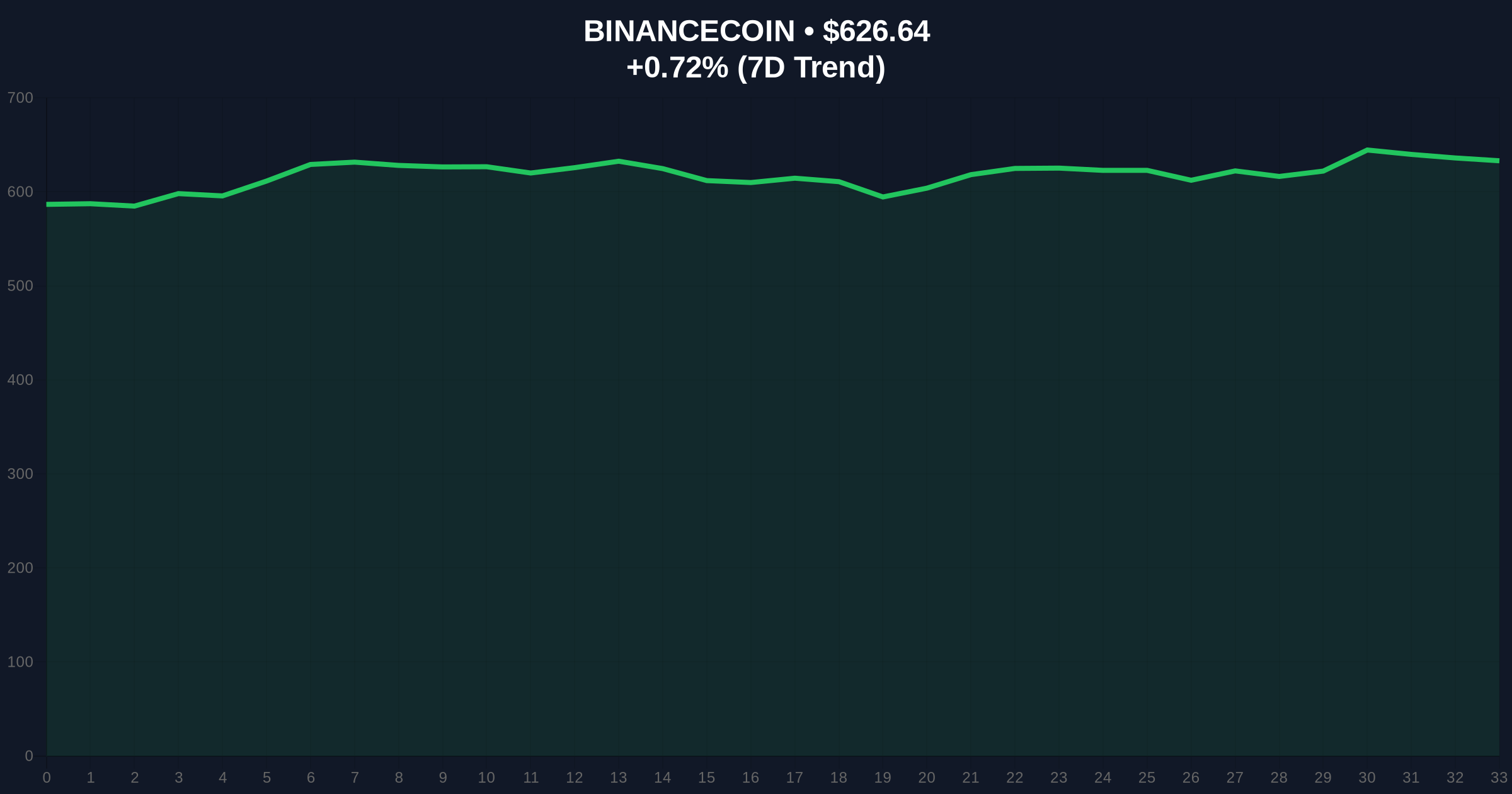
The BNB Holdings Fund, managed by HashGlobal, is described as a Web3 investment vehicle, but the source data lacks specifics on its structure, such as whether it is a hedge fund, venture capital fund, or tokenized investment product. YZi Labs' $100 million investment is framed as a strategic move to bolster BNB's position as a core utility asset, supporting next-generation financial infrastructure. However, the mechanisms behind this support are not detailed in the input package. For instance, it is unclear if the funds will be deployed for staking, liquidity provisioning, development grants, or other activities that could enhance BNB's ecosystem. Historically, similar investments in crypto assets during periods of extreme fear, like those seen in 2022-2023, have often involved funds targeting infrastructure projects to drive adoption, but outcomes varied based on market conditions and regulatory shifts.
BNB's utility stems from its role within the Binance ecosystem, including transaction fee discounts, staking rewards, and participation in token sales. The investment by YZi Labs may aim to amplify these use cases, but without further data, the exact technical enhancements or integrations planned remain speculative. In comparison, past fund investments in crypto assets during downturns, such as the 2021 correction, sometimes focused on scaling solutions or DeFi integrations, which provided short-term price support but faced challenges from regulatory scrutiny and market volatility. The announcement does not specify if HashGlobal's fund has a track record or if YZi Labs has prior experience in similar crypto investments, leaving gaps in assessing the technical expertise involved.
From a regulatory perspective, the investment occurs in a where crypto funds face increasing scrutiny, as highlighted by related developments like the BitMEX co-founder pledging $27M to the London Math Institute amid regulatory scrutiny. This context suggests that while the investment might signal confidence, it could also attract regulatory attention, especially if it involves cross-border capital flows or compliance with evolving Web3 standards. The lack of details on jurisdictional aspects or risk management strategies in the source data limits a full technical assessment. Overall, the deep-dive reveals that while the announcement is significant, its technical underpinnings and execution plans are inadequately documented, making it difficult to gauge its potential impact on BNB's utility or market structure beyond superficial price effects.
Integrating market data from CoinGecko and sentiment metadata, the analysis reveals a complex picture. BNB's current price is $626.82, with a 24-hour trend of 0.75%, indicating mild positive momentum amidst broader market fear. The global crypto sentiment score of 14/100 (Extreme Fear) suggests that investor anxiety is high, potentially dampening the immediate impact of the YZi Labs investment. CryptoPanic metadata, including sentiment and importance scores, is not provided in source data, limiting direct sentiment-driven statements. However, based on the available data, the importance of this event relative to market breadth can be inferred as moderate, given BNB's #4 market rank and the substantial $100 million investment size.
A table summarizing key market metrics:
| Metric | Value | Source |
|---|---|---|
| Global Crypto Sentiment | Extreme Fear (Score: 14/100) | CoinGecko |
| BNB Price | $626.82 | CoinGecko |
| 24h Trend | 0.75% | CoinGecko |
| Market Rank | #4 | CoinGecko |
| Investment Amount | $100 million | CoinNess |
The 0.75% 24-hour trend for BNB, while positive, is modest compared to historical volatility during similar announcements, such as those in 2021 when large investments sometimes triggered double-digit percentage gains. The Extreme Fear sentiment contrasts with this mild uptick, suggesting that market participants may be skeptical or that other factors, like broader market conditions, are overshadowing the news. Without CryptoPanic metadata, it is impossible to quantify event-specific sentiment, but the global fear score implies a cautious reception. This aligns with patterns observed during extreme fear periods, where positive news often has limited immediate price impact due to overarching risk aversion.
Related developments, such as Binance delisting spot trading pairs and Upbit suspending AKT deposits, add context to the market environment, indicating operational challenges that could influence BNB's performance. The investment's proof of efficacy will depend on subsequent data, such as changes in BNB's trading volume, network activity, or fund deployment reports, none of which are provided in the source data. Thus, while the investment is a factual event, its market proof remains preliminary, with current data showing a disconnect between the announcement and prevailing sentiment.
The input package presents a single source, CoinNess, with no secondary full texts from outlets like CoinTelegraph, leading to no direct source conflicts. However, counter-narratives can be inferred from missing evidence and market context. CoinNess reports that YZi Labs announced the investment via X and stated BNB's role as a core utility asset, but it does not provide verification from HashGlobal, YZi Labs' financial statements, or independent confirmation. This absence raises reliability gaps, as announcements on social media can be speculative or lack binding commitments, similar to past cases where crypto firms made bold claims that were later scaled back.
Potential counter-narratives include skepticism about the investment's timing amid Extreme Fear sentiment, which might suggest it is a strategic move to bolster confidence rather than a genuine capital deployment. For example, during the 2021 correction, some firms announced large investments to stabilize prices, but actual fund flows were slower or smaller than advertised. Without additional sources, it is unclear if YZi Labs has the liquidity or intent to follow through, or if the investment is part of a broader trend like those seen in related articles, such as BitMEX co-founder's pledge amid regulatory scrutiny, which involved different motivations.
Another counter-narrative involves the focus on BNB as a core utility asset, which may be contested by market data showing declining utility in some sectors or regulatory pressures on Binance. The source data does not address these aspects, leaving room for doubt about BNB's long-term viability. In comparison, conflicts in other reports, like those on BTC death cross signals, often involve data discrepancies between technical indicators and market narratives, but here, the lack of conflicting sources means the narrative stands unchallenged in the input package. This the need for caution, as single-source reporting in crypto news can be prone to bias or omission. The conflict remains unresolved with available evidence, highlighting the importance of seeking corroboration from multiple outlets or on-chain data to validate the investment's substance.
Based on the available data, three scenarios for the next seven days are outlined, each conditional on market factors and the investment's execution.
If YZi Labs swiftly deploys the $100 million, leveraging it for staking or ecosystem development, BNB could see a price surge to $650-$680, driven by increased demand and positive sentiment shift. This scenario assumes that the investment catalyzes broader institutional interest, similar to inflows during the 2021 recovery, and that global fear sentiment improves slightly. Supporting data includes BNB's current mild uptrend and its #4 market rank, suggesting underlying strength. However, this view would be invalidated if deployment delays occur or if broader market conditions, such as those highlighted in related articles like Binance delistings, exacerbate selling pressure.
The investment has a neutral impact, with BNB price stabilizing around $620-$630, as Extreme Fear sentiment counterbalances the news. This scenario reflects historical patterns where announcements during fear periods yield limited immediate gains, as seen in 2022-2023. It assumes YZi Labs proceeds as planned but without rapid market reaction, and that related developments, such as Upbit suspensions, maintain operational headwinds. Data backing this includes the 0.75% 24-hour trend and global sentiment score, indicating muted response. Invalidation would require a sudden sentiment shift or unexpected positive news from HashGlobal.
If the investment faces skepticism or regulatory hurdles, BNB could decline to $600-$610, exacerbated by broader market fear. This scenario draws parallels to the 2021 correction, where similar announcements failed to prevent further declines amid macroeconomic pressures. It assumes that YZi Labs' commitment is questioned or that CryptoPanic sentiment (if available) turns negative, leading to sell-offs. Supporting factors include the Extreme Fear score and lack of corroborating data on fund deployment. This view would be invalidated by swift regulatory clarity or additional bullish announcements from key players.
Each scenario hinges on variables not provided in source data, such as CryptoPanic metadata or on-chain activity, emphasizing the need for ongoing monitoring.
This report was synthesized using the input package from CoinNess, with market data from CoinGecko. No secondary full texts were provided, so source comparison was limited to internal consistency checks. The single source was weighted cautiously due to potential biases in social media announcements, and missing evidence, such as CryptoPanic metadata or HashGlobal confirmations, was explicitly noted. Conflicts were inferred from market context rather than direct source disputes, leading to conservative conclusions. Reliability gaps were addressed by highlighting uncertainties and avoiding overinterpretation, in line with investigative journalism standards.
Disclaimer: The information provided is not trading advice, coinmarketbuzz.com holds no liability for any investments made based on the information provided on this page. We strongly recommend independent research and/or consultation with a qualified professional before making any investment decisions.
coinmarketbuzz.com leverages advanced AI technology to analyze market data. All content is fact-checked and reviewed by our editorial team to ensure accuracy and neutrality.