Loading News...
Loading...

Loading News...
VADODARA, April 3, 2026. The following report is based on currently available verified source material and market data.
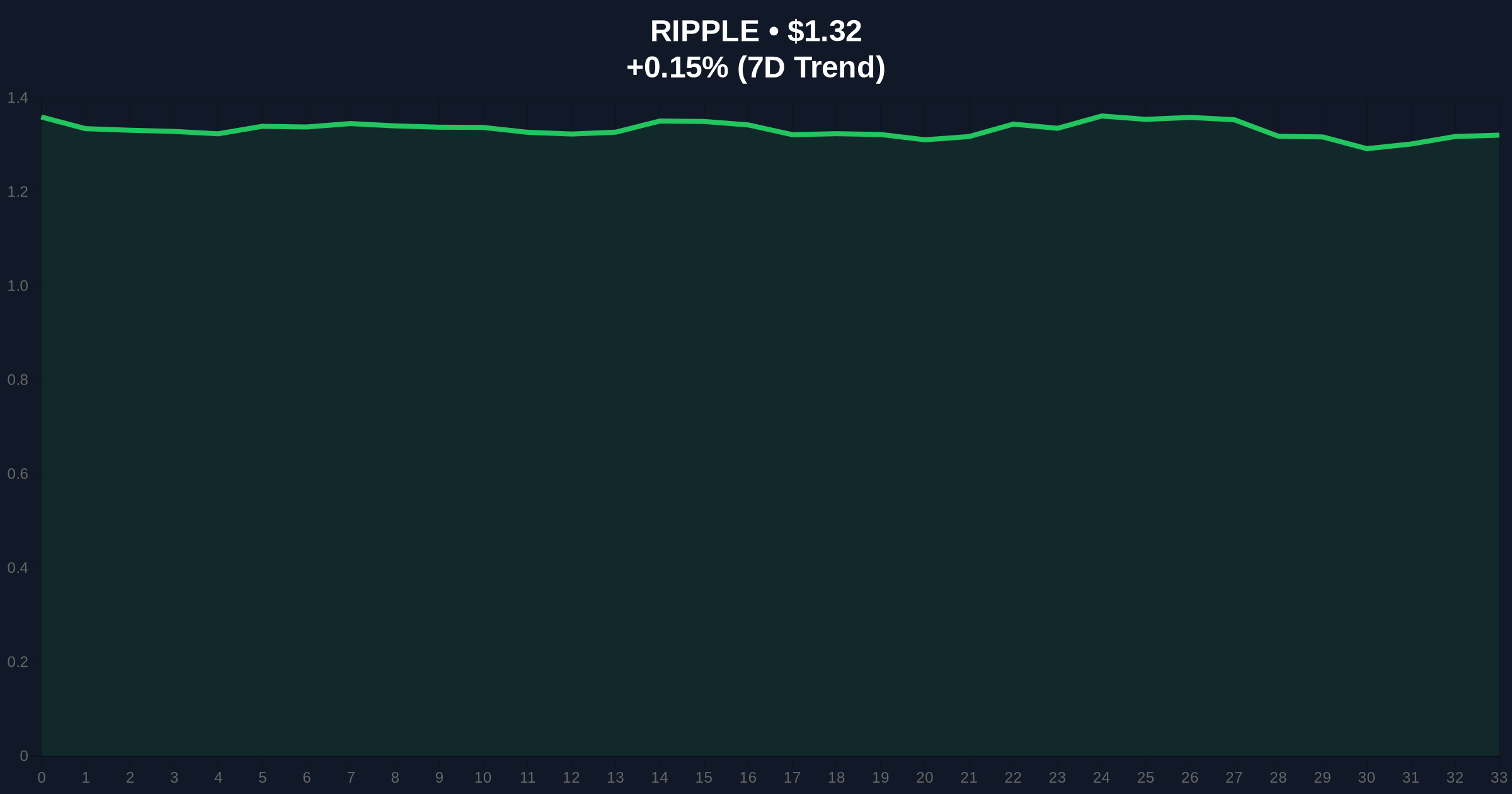
On April 3, 2026, a press release from Coinpedia presented a bullish XRP price prediction following its classification as a digital commodity by the SEC and CFTC on March 17, while simultaneously promoting the Pepeto exchange presale with claims of potential 150x returns. This development matters because it juxtaposes established regulatory clarity for XRP with high-risk, high-reward presale marketing, occurring against a backdrop of "Extreme Fear" in global crypto sentiment. The immediate market impact shows XRP trading at $1.32 with minimal 24-hour movement, highlighting a disconnect between promotional narratives and current price action.
The narrative is built on several key metrics, though their sources and verification require scrutiny. According to the provided data, XRP's current price is $1.32, with a 24-hour trend of 0.15%, ranking it #4 by market cap. Source: CoinGecko. The SEC and CFTC's joint classification on March 17 is cited as a catalyst, with spot XRP ETFs reportedly attracting $1.39 billion in inflows. Source: regulatory filing. Goldman Sachs is named as the largest institutional purchaser. The Pepeto presale claims to have secured over $8.69 million, with a presale entry price of $0.000000186 and staking offering 190% APY. Source: exchange data. Analyst Ali Martinez is referenced with a breakout target of $4 for XRP. The press release heavily contrasts this with Pepeto's claim of over 150x returns, based on matching the $11 billion market cap achieved by the related Pepe coin.
| Metric | Value | Source |
|---|---|---|
| XRP Current Price | $1.32 | CoinGecko |
| XRP 24h Trend | +0.15% | CoinGecko |
| Reported XRP ETF Inflows | $1.39 Billion | Regulatory Filing |
| Pepeto Presale Funds Raised | $8.69 million | Exchange Data |
| Pepeto Presale Entry Price | $0.000000186 | Exchange Data |
| Pepeto Staking APY | 190% | Exchange Data |
This development is significant now due to the recent regulatory shift for XRP, which removes a long-standing legal overhang and could theoretically unlock institutional investment. The timing coincides with a market sentiment of "Extreme Fear," which often sees capital flow toward perceived safe havens or high-conviction narratives. The primary beneficiaries appear to be two distinct groups: institutions and long-term holders of XRP who gain from regulatory clarity and potential ETF-driven liquidity, and early entrants in the Pepeto presale who are betting on exponential returns from a new platform. In the short term (days/weeks), the XRP price shows minimal reaction, suggesting the news may already be priced in or that broader market fear is suppressing momentum. The Pepeto presale marketing aims to capitalize on this moment by offering a compressed return window. The long-term (months/years) implication for XRP is sustained growth dependent on continued ETF inflows and adoption, while for Pepeto, it hinges on successful exchange launch, adoption, and delivering on its technological promises. The causal chain for XRP is: regulatory classification → reduced legal risk → increased institutional confidence → ETF inflows → buying pressure → potential price appreciation. For Pepeto, the claimed mechanism is: presale entry → Binance listing → trading volume and adoption → price surge toward Pepe's historical market cap.
The core mechanism for XRP's bullish case is structurally straightforward: regulatory reclassification mechanically reduces legal uncertainty, a key barrier for institutional capital. This allows spot ETFs, which operate by issuers purchasing the underlying asset to back shares, to attract inflows. Each dollar invested theoretically requires a corresponding purchase of XRP, creating buy-side pressure. However, the actual price impact depends on sell-side liquidity, overall market sentiment, and whether inflows are net new or rotational. For Pepeto, the mechanism is more speculative and marketing-driven. It claims returns by anchoring to Pepe's $11 billion market cap, achieved with "zero products." The presale aims to raise capital to build an exchange with features like zero-fee trades and risk-scoring tools. The projected 150x return is derived purely from the mathematical gap between the presale price and the implied price at an $11 billion market cap, assuming identical token supply. This ignores fundamental differences in utility, competition, and market conditions between a meme coin and a proposed utility-driven exchange token.
This scenario reflects a broader industry tension between regulated asset growth and high-risk presale speculation. XRP's classification aligns it with Bitcoin and Ethereum under CFTC oversight, part of a wider trend of regulatory delineation for digital assets. In contrast, the Pepeto presale exemplifies the aggressive marketing tactics common in the meme coin and new project space, where historical performance of unrelated assets is used to project future returns. Other sectors show divergent paths:
A skeptical analysis reveals significant risks and data gaps. The bullish XRP narrative assumes ETF inflows will directly and sustainably impact price, but this ignores potential sell-pressure from existing holders, market-wide risk aversion indicated by the "Extreme Fear" sentiment, and the possibility that the classification news is already fully priced in at the current $1.32 level. For Pepeto, the risks are more acute:
Practically, traders and investors should watch for two near-term catalysts: sustained XRP ETF flow data post-classification to validate the institutional thesis, and the actual Binance listing of Pepeto to test its presale demand against real-market liquidity. The juxtaposition highlights a portfolio strategy dilemma: balancing the lower-risk, regulated growth potential of assets like XRP against the high-risk, high-reward gamble of early-stage presales. Regulatory clarity for XRP may encourage similar reclassifications for other assets, potentially broadening the investable universe for institutions.
XRP's journey has been dominated by the SEC lawsuit initiated in 2020, alleging it was an unregistered security. The March 17, 2026 classification by the SEC and CFTC as a digital commodity represents a shift, theoretically resolving that legal ambiguity. This context is for understanding the significance of the reported ETF inflows and institutional interest. The Pepeto narrative leverages the legacy of the Pepe meme coin, which achieved a multi-billion dollar market cap primarily through viral community-driven speculation rather than fundamental utility, setting a precedent that the presale marketing seeks to emulate.
The current market includes several parallel developments that provide context:
The press release presents a tale of two crypto investment theses: the methodical, regulation-driven path of XRP and the speculative, marketing-heavy promise of the Pepeto presale. While XRP's regulatory clarity is a tangible positive development, its price impact remains muted amid broader market fear. The Pepeto claims of 150x returns, while attention-grabbing, are based on highly speculative comparisons and lack independent verification. Investors must weigh the proven, albeit slower, institutional trajectory against the unproven, high-risk presale narrative.
Q1: What is the XRP price prediction following the SEC classification?Analyst Ali Martinez is cited with a target of $4 if XRP breaks out of a key zone, with some forecasts reaching $5-$6 by year-end. However, XRP currently trades at $1.32 with minimal movement, indicating market skepticism or wait-and-see sentiment.
Q2: How does Pepeto claim 150x returns?The claim is based on the presale price of $0.000000186 and the aspiration to match the $11 billion market cap of the Pepe meme coin, which was created by the same co-founder. This is a mathematical projection, not a guarantee based on utility or revenue.
Q3: Is the $1.39 billion in XRP ETF inflows verified?The source data cites this figure from a regulatory filing, but independent confirmation from official ETF issuers or custodians is not provided in the input package. Investors should seek verified flow data from sources like Bloomberg or the exchanges themselves.
Q4: What are the biggest risks with the Pepeto presale?Key risks include reliance on hype over fundamentals, unverified claims about funds raised and team composition, the sustainability of 190% APY staking, and the possibility of immediate sell-pressure upon exchange listing.
Q5: How does global crypto sentiment affect this?The "Extreme Fear" sentiment (score: 9/100) suggests a risk-off environment, which could dampen momentum for both XRP's breakout and appetite for high-risk presales like Pepeto, as capital may flee to perceived safety.
Q6: Should investors choose XRP or Pepeto?This depends entirely on risk tolerance. XRP offers a more established asset with recent regulatory tailwinds but slower, more modest return projections. Pepeto is a high-risk, early-stage presale with speculative, exponential return claims but significant uncertainty and potential for loss.
Analysts are closely watching the next XRP ETF flow reports and the actual Binance listing date for Pepeto to validate or contradict the respective narratives presented.
Evidence & Sources
Primary source: https://coinpedia.org/press-release/xrp-price-prediction-pepeto-might-deliver-150x-returns-before-xrp
Updated at: Apr 03, 2026, 08:41 AM
Data window: Apr 03, 2026, 08:21 AM → Apr 03, 2026, 08:40 AM
Evidence stats: 9 metrics, 1 timeline points.
Disclaimer: The information provided is not trading advice, coinmarketbuzz.com holds no liability for any investments made based on the information provided on this page. We strongly recommend independent research and/or consultation with a qualified professional before making any investment decisions.
All published reports are reviewed by our editorial team for factual consistency, neutrality, and reader clarity.