Loading News...
Loading...

Loading News...

VADODARA, April 2, 2026. The following report is based on currently available verified source material and market data.
Trump's Iran Stance Triggers Bitcoin Sell-Off, While STO, NOM, ONT Defy Market Downturn developed into a market-moving story within the reported window. The initial source indicates immediate relevance for crypto sentiment, while fuller validation is still tied to cited datasets and official statements.
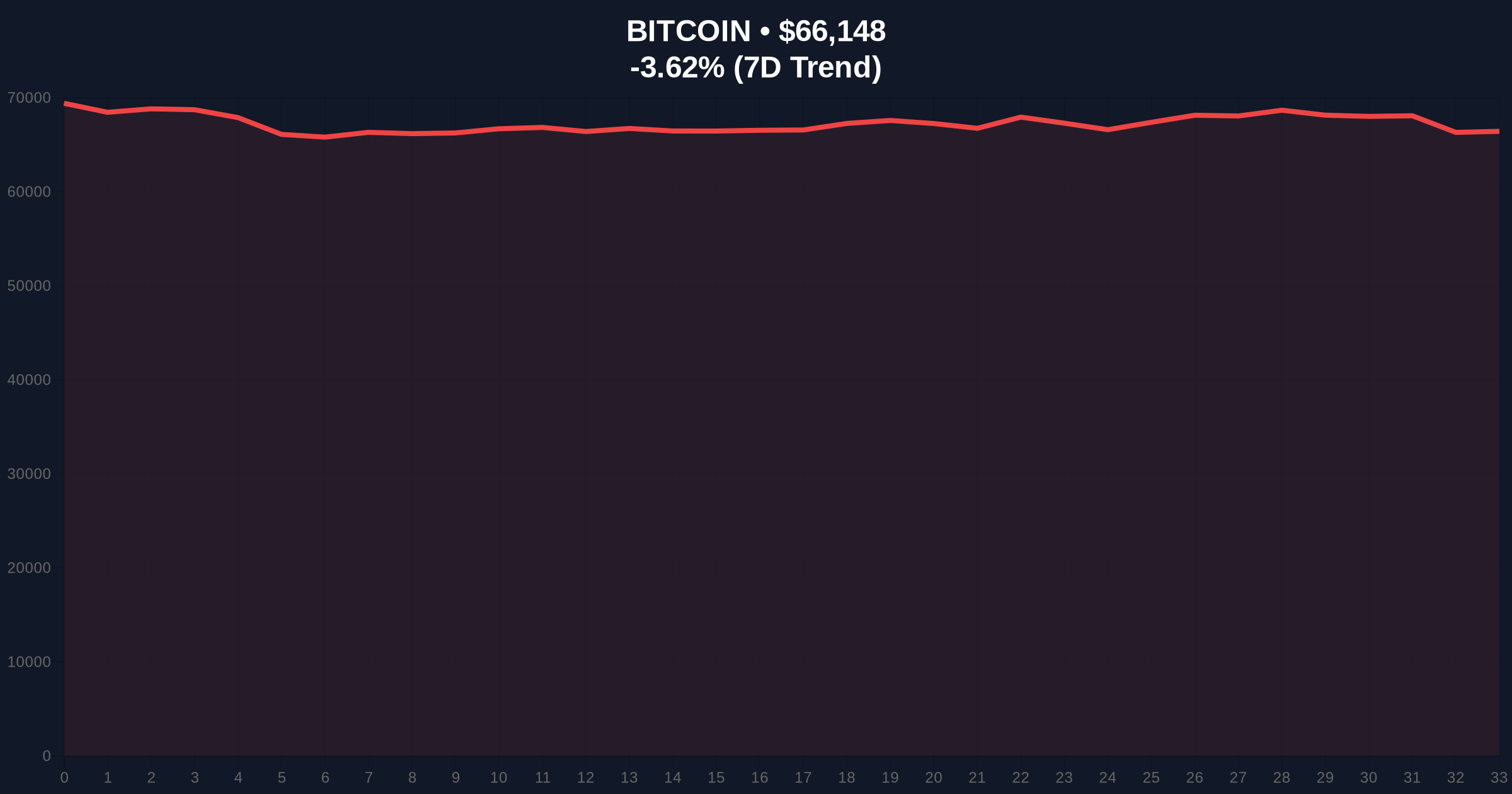
On April 2, 2026, Bitcoin (BTC) dropped sharply to $66,000, erasing gains from earlier in the week, following President Donald Trump's reported shift toward a harder stance on Iran. The BTC price fell 3.24% over 24 hours with negative volume, reflecting heightened geopolitical risk aversion. Concurrently, select altcoins like STO, NOM, and ONT posted significant gains, driven by organic catalysts and technical breakouts, highlighting a divergent market response amid broader crypto fear.
Bitcoin's decline was marked by key technical failures and sentiment shifts. According to CoinGecko data, BTC's current price is $66,158, with a 24-hour trend of -3.61%. The global crypto sentiment is "Extreme Fear" with a score of 12/100. Technical analysis from the source indicates Bitcoin failed to break above the $71,985 resistance (a 61.8% Fibonacci retracement) and declined to near $65,030, with another hard ceiling at $69,200. A rising channel breakout occurred near $67,200, and Bitcoin is trading below the SMA 100 value. In contrast, altcoins showed resilience: STO surged 226% in 24 hours to $0.8404, NOM rose 65% to $0.01031, and ONT gained 11.17% to $0.1164.
| Asset | Price | 24h Change | Key Level |
|---|---|---|---|
| Bitcoin (BTC) | $66,158 | -3.61% | Support: $64,200 |
| STO | $0.8404 | +226% | Target: $1.2 |
| NOM | $0.01031 | +65% | Range: $0.010-$0.012 |
| ONT | $0.1164 | +11.17% | Support: $0.104 |
Source: CoinGecko, public statement.
This event matters due to its timing amid geopolitical tensions and market structure shifts. Why now? The market is sensitive to geopolitical headlines, with Bitcoin acting as a risk-off asset when war news escalates, similar to past corrections during global crises. Who benefits? Short-term traders may capitalize on volatility, while altcoin holders in STO, NOM, and ONT see gains from specific catalysts; however, long-term investors face uncertainty from macro risks. Time horizons: In the short term (days/weeks), Bitcoin's price could test lower supports if fear persists, while altcoins may see continued momentum if catalysts hold. Over the longer term (months/years), regulatory and macro developments will dictate broader crypto adoption. Causal chain: Trump's stance → increased geopolitical risk → Bitcoin sell-off due to its correlation with traditional risk assets → capital rotation into niche altcoins with strong fundamentals → divergent performance within the crypto market.
The market mechanism involves a liquidity and sentiment-driven cascade. For Bitcoin, the initial trigger was Trump's geopolitical shift, which mechanically works by increasing perceived global risk, leading traders to reduce exposure to volatile assets like crypto. This caused selling pressure, with Bitcoin failing at key technical resistances (e.g., $71,985 Fibonacci level), resulting in a breakdown below the SMA 100 and rising channel support near $67,200. The immediate effect was a 3.24% price drop and negative volume, indicating bearish momentum. For altcoins like STO, NOM, and ONT, the mechanism differs: STO's surge is driven by its launch as an ETH/BTC staking platform, attracting speculative capital; NOM gains despite delisting news due to accumulation phases; and ONT benefits from partnership news with European officials, creating bullish technical breakouts above Ichimoku clouds.
The bearish scenario presents several risks that could invalidate the current narrative. Uncertainty exists due to missing data on whale activity specifics and institutional responses. Key risks include:
Failure conditions: The assumed mechanism breaks if Bitcoin's correlation with risk assets decouples or if altcoin volumes dry up unexpectedly.
Practically, traders should monitor Bitcoin's support levels and altcoin volume trends. Near-term, if Bitcoin holds above $64,200, a consolidation phase may occur, while altcoins like ONT could test $0.12 if channel breakouts sustain. Regulatory and partnership developments will be critical for altcoin longevity.
Historically, Bitcoin has shown sensitivity to geopolitical events, often reacting to headlines with sharp price moves. This pattern is reminiscent of its behavior during past conflicts, where it served as a digital gold alternative amid uncertainty. The current "Extreme Fear" sentiment score of 12/100 market caution, similar to periods like early 2022 when crypto faced macro headwinds.
Cross-market reactions include increased risk-off behavior in traditional assets, though specific data is not provided in source data. Related articles discuss broader crypto trends, such as market tumbles linked to oil surges, which align with the current risk-averse environment.
In summary, Trump's geopolitical shift triggered a Bitcoin sell-off, highlighting crypto's sensitivity to macro risks, while altcoins STO, NOM, and ONT demonstrated resilience through specific catalysts. The market remains in "Extreme Fear," with technical levels dictating near-term direction.
What to watch next: BTC price today dropped 3.24% over...; BTC price today dropped 3.24% over 24 hours, with negative volume..
Evidence & Sources
Primary source: https://coinpedia.org/price-analysis/trumps-extremely-hard-hits-hard-on-bitcoin-but-some-altcoins-make-it-through
Updated at: Apr 02, 2026, 04:19 PM
Data window: Apr 02, 2026, 02:10 PM → Apr 02, 2026, 02:18 PM
Evidence stats: 9 metrics, 3 timeline points.
Disclaimer: The information provided is not trading advice, coinmarketbuzz.com holds no liability for any investments made based on the information provided on this page. We strongly recommend independent research and/or consultation with a qualified professional before making any investment decisions.
All published reports are reviewed by our editorial team for factual consistency, neutrality, and reader clarity.