Loading News...
Loading...

Loading News...
VADODARA, April 8, 2026. The following report is based on currently available verified source material and market data.
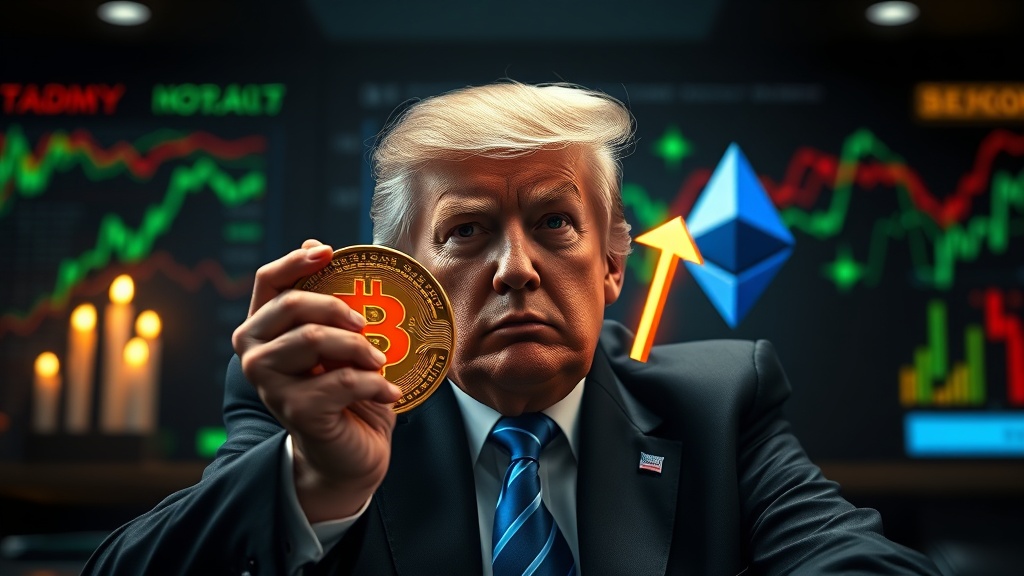
On April 8, 2026, U.S. President Donald Trump announced a policy to impose an immediate 50% tariff on all exports to the United States from any country supplying military weapons to Iran, with no exceptions or exemptions. This geopolitical development emerges as the crypto market grapples with "Extreme Fear" sentiment, with Bitcoin trading at $71,592, up 4.83% in 24 hours. The announcement injects uncertainty into global trade and financial markets, potentially impacting risk assets like cryptocurrencies through macro-economic channels.
The announcement centers on a 50% tariff, a significant trade barrier that could disrupt international commerce. Concurrent market data shows Bitcoin at $71,592, reflecting a 4.83% 24-hour gain, while the global crypto sentiment score stands at 17/100, indicating "Extreme Fear." The exact timing of the tariff implementation is not provided in source data, leaving a critical gap in understanding its immediate operational timeline.
| Metric | Value | Source |
|---|---|---|
| Tariff Rate | 50% | Source: public statement |
| Bitcoin Price | $71,592 | Source: CoinGecko |
| Bitcoin 24h Change | +4.83% | Source: CoinGecko |
| Crypto Sentiment Score | 17/100 (Extreme Fear) | Source: CoinGecko |
Why now? This tariff threat arrives during a period of heightened geopolitical tensions and market volatility, as evidenced by the Extreme Fear sentiment. Such announcements can trigger risk-off behavior, where investors flee volatile assets like cryptocurrencies for safer havens, though Bitcoin's recent price rise suggests a complex reaction.
Who benefits? In the short term, traders might capitalize on volatility spikes, while nations not involved in arms trade with Iran could see competitive advantages. Conversely, countries targeted by the tariff face economic strain, and crypto markets may experience indirect pressure from broader financial instability.
Time horizons: Short-term (days/weeks) impacts include potential market jitters and increased trading volume as participants react to news. Longer-term (months/years) implications depend on enforcement and diplomatic responses, which could reshape trade alliances and influence crypto adoption as an alternative asset during geopolitical strife.
Causal chain: The mechanism links geopolitical action to market psychology: tariff announcement → increased global trade uncertainty → risk aversion among investors → potential capital rotation away from or toward crypto as a hedge → price volatility and sentiment shifts.
The tariff functions as a punitive trade measure, mechanically increasing the cost of exports from affected countries to the U.S. by 50%. This reduces the competitiveness of those goods, potentially leading to decreased trade volumes, economic slowdowns in targeted nations, and ripple effects through global supply chains. For crypto markets, the impact is indirect: such geopolitical events can alter investor risk appetite, influencing capital flows into or out of digital assets. The Extreme Fear sentiment score of 17/100 indicates a market already prone to negative reactions, which could amplify volatility if the tariff leads to broader financial instability.
This development contrasts with other recent crypto news, highlighting diverse market influences:
The bullish narrative assumes the tariff will significantly impact markets, but several risks could invalidate this:
Failure conditions include diplomatic resolutions that soften the tariff or investor indifference due to crypto's niche status.
In the near term, traders should monitor for increased volatility and potential correlations between crypto prices and traditional safe-haven assets. If enforced, the tariff could spur discussions on crypto as a geopolitical hedge, though its practical role remains untested. Regulatory attention may shift toward how digital assets interact with trade policies.
Historically, U.S. tariffs have been used as tools of foreign policy, often impacting global markets. In crypto, such events are part of a broader narrative where digital assets react to macro-economic shifts, though their response can be unpredictable due to the market's relative youth and speculative nature.
Contextual links to other articles include:
Trump's tariff threat adds a layer of geopolitical risk to an already fearful crypto market, with mechanisms that could influence investor behavior through trade disruptions. However, limited data and market resilience suggest cautious interpretation is warranted.
Q1: What is the 50% tariff about?It's a U.S. policy to impose a 50% tariff on exports from countries supplying military weapons to Iran, announced by President Trump on April 8, 2026.
Q2: How does this affect cryptocurrencies?Indirectly, by increasing global trade uncertainty, which can shift investor risk appetite and potentially impact crypto prices through macro-economic channels.
Q3: What is the current crypto market sentiment?Extreme Fear, with a score of 17/100, as per CoinGecko data.
Q4: When will the tariff be implemented?Not provided in source data; the timeline remains unclear.
Q5: Which countries are targeted?Not specified in the announcement; it applies to any country arming Iran.
Q6: How does Bitcoin's price relate to this news?Bitcoin is at $71,592, up 4.83%, showing a complex reaction that may not align directly with fear sentiment.
Analysts are watching for enforcement details and market correlations to gauge the tariff's real impact on crypto volatility.
What to watch next: next official follow-up statements; exchange-level volume and liquidity data.
Evidence & Sources
Primary source: https://coinness.com/news/1153962
Updated at: Apr 09, 2026, 12:13 AM
Data window: Apr 08, 2026, 01:34 PM → Apr 08, 2026, 01:37 PM
Evidence stats: 3 metrics, 0 timeline points.
Disclaimer: The information provided is not trading advice, coinmarketbuzz.com holds no liability for any investments made based on the information provided on this page. We strongly recommend independent research and/or consultation with a qualified professional before making any investment decisions.
All published reports are reviewed by our editorial team for factual consistency, neutrality, and reader clarity.