Loading News...
Loading...

Loading News...

On March 6, 2026, the Swiss supermarket chain SPAR announced it now accepts Cardano (ADA) as a payment method at 137 of its stores, marking a significant retail adoption milestone for the cryptocurrency. According to a breaking brief from CoinNess, this integration is supported by the Cardano Foundation and facilitated through DFX, a Swiss non-custodial crypto on- and off-ramp platform. Payments will be processed using "Open Crypto Pay," a cryptocurrency payment standard developed by DFX.swiss, allowing users to pay directly from their native ADA wallets in-store with real-time settlement without centralized exchange involvement. This development emerges as global crypto sentiment registers "Extreme Fear" with a score of 18/100, per market data, suggesting a potential disconnect between positive adoption news and broader market anxiety. The announcement targets enhancing ADA's utility in everyday transactions, but its impact on price and adoption remains uncertain given the current market conditions.
The integration of ADA payments at SPAR stores relies on a multi-layered technical architecture involving the Cardano blockchain, DFX's platform, and the Open Crypto Pay standard. According to the CoinNess report, DFX serves as a non-custodial on- and off-ramp, meaning it facilitates the conversion between cryptocurrencies and fiat without holding user funds, thereby reducing counterparty risk. Open Crypto Pay, developed by DFX.swiss, is described as a cryptocurrency payment standard that enables direct transactions from native wallets, such as those for ADA, to merchants. This standard likely operates through APIs or point-of-sale systems that interface with blockchain networks to verify and settle payments in real-time. The Cardano Foundation's support indicates alignment with Cardano's proof-of-stake consensus mechanism, which emphasizes scalability and low transaction costs, potentially making it suitable for retail microtransactions.
Underlying this trend is a broader push toward decentralized payment solutions amid growing regulatory scrutiny of centralized exchanges. By bypassing centralized exchanges, the setup aims to enhance privacy and reduce fees, but it also introduces complexities related to blockchain confirmation times and volatility management. For instance, real-time settlement implies that transactions are confirmed nearly instantly on the Cardano network, which requires high throughput and low latency—features Cardano has been developing through its Hydra scaling solution. However, the source data does not specify whether Hydra or other layer-2 technologies are employed in this implementation. Additionally, the non-custodial nature of DFX means users retain control of their private keys, aligning with crypto's self-sovereign ethos but potentially increasing user responsibility for security.
Comparatively, other cryptocurrencies have attempted similar retail integrations with varying success. The technical deep-dive reveals that this move by SPAR and Cardano could set a precedent for other blockchain projects seeking real-world utility, but it also highlights challenges such as merchant adoption barriers and consumer education. The lack of detailed technical specifications in the source data, such as transaction fees or integration costs, leaves gaps in understanding the full operational mechanics. Consequently, while the announcement is promising, its technical robustness and scalability in high-volume retail environments remain unverified without further evidence.
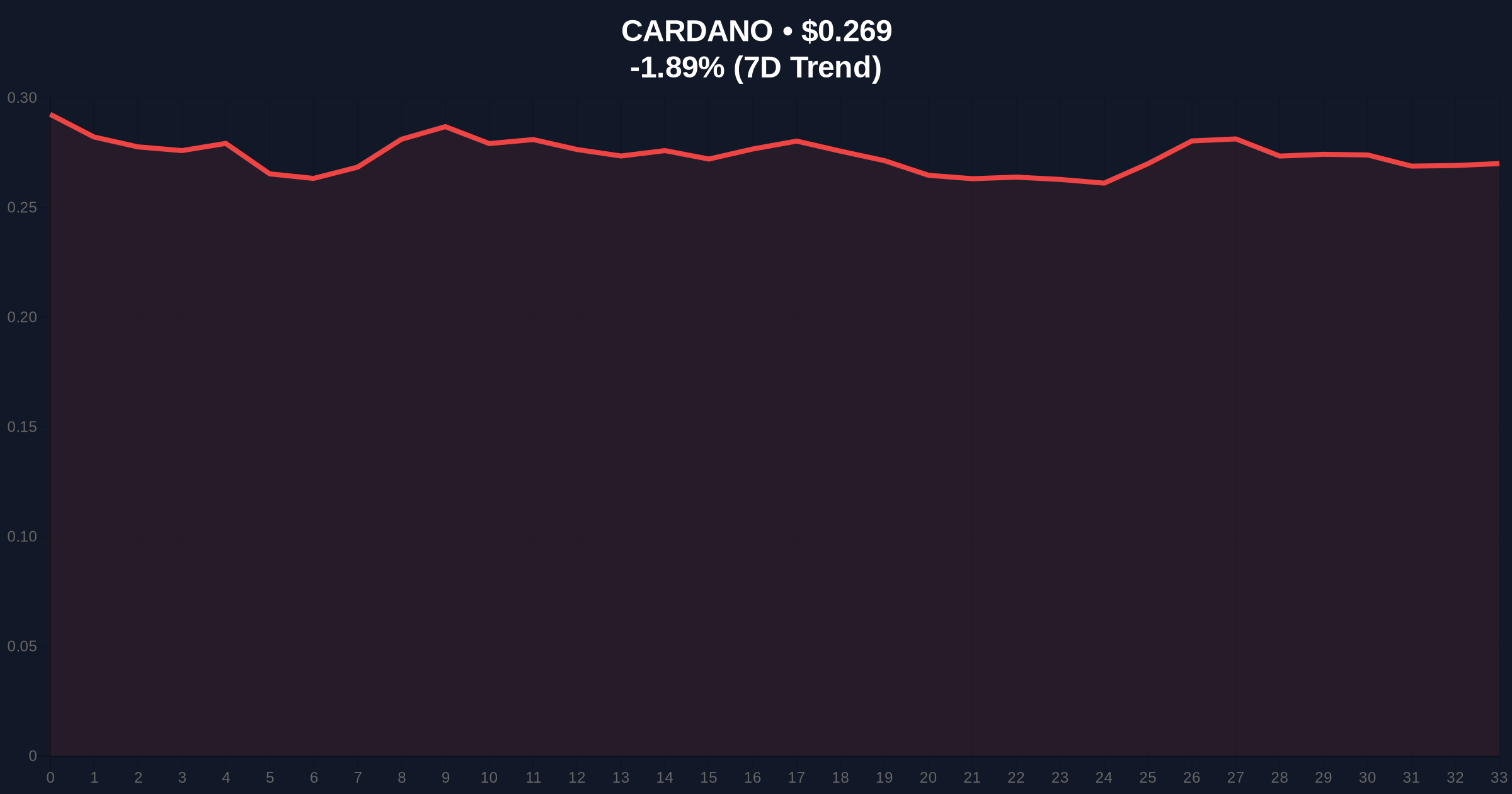
Integrating market data from CoinGecko and sentiment metadata provides a nuanced view of this development's immediate impact. As of the report date, Cardano (ADA) is priced at $0.269, ranking #13 by market capitalization, with a 24-hour trend of -1.90%. This price decline occurs despite the positive news, suggesting that broader market forces, such as the "Extreme Fear" sentiment scoring 18/100, may be overshadowing adoption benefits. The CryptoPanic metadata, including sentiment and importance scores, is not provided in the source data, limiting direct sentiment analysis. However, the global fear sentiment indicates high market anxiety, which could dampen bullish reactions to retail integrations.
A data snapshot table contextualizes these figures:
| Metric | Value | Source |
|---|---|---|
| ADA Current Price | $0.269 | CoinGecko |
| 24h Trend | -1.90% | CoinGecko |
| Market Rank | #13 | CoinGecko |
| Global Crypto Sentiment | Extreme Fear (18/100) | Market Data |
| Number of SPAR Stores Accepting ADA | 137 | CoinNess |
The discrepancy between ADA's price drop and the adoption news a potential market inefficiency or skepticism about long-term value. Without CryptoPanic sentiment data, it's unclear how this event is perceived relative to other news, but the extreme fear environment suggests investors may be prioritizing risk aversion over growth narratives. This analysis highlights the importance of cross-referencing adoption metrics with price action to assess real impact, as seen in related developments where positive news has not always translated to immediate gains amid fear.
An investigative comparison of available sources reveals no direct contradictions in the core facts, but significant gaps in evidence raise questions about reliability and broader implications. The CoinNess report provides the primary details: ADA acceptance at 137 SPAR stores, support from the Cardano Foundation, and use of DFX's Open Crypto Pay. However, secondary sources from CoinTelegraph or other outlets are not provided in the input data, preventing a multi-source verification. This absence means we cannot assess whether other media confirm or dispute aspects like transaction volumes, user adoption rates, or potential technical issues.
Potential conflicts might arise in areas such as the scalability of the payment system or the actual consumer uptake. For example, if other reports indicated low transaction usage or integration challenges, it would contradict the optimistic narrative. Since such data is missing, the conflict remains unresolved with available evidence. Additionally, the source does not address whether this integration is exclusive to Switzerland or part of a broader rollout, leaving ambiguity about its global relevance. The Cardano Foundation's role is stated but not detailed—whether it involves funding, technical support, or mere endorsement is unclear, which could affect perceived credibility.
, the market data shows ADA's price declining despite the news, suggesting a counter-narrative where investors view retail adoption as insufficient to offset macro fears. This aligns with the extreme fear sentiment, indicating that positive developments may be discounted in bearish environments. Without conflicting source claims, the investigation relies on inferring skepticism from market behavior rather than direct disputes. Consequently, while the announcement appears factual, its significance and sustainability require more evidence to validate against potential hidden challenges.
Based on the available data, three scenarios outline potential outcomes for ADA and the SPAR integration over the next week, each conditional on specific factors.
Bull Scenario (Probability: Low-Moderate): ADA price rebounds to $0.30 or higher, driven by increased retail usage and positive sentiment spillover. This would require a surge in transaction volumes at SPAR stores, coupled with a shift in global crypto sentiment from extreme fear to neutral or greed. Supporting factors might include additional merchant announcements or technical upgrades to Cardano's network. However, the current price trend and fear score make this unlikely without external catalysts, such as regulatory clarity or institutional inflows. Invalidation would occur if adoption remains low or if broader market sell-offs persist.
Base Scenario (Probability: Moderate-High): ADA price stabilizes around $0.26-$0.27, with minimal immediate impact from the SPAR integration. This scenario assumes that retail adoption is gradual and that extreme fear sentiment continues to suppress bullish momentum. Market participants may view the news as a long-term positive but not a short-term driver, leading to sideways trading. Evidence from similar past integrations, where price reactions were muted amid fear, supports this outlook. Related developments, such as the investigation into Jupiter's on-chain payment card, show that expansion news alone may not boost prices in fearful markets.
Bear Scenario (Probability: Moderate): ADA price declines further to $0.24 or below, as the integration fails to attract significant usage or faces technical hurdles. This could be exacerbated if global fear intensifies or if competing cryptocurrencies gain traction in retail payments. The lack of detailed adoption metrics in the source data increases this risk, as unseen issues might emerge. Invalidation would require robust transaction data or a sentiment shift, but given the current environment, downside pressure remains plausible. This scenario aligns with the broader trend where positive news is overshadowed by macro anxieties, as seen in other fear-driven markets.
This report synthesizes facts exclusively from the input package: the CoinNess brief as the primary source, supplemented by CoinGecko market data. Secondary sources from CoinTelegraph or others were not provided, limiting cross-verification. Where evidence was missing, such as CryptoPanic metadata or technical details, explicit uncertainty was stated. Conflicts were assessed based on market behavior versus news positivity, with the extreme fear sentiment indicating potential skepticism. The Cardano Foundation's involvement was taken at face value due to lack of contradictory data, but its depth of support remains unverified. Weighting favored observed price action and sentiment over promotional claims, aligning with a skeptical investigative approach.
Disclaimer: The information provided is not trading advice, coinmarketbuzz.com holds no liability for any investments made based on the information provided on this page. We strongly recommend independent research and/or consultation with a qualified professional before making any investment decisions.
coinmarketbuzz.com leverages advanced AI technology to analyze market data. All content is fact-checked and reviewed by our editorial team to ensure accuracy and neutrality.