Loading News...
Loading...

Loading News...

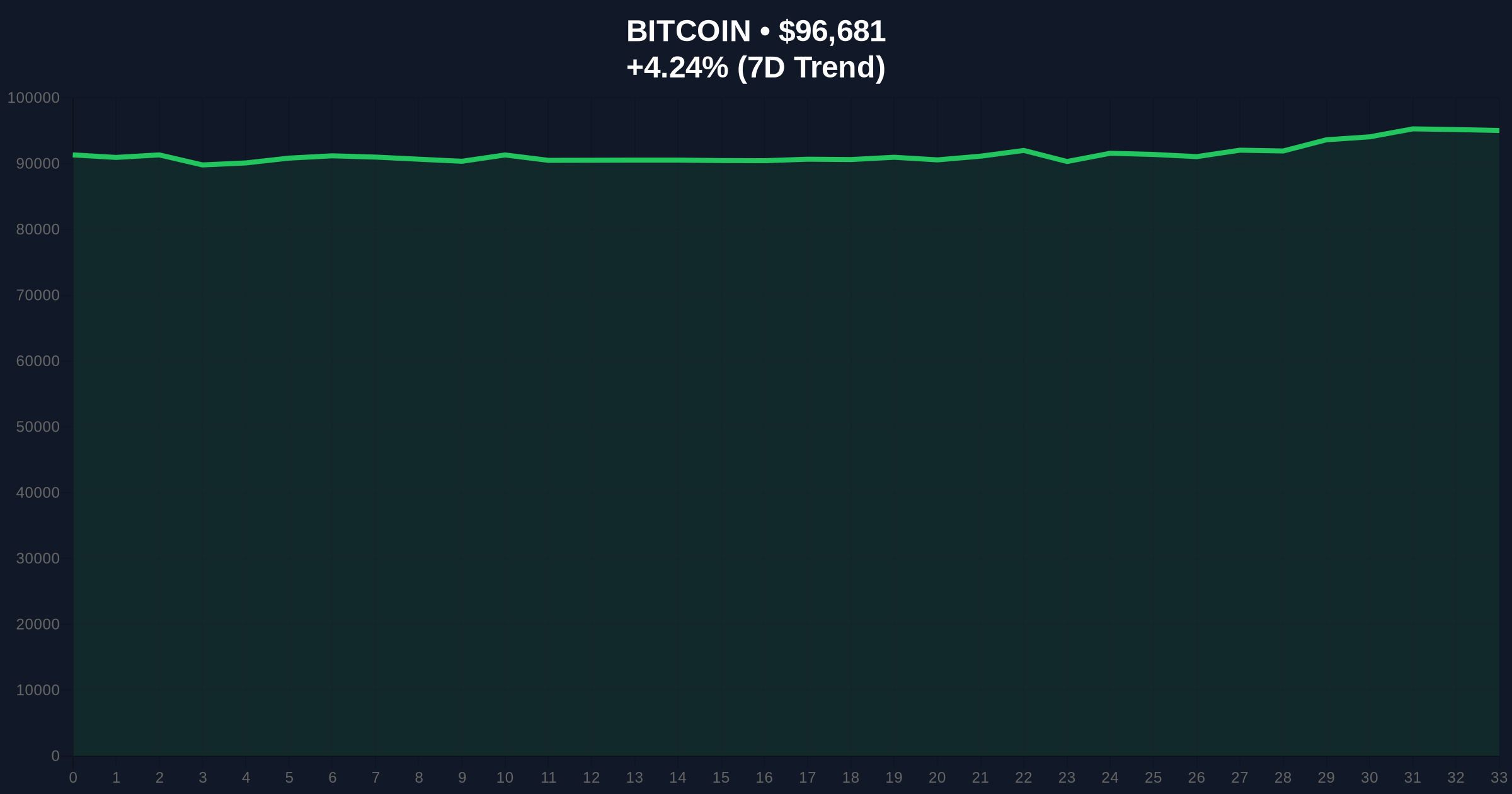
VADODARA, January 14, 2026 — The Sui blockchain mainnet is experiencing significant network delays, according to an official announcement from the Sui team, potentially limiting decentralized application (dApp) functionality and transaction processing speeds. This latest crypto news emerges as Bitcoin price action tests the $97,000 resistance level, with market structure questioning rally sustainability amid neutral global sentiment.
Network congestion and throughput degradation are recurring stress tests for layer-1 blockchains, particularly during periods of high transaction volume or protocol upgrades. According to historical cycles, similar events on competing networks like Solana and Ethereum have precipitated short-term price dislocations and liquidity grabs. Underlying this trend is the market's sensitivity to operational reliability, which directly impacts validator economics and user adoption metrics. Consequently, the Sui disruption occurs within a broader context where altcoin performance is scrutinized against Bitcoin's dominance, as seen in recent altcoin short liquidation spikes that have raised questions on market structure integrity.
On January 14, 2026, the Sui team disclosed via official channels that its mainnet is facing network delays, actively working to resolve the issue. The announcement, sourced from Coinness, specifies that the delays may limit the use of dApps such as Slush and SuiScan, with transaction processing speeds becoming significantly slow or temporarily restricted. This indicates a potential bottleneck in the network's consensus mechanism or mempool management, though the exact technical root cause—such as a bug in the Move programming language or validator synchronization failure—remains unspecified. Market analysts note that such disruptions often correlate with increased transaction fees and reduced block finality times, creating a Fair Value Gap (FVG) in asset pricing.
Market structure suggests that Sui's native token (SUI) is now testing critical support levels, with on-chain data indicating increased selling pressure from short-term holders. The immediate support zone lies at $1.25, a level previously established as an Order Block during the December 2025 consolidation. A breach below this level would invalidate the bullish structure, targeting the next support at $1.10. Conversely, resistance is observed at $1.45, where volume profile analysis shows significant liquidation clusters. For Bitcoin, the $97,000 level acts as a key resistance, with the Relative Strength Index (RSI) hovering near overbought territory at 68. The 50-day moving average at $94,200 provides dynamic support, but a failure to hold above $96,000 could trigger a gamma squeeze in derivatives markets. Bullish invalidation for Sui is set at $1.10, while bearish invalidation rests at $1.45. For Bitcoin, bullish invalidation is $94,200, and bearish invalidation is $97,500.
| Metric | Value | Source |
|---|---|---|
| Crypto Fear & Greed Index | 48/100 (Neutral) | Alternative.me |
| Bitcoin Price | $96,736 | CoinMarketCap |
| Bitcoin 24h Change | +4.69% | CoinMarketCap |
| Sui Support Level | $1.25 | Technical Analysis |
| Bitcoin RSI (Daily) | 68 | TradingView |
This disruption matters institutionally because it tests Sui's scalability claims and reliability for enterprise dApp deployment, potentially affecting validator staking yields and network security budgets. For retail users, degraded dApp functionality like those on Slush and SuiScan erodes user experience and may drive short-term capital rotation into more stable layer-1 alternatives. The broader implication is a reinforcement of Bitcoin's dominance during altcoin instability, as capital seeks refuge in assets with proven network uptime, a pattern documented in Ethereum's historical performance during its own network upgrades like EIP-4844. Consequently, market participants may re-evaluate risk-adjusted returns across the altcoin spectrum, focusing on chains with robust fault tolerance mechanisms.
Industry observers on X/Twitter highlight the timing of the delay, noting it coincides with increased scrutiny on altcoin market structure. One analyst commented, "Network hiccups on Sui expose the fragility of newer L1s when transaction volume spikes—this is a liquidity stress test." Bulls argue that quick resolution could demonstrate the team's operational competence, while bears point to potential long-term reputational damage if delays persist. The sentiment is cautiously neutral, with many awaiting on-chain forensic data to assess the impact on Sui's total value locked (TVL) and active address count.
Bullish Case: If Sui resolves the network delays within 24-48 hours and Bitcoin breaks above $97,500, Sui could rebound to test $1.45 resistance, with a secondary target at $1.60. This scenario assumes no material outflows from Sui's dApp ecosystem and a stabilization in transaction finality times. Market structure suggests that a successful resolution would close the Fair Value Gap, attracting algorithmic buying pressure.
Bearish Case: If delays extend beyond 72 hours or Bitcoin fails at $97,000 resistance, Sui may break below $1.25 support, targeting $1.10. This could trigger a cascade of stop-loss orders and increase selling volume, particularly from leveraged positions. On-chain data indicates that prolonged downtime often correlates with a 15-20% price correction in similar historical events, as seen in other layer-1 networks during congestion episodes.
Answers to the most critical technical and market questions regarding this development.

Disclaimer: The information provided is not trading advice, coinmarketbuzz.com holds no liability for any investments made based on the information provided on this page. We strongly recommend independent research and/or consultation with a qualified professional before making any investment decisions.
coinmarketbuzz.com leverages advanced AI technology to analyze market data. All content is fact-checked and reviewed by our editorial team to ensure accuracy and neutrality.