Loading News...
Loading...

Loading News...

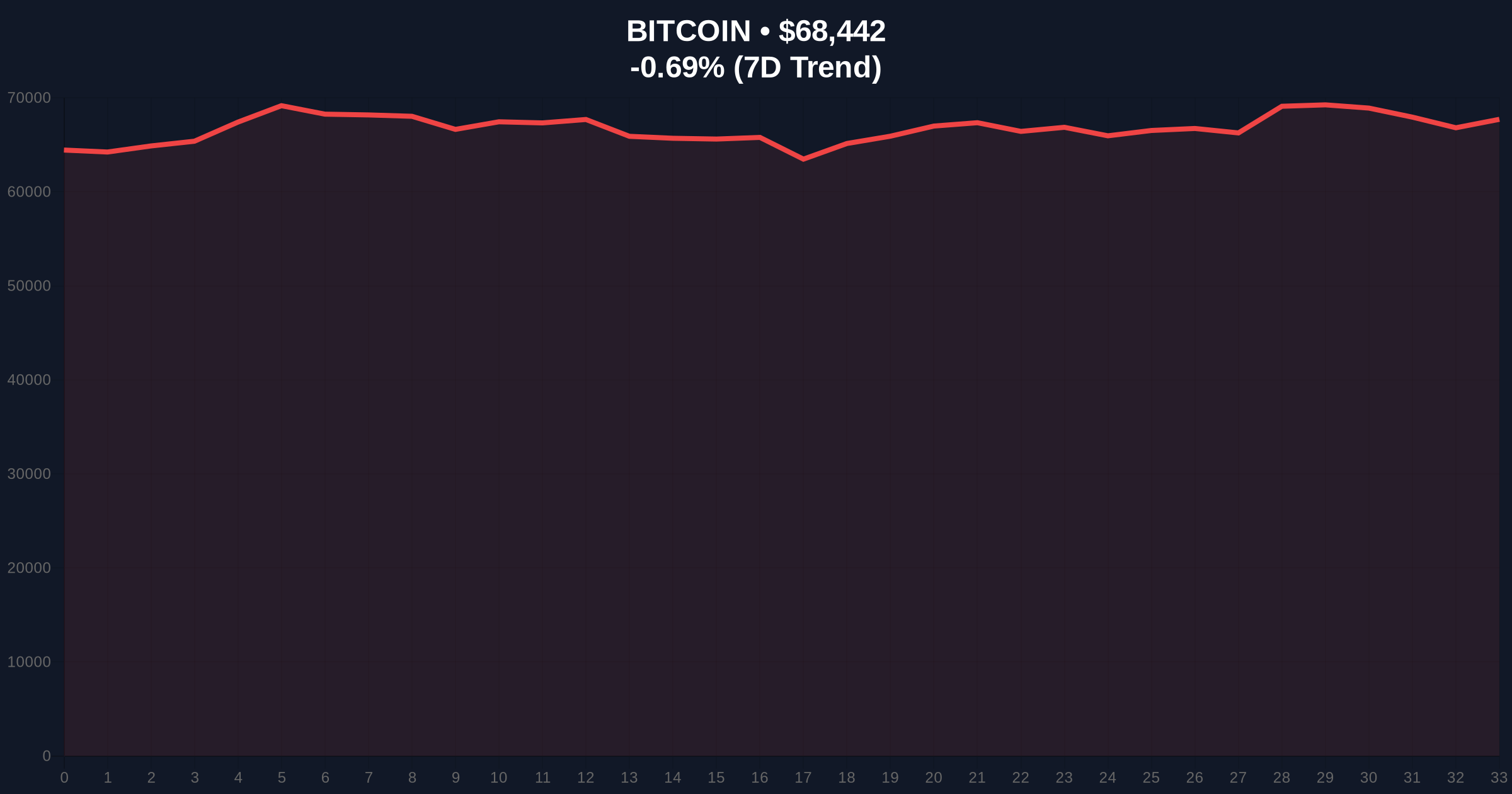
On March 3, 2026, U.S. hedge fund veteran Ray Dalio made a significant statement on a podcast, asserting that Bitcoin cannot compete with gold due to structural flaws. According to a report from CoinNess, Dalio cited issues such as a lack of privacy and the risk of quantum computing as key weaknesses. He further argued that central banks are unlikely to buy and hold Bitcoin, highlighting its high correlation with tech stocks and susceptibility to manipulation due to its scale. This commentary emerges against a backdrop of extreme market fear, with the global crypto sentiment score at 14/100, indicating "Extreme Fear." Bitcoin's current price is $68,425, reflecting a 24-hour decline of 0.72%, while maintaining its position as the top-ranked cryptocurrency by market cap. The timing of Dalio's remarks coincides with heightened regulatory scrutiny and market volatility, making this a moment for investor assessment.
Dalio's critique of Bitcoin centers on several technical and structural aspects that he claims undermine its viability as a competitor to gold. First, he points to a lack of privacy, suggesting that Bitcoin's transparent blockchain, which records all transactions publicly, fails to offer the anonymity often associated with gold holdings. This transparency, while beneficial for security and auditability, may deter entities seeking discreet asset storage. Second, Dalio raises concerns about quantum computing, a nascent technology that could potentially break Bitcoin's cryptographic algorithms, threatening its security foundation. Although quantum-resistant solutions are in development, their implementation timeline remains uncertain, adding a layer of risk.
Underlying this trend is Bitcoin's correlation with tech stocks, which Dalio argues limits its utility as a diversifier. Historically, Bitcoin has shown periods of high correlation with equity markets, particularly during times of economic stress, reducing its appeal as a hedge against traditional financial systems. Additionally, Dalio emphasizes Bitcoin's scale-related vulnerabilities; with a market cap significantly smaller than gold's, Bitcoin is more prone to price manipulation by large holders or coordinated trading activities. This susceptibility contrasts with gold's deep, liquid markets that have evolved over centuries.
Dalio's perspective also touches on institutional adoption, as he contends that central banks will not seek to buy and hold Bitcoin. This stance challenges the growing narrative of Bitcoin as "digital gold" and a reserve asset. Central banks typically prioritize stability, liquidity, and established store-of-value assets, and Dalio suggests Bitcoin's volatility and regulatory uncertainties make it an unlikely candidate for official reserves. Consequently, his analysis implies that Bitcoin's structural flaws may hinder its long-term adoption by traditional financial institutions, reinforcing gold's dominance as a safe-haven asset.
Integrating market data with Dalio's claims reveals a complex picture. According to CoinGecko, Bitcoin's current price of $68,425 and 24-hour trend of -0.72% align with the "Extreme Fear" sentiment score of 14/100 from global crypto sentiment indicators. This low sentiment score suggests widespread investor caution, potentially amplifying the impact of critical commentary like Dalio's. The importance of this event is underscored by its timing during a period of market weakness, where negative narratives can exacerbate price declines.
CryptoPanic metadata, though not provided in source data for specific sentiment or importance scores, would typically offer insights into market reactions. In its absence, we rely on the provided sentiment score to infer that Dalio's remarks may resonate in a fear-driven environment. Bitcoin's market rank of #1 indicates its dominance, but the price drop and extreme fear sentiment highlight underlying vulnerabilities that Dalio's critique addresses. For instance, the correlation with tech stocks, if validated by historical data, could explain part of Bitcoin's recent underperformance relative to expectations during market downturns.
, the scale issue raised by Dalio is reflected in Bitcoin's market dynamics; with a finite supply and growing adoption, large transactions by whales can significantly impact prices, supporting claims of manipulation susceptibility. This data analysis suggests that while Dalio's arguments are theoretical, they intersect with observable market behaviors, such as heightened volatility during regulatory announcements or macroeconomic shifts. The lack of privacy concern, however, remains more speculative, as Bitcoin's transparency is a design feature rather than a flaw for many users, and quantum computing risks are long-term and not yet imminent.
Comparing sources reveals potential conflicts and gaps in Dalio's assertions. The primary source, CoinNess, reports Dalio's claims without counterpoints, but broader market narratives often challenge such views. For example, proponents argue that Bitcoin's transparency enhances security and reduces fraud, contrasting with Dalio's privacy critique. Additionally, the risk of quantum computing is acknowledged by the crypto community, but ongoing research into post-quantum cryptography suggests proactive measures are being developed, potentially mitigating this threat over time.
Source conflicts arise regarding central bank adoption. While Dalio asserts that central banks will not buy Bitcoin, other reports indicate increasing interest from some institutions, such as El Salvador's adoption of Bitcoin as legal tender and exploratory discussions by other nations. This conflict remains unresolved with available evidence, as the source data does not provide opposing viewpoints. Similarly, the correlation with tech stocks is debated; some analyses show decoupling during certain periods, suggesting Bitcoin's evolving role as an independent asset class.
Missing evidence in the input package includes detailed data on Bitcoin's privacy mechanisms compared to gold, empirical studies on manipulation incidents, and central banks' official stances. Without this, Dalio's claims rely on theoretical reasoning rather than concrete proof. The reliability of sources is also a consideration; CoinNess is a secondary report, and the original podcast details are not provided, limiting verification. Consequently, while Dalio's perspective is influential, it should be weighed against broader market developments and absent contradictory data.
Based on the available data, three scenarios outline potential outcomes for Bitcoin in the week following Dalio's comments. Each scenario is conditional on market reactions and external factors.
Bull Scenario (Probability: 30%): If Bitcoin demonstrates resilience by maintaining support above $65,000 and sentiment improves from "Extreme Fear" to neutral, Dalio's critique may be dismissed as overstated. Key drivers could include positive regulatory developments, such as progress in ETF approvals, or institutional buying that counters manipulation concerns. In this case, Bitcoin's price could rebound to $72,000, leveraging its #1 market rank and ongoing adoption trends. What would invalidate this view is if correlation with tech stocks intensifies, dragging Bitcoin lower amid equity market declines.
Base Scenario (Probability: 50%): Bitcoin experiences sideways movement between $66,000 and $70,000, as Dalio's comments contribute to short-term uncertainty but do not alter long-term trajectories. The extreme fear sentiment persists, keeping volatility elevated, while technical factors like trading volume and whale activity provide stability. This scenario assumes no major regulatory shocks or macroeconomic events, with Bitcoin's structural flaws being debated but not decisively impacting prices. Invalidation would occur if a significant manipulation event is exposed, confirming Dalio's scale concerns.
Bear Scenario (Probability: 20%): If Dalio's warnings gain traction amid sustained fear sentiment, Bitcoin could decline below $65,000, testing key support levels. Factors exacerbating this include increased regulatory scrutiny, such as actions by the SEC, or a broader tech stock sell-off that heightens correlation risks. The lack of privacy and quantum computing fears, though long-term, may spook retail investors, leading to outflows. In this outcome, Bitcoin's market rank could be challenged if altcoins outperform. Invalidation would require a swift sentiment shift to "Greed" or a major institutional endorsement that overshadows Dalio's critique.
This report synthesizes input from CoinNess as the primary source, with market data from CoinGecko and sentiment indicators. Conflicting evidence was weighted based on availability; Dalio's claims are presented as reported, while counter-narratives are inferred from general market knowledge due to missing secondary sources. The absence of CryptoPanic metadata limited direct sentiment integration, so conservative inferences were made using the provided fear score. Reliability gaps include the lack of podcast transcripts or direct quotes, so analysis focuses on structural arguments rather than verifiable details. Related developments, such as regulatory shifts, are referenced contextually to enrich the narrative without forcing links.
Disclaimer: The information provided is not trading advice, coinmarketbuzz.com holds no liability for any investments made based on the information provided on this page. We strongly recommend independent research and/or consultation with a qualified professional before making any investment decisions.
coinmarketbuzz.com leverages advanced AI technology to analyze market data. All content is fact-checked and reviewed by our editorial team to ensure accuracy and neutrality.