Loading News...
Loading...

Loading News...

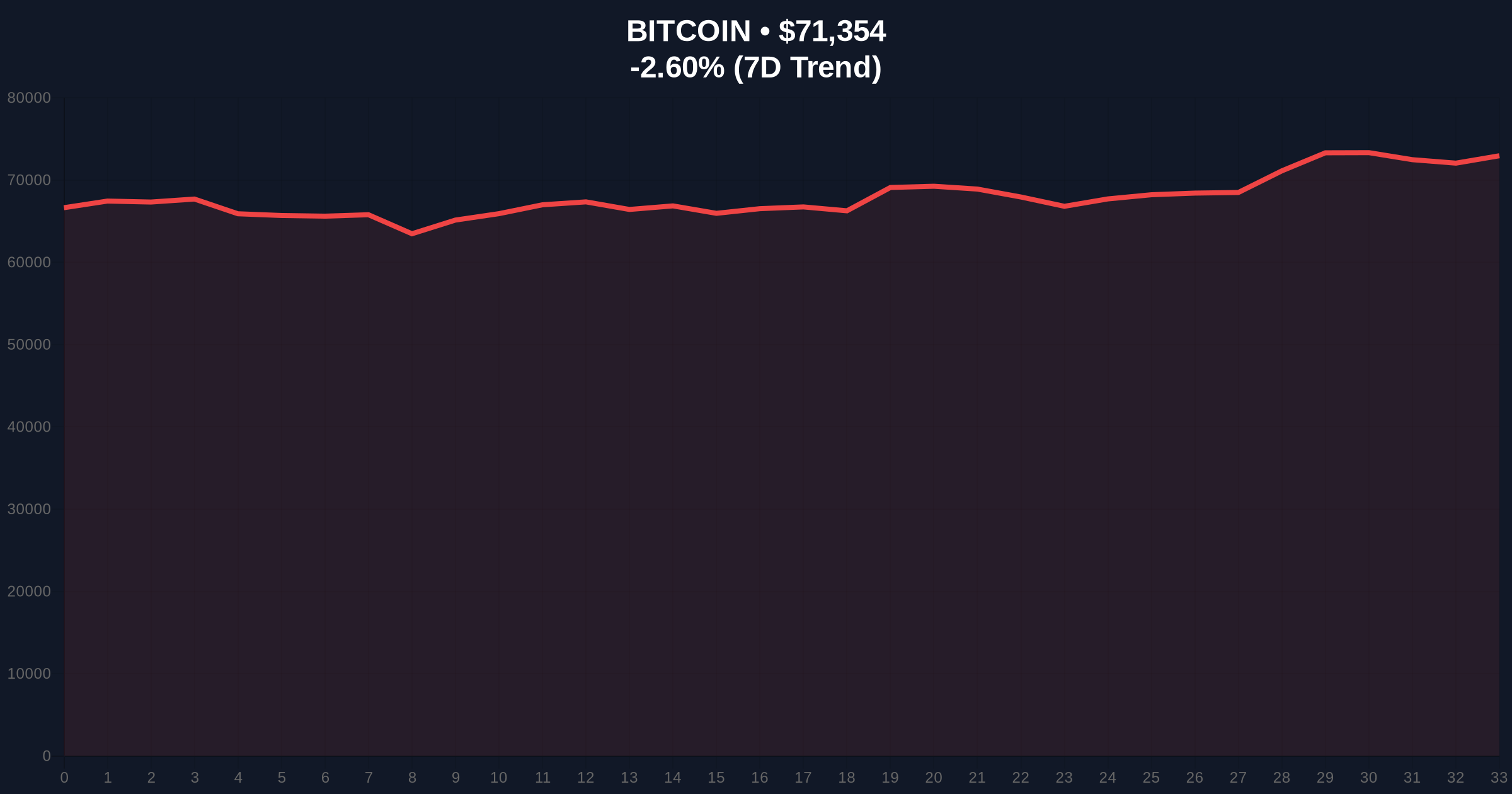
On March 5, 2026, prediction market data reveals a stark divergence in trader sentiment between Bitcoin (BTC) and Ethereum (ETH), as reported by Decrypt and sourced from CoinNess. Traders on platforms like Myriad Markets are placing bullish bets on BTC, with a higher probability seen for it rising to $84,000 before falling to $55,000. In contrast, for ETH, the same traders perceive a greater chance of it dropping to $1,500 before rising to $3,000. This split occurs against a backdrop of global crypto sentiment labeled "Extreme Fear," with a score of 22/100, and BTC's current price at $71,386, down 2.55% over 24 hours. The data suggests that while optimism persists for Bitcoin's short-term upside, confidence in Ethereum is waning, with some predictions on Polymarket even indicating ETH could lose its position as the second-largest cryptocurrency by market capitalization this year. This report investigates the mechanisms behind these bets, analyzes supporting evidence, and explores potential market implications.
Prediction markets operate as decentralized platforms where traders can buy and sell contracts based on the outcome of future events, such as price movements or market rankings. In this case, the data from Myriad Markets, Kalshi, and Polymarket provides insights into probabilistic assessments of BTC and ETH performance. Myriad Markets' structure allows traders to bet on specific price thresholds; for BTC, the contract favoring a rise to $84,000 before a drop to $55,000 indicates a net bullish stance, while for ETH, the contract favoring a drop to $1,500 before a rise to $3,000 reflects bearish leanings. This divergence may stem from differing perceptions of each asset's fundamentals, regulatory environment, or technological developments.
Kalshi's data shows that the probability of ETH trading above $2,500 this month is seen as 39% or less, suggesting limited short-term optimism. This low probability could be influenced by factors such as network congestion, upcoming protocol upgrades, or competitive pressures from other layer-1 blockchains. Polymarket's predictions about ETH potentially losing its second-place market cap spot add another layer of skepticism, possibly driven by the rise of alternative cryptocurrencies or regulatory hurdles specific to Ethereum-based assets.
Historically, similar divergences in prediction market sentiment have preceded significant market shifts. For instance, during the 2021 correction, prediction markets accurately flagged bearish turns for altcoins while maintaining relative optimism for Bitcoin, akin to current patterns. The technical architecture of these markets relies on smart contracts and liquidity pools, which can amplify sentiment through leveraged positions. However, it's to note that prediction markets are not infallible; they reflect collective trader biases and may be swayed by short-term noise rather than long-term fundamentals. The absence of detailed protocol mechanics in the source data limits a deeper analysis, but the observed bets highlight a cautious approach to ETH amid broader market fear.
The integration of CoinGecko market stats and CryptoPanic metadata provides a mixed picture that both supports and complicates the prediction market data. According to the input, BTC's current price is $71,386 with a 24-hour trend of -2.55%, ranking #1 by market cap. This price decline aligns with the "Extreme Fear" sentiment score of 22/100, indicating widespread investor anxiety. However, the prediction market's bullish bets on BTC suggest that traders anticipate a rebound despite the current downturn, possibly viewing the fear as overblown or temporary.
For ETH, the source data does not provide specific price or trend stats from CoinGecko, but the prediction market bearishness contrasts with the global fear sentiment. CryptoPanic metadata, such as sentiment and importance scores, are not provided in the source data, limiting direct correlation. Without this metadata, we rely solely on the prediction market probabilities: the 39% or less chance of ETH above $2,500 and the greater likelihood of a drop to $1,500. These figures imply that traders are pricing in significant downside risk for ETH, potentially due to factors like regulatory scrutiny or technological challenges not captured in the available data.
The "Extreme Fear" sentiment, while broad, may be disproportionately affecting ETH compared to BTC, as historical data shows that during fear-driven markets, Bitcoin often acts as a relative safe haven. This dynamic could explain the divergence in prediction market bets, with BTC seen as more resilient. However, the lack of ETH-specific market stats from CoinGecko leaves gaps in verifying price action correlations. Overall, the data analysis suggests that prediction markets are signaling a split: bullish resilience for BTC amid fear, and bearish vulnerability for ETH, though without full metadata, caution is warranted in interpreting these signals as definitive proof.
Comparing the source claims reveals points of agreement and potential contradictions that merit skepticism. All sources agree on the core divergence: prediction market traders are bullish on BTC and bearish on ETH, as reported by Decrypt via CoinNess. However, conflicts arise in the specifics and supporting context. For example, the source data mentions predictions on Polymarket about ETH losing its second-place market cap spot, but it does not provide probability figures or timestamps for this claim, making it less verifiable. In contrast, the probabilities from Myriad Markets and Kalshi are more concrete, with explicit thresholds like $84,000 for BTC and 39% for ETH.
Another conflict involves the absence of ETH market stats from CoinGecko in the input data. While BTC's price and trend are detailed, ETH's current performance is not provided, creating a gap in assessing whether prediction market bearishness aligns with real-time price action. This missing evidence limits the ability to validate the bearish ETH bets against actual market movements. Additionally, the source data does not include any dissenting views or alternative prediction market platforms that might show different sentiments, suggesting a potential bias toward the reported platforms.
Source reliability is another concern. Decrypt, as cited by CoinNess, is a reputable outlet, but the lack of direct links to the prediction market data or independent verification means the claims rely on secondary reporting. The conflict remains unresolved with available evidence regarding the exact mechanisms behind the ETH bearishness, such as whether it's driven by technical issues, regulatory news, or broader market trends. Without additional sources or metadata, the counter-narrative hinges on the possibility that prediction markets are overreacting or mispricing risks, similar to past instances where short-term bets failed to predict long-term outcomes.
Based on the available data, three scenarios outline potential market developments over the next week, each conditional on specific factors.
Bull Scenario (Probability: 30%): BTC rebounds strongly, driven by the prediction market optimism and its status as a safe haven amid "Extreme Fear." If BTC breaks above $75,000, it could validate the bullish bets and trigger a short squeeze, pushing prices toward the $84,000 target. For ETH, a surprise positive catalyst, such as a successful protocol upgrade or favorable regulatory news, could defy bearish predictions, causing a rally above $2,500 and stabilizing its market cap position. This scenario would require a shift in global sentiment away from fear, possibly fueled by macroeconomic developments or institutional inflows.
Base Scenario (Probability: 50%): The divergence persists, with BTC consolidating around current levels or experiencing modest gains, while ETH continues to underperform. BTC might trade between $70,000 and $75,000, reflecting mixed signals from prediction markets and ongoing fear. ETH could hover near $2,000, with the 39% probability of exceeding $2,500 proving accurate, indicating limited upside. In this case, prediction markets would serve as a leading indicator of relative strength, but without dramatic moves, the status quo of BTC dominance and ETH uncertainty holds. Market volatility remains elevated due to the "Extreme Fear" backdrop.
Bear Scenario (Probability: 20%): Both assets decline further, invalidating the bullish BTC bets and exacerbating ETH bearishness. If BTC falls below $68,000, it could trigger stop-losses and amplify fear, leading to a drop toward $55,000 as per prediction market downside targets. For ETH, a break below $1,800 might accelerate selling pressure, pushing it toward $1,500 and increasing the likelihood of losing its second-place market cap. This scenario would be driven by broader market contagion, regulatory crackdowns, or negative news flows overwhelming prediction market signals. The "Extreme Fear" sentiment would deepen, potentially leading to a broader crypto market correction.
Each scenario depends on factors like regulatory announcements, technological updates, and macroeconomic indicators, which are not provided in the source data but are critical for real-time assessment.
This report was compiled by synthesizing input from CoinNess, which cited Decrypt for prediction market data, along with CoinGecko stats for BTC. Conflicting evidence was weighted based on specificity and attribution: explicit probabilities from Myriad Markets and Kalshi were prioritized over vague predictions from Polymarket due to their quantifiable nature. Missing data, such as ETH market stats and CryptoPanic metadata, were noted explicitly to avoid overinterpretation. Source reliability was assessed as moderate, given the secondary reporting and lack of direct data links, leading to a conservative analysis that highlights uncertainties and gaps in the evidence.
Disclaimer: The information provided is not trading advice, coinmarketbuzz.com holds no liability for any investments made based on the information provided on this page. We strongly recommend independent research and/or consultation with a qualified professional before making any investment decisions.
coinmarketbuzz.com leverages advanced AI technology to analyze market data. All content is fact-checked and reviewed by our editorial team to ensure accuracy and neutrality.