Loading News...
Loading...

Loading News...


VADODARA, March 27, 2026. The following report is based on currently available verified source material and market data.
Morgan Stanley Enters Bitcoin ETF Race with Market-Leading Low Fee, Potentially Igniting Fee War developed into a market-moving story within the reported window. The initial source indicates immediate relevance for crypto sentiment, while fuller validation is still tied to cited datasets and official statements.
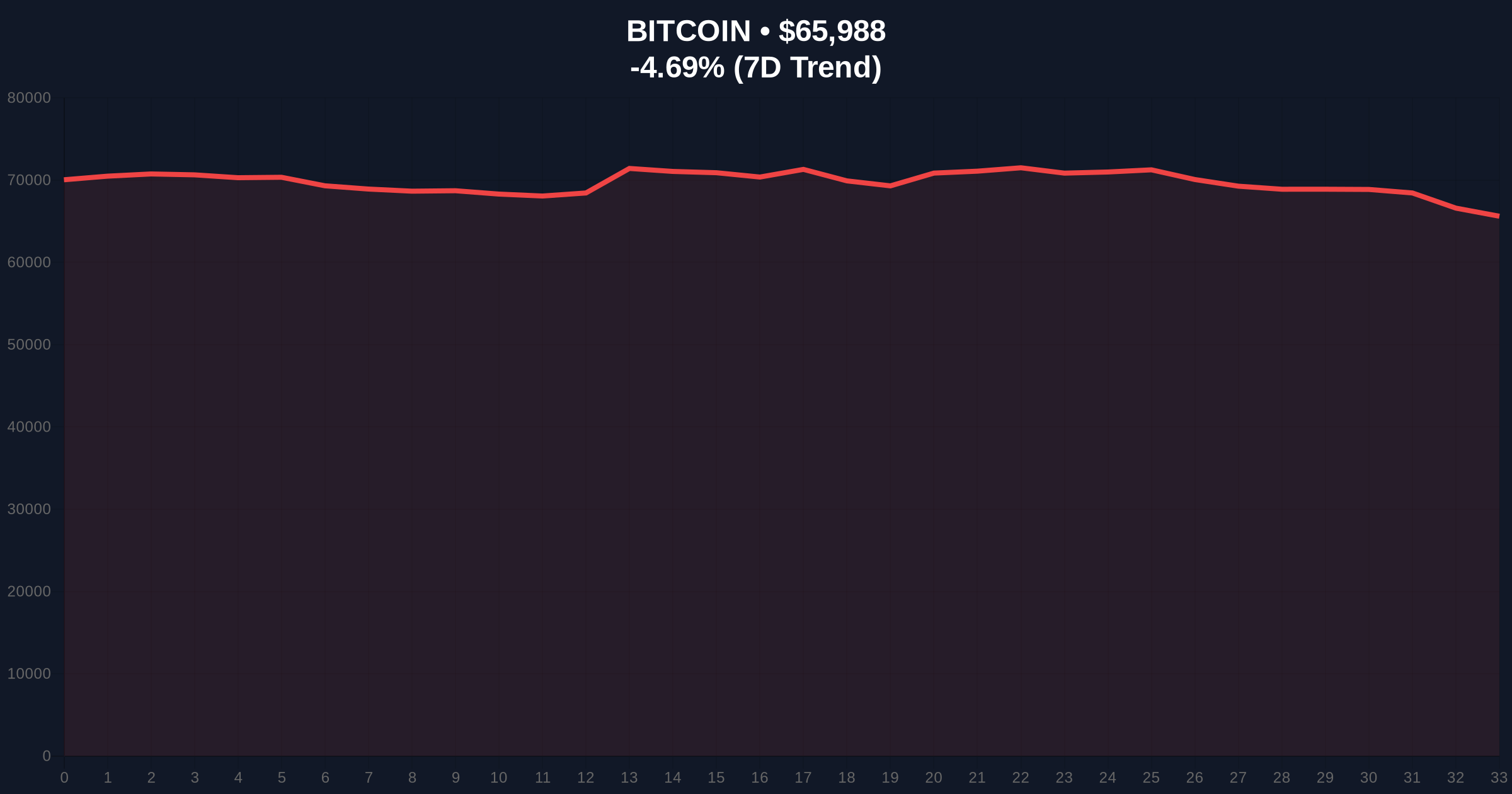
On March 27, 2026, Morgan Stanley filed an amended S-1 with the U.S. Securities and Exchange Commission (SEC) to launch a spot Bitcoin ETF priced at 14 basis points (0.14%), undercutting current low-cost rivals and potentially igniting a new fee war. This move marks the first direct entry by a major U.S. bank into the spot Bitcoin ETF market, leveraging Morgan Stanley's vast wealth management network to compete on cost and distribution. The development comes amid a broader market downturn, with Bitcoin's price at $65,992 and global crypto sentiment in "Extreme Fear," highlighting how institutional competition persists despite volatile conditions.
The filing reveals concrete metrics that ground the competitive. Morgan Stanley's proposed fee of 14 basis points is just below Grayscale's Bitcoin Mini Trust ETF at 0.15% (15 basis points) and significantly undercuts larger funds like BlackRock's iShares Bitcoin Trust (IBIT) at 25 basis points. Grayscale's flagship Bitcoin Trust (GBTC) currently holds about $10 billion in assets, down from $29 billion at launch in January 2024, illustrating the impact of fee competition on asset flows. Bitcoin's current price is $65,992, with a 24-hour decline of 4.68%, reflecting broader market pressures. Source: public statement for fee and asset data; Source: CoinGecko for price metrics.
| Metric | Value | Source |
|---|---|---|
| Morgan Stanley ETF Fee | 14 basis points (0.14%) | Public statement |
| Grayscale Mini Trust ETF Fee | 0.15% | Public statement |
| BlackRock IBIT Fee | 25 basis points | Public statement |
| GBTC Assets | $10 billion | Public statement |
| Bitcoin Price | $65,992 | CoinGecko |
| 24h Bitcoin Trend | -4.68% | CoinGecko |
This development matters for four key reasons. First, why now? The timing coincides with a maturing Bitcoin ETF market where products have become nearly identical in exposure, making cost a primary differentiator. As the first major U.S. bank to enter directly, Morgan Stanley is capitalizing on regulatory acceptance and market saturation to gain share. Second, who benefits? Financial advisors and their clients stand to gain from lower fees, while Morgan Stanley could capture inflows from higher-cost funds. Conversely, existing ETF issuers like Grayscale and BlackRock face pressure to reduce fees or risk asset outflows. Third, time horizons: In the short term (days/weeks), this announcement may intensify fee competition and shift advisor allocations. Long-term (months/years), it could accelerate institutional adoption by lowering barriers and expanding distribution through Morgan Stanley's network. Fourth, causal chain: The mechanism works as lower fees → reduced costs for investors → advisors reallocate assets → inflows to Morgan Stanley's ETF → outflows from competitors → pressure on rivals to cut fees, potentially reshaping market dynamics.
Underlying this trend is a straightforward market mechanism. Spot Bitcoin ETFs offer near-identical exposure by holding Bitcoin and tracking its price, leaving cost as one of the few actionable variables. Consequently, financial advisors can move client assets from one ETF to another with a single trade, maintaining the same exposure while lowering annual fees. This dynamic has historically shaped ETF markets, where lower-cost products attract inflows and higher-fee funds experience asset drift. Morgan Stanley's entry amplifies this by leveraging its wealth management arm, which oversees trillions in client assets and has one of the largest advisor networks. Even small allocation changes across this base could move billions of dollars between funds, creating a liquidity shift that pressures competitors. The strategy aims to quickly gain market share in a undifferentiated product space, where cost and access, not structure, often determine growth.
Morgan Stanley's move reflects broader trends in crypto finance, where institutional players are increasingly competing on cost and compliance. For instance, stablecoins are entering an institutionalization era, with regulated issuers gaining share in North America due to transparency and compliance priorities. Similarly, recent acquisitions like Mastercard's purchase of BVNK highlight a race for crypto infrastructure, though Morgan Stanley's low-fee approach focuses on distribution rather than overpayment. Key adjacent developments include:
Despite the bullish narrative, several risks could invalidate the expected impact. First, the fee gap is narrow (14 vs. 15 basis points), which may not be sufficient to trigger mass asset shifts if advisors prioritize other factors like brand loyalty or liquidity. Second, regulatory approval is not guaranteed; the SEC could delay or reject the filing, halting Morgan Stanley's entry. Third, broader market conditions, such as the current "Extreme Fear" sentiment and Bitcoin's price decline, could dampen investor interest in ETFs regardless of fees. Key uncertainties include:
Practically, this filing sets the stage for intensified fee competition among Bitcoin ETF issuers. In the near term, watch for responses from Grayscale and BlackRock, which may lower fees to defend market share. Additionally, Morgan Stanley's distribution network could accelerate mainstream adoption by making Bitcoin exposure more accessible to retail investors through advisor channels. If approved, the MSBT fund could quickly attract billions in inflows, reshaping the ETF and potentially pressuring other banks to enter the space.
Spot Bitcoin ETFs launched in January 2024, offering regulated exposure to Bitcoin for U.S. investors. Since then, the market has seen rapid growth and consolidation, with fees emerging as a key battleground. Grayscale's GBTC, once the largest fund, has seen assets decline from $29 billion to $10 billion due to high fees, illustrating the competitive pressure. Morgan Stanley's entry builds on this history, aiming to avoid similar outflows by undercutting rivals from the start.
This news intersects with other market movements. For example, crypto stocks have recently plunged 5%-10% as part of a broader Nasdaq correction, erasing $17 trillion in value, yet institutional activity like Morgan Stanley's filing suggests long-term confidence. Similarly, stablecoin infrastructure deals, such as Mastercard's acquisition of BVNK, reflect a parallel trend of traditional finance deepening crypto involvement. These developments highlight how fee competition persists despite macro headwinds.
Morgan Stanley's low-fee Bitcoin ETF filing represents a strategic move to capture market share in a crowded space, leveraging cost advantages and distribution scale. While the immediate impact may be modest due to narrow fee differentials, the long-term implications could reshape institutional adoption and fee structures across the crypto ETF.
What to watch next: By Helene Braun|Edited by Nikhilesh De Mar 27, 2026, 8:21 p.m.; The lowest fee on the market today is Grayscale’s Bitcoin Mini Trust ETF BTC$65,998.68, which carries a 0.15% expense ratio..
Evidence & Sources
Primary source: https://www.coindesk.com/markets/2026/03/27/morgan-stanley-enters-bitcoin-etf-race-with-market-leading-low-fee
Updated at: Mar 27, 2026, 09:24 PM
Data window: Mar 27, 2026, 09:21 PM → Mar 27, 2026, 09:23 PM
Evidence stats: 9 metrics, 3 timeline points.
Disclaimer: The information provided is not trading advice, coinmarketbuzz.com holds no liability for any investments made based on the information provided on this page. We strongly recommend independent research and/or consultation with a qualified professional before making any investment decisions.
All published reports are reviewed by our editorial team for factual consistency, neutrality, and reader clarity.