Loading News...
Loading...

Loading News...

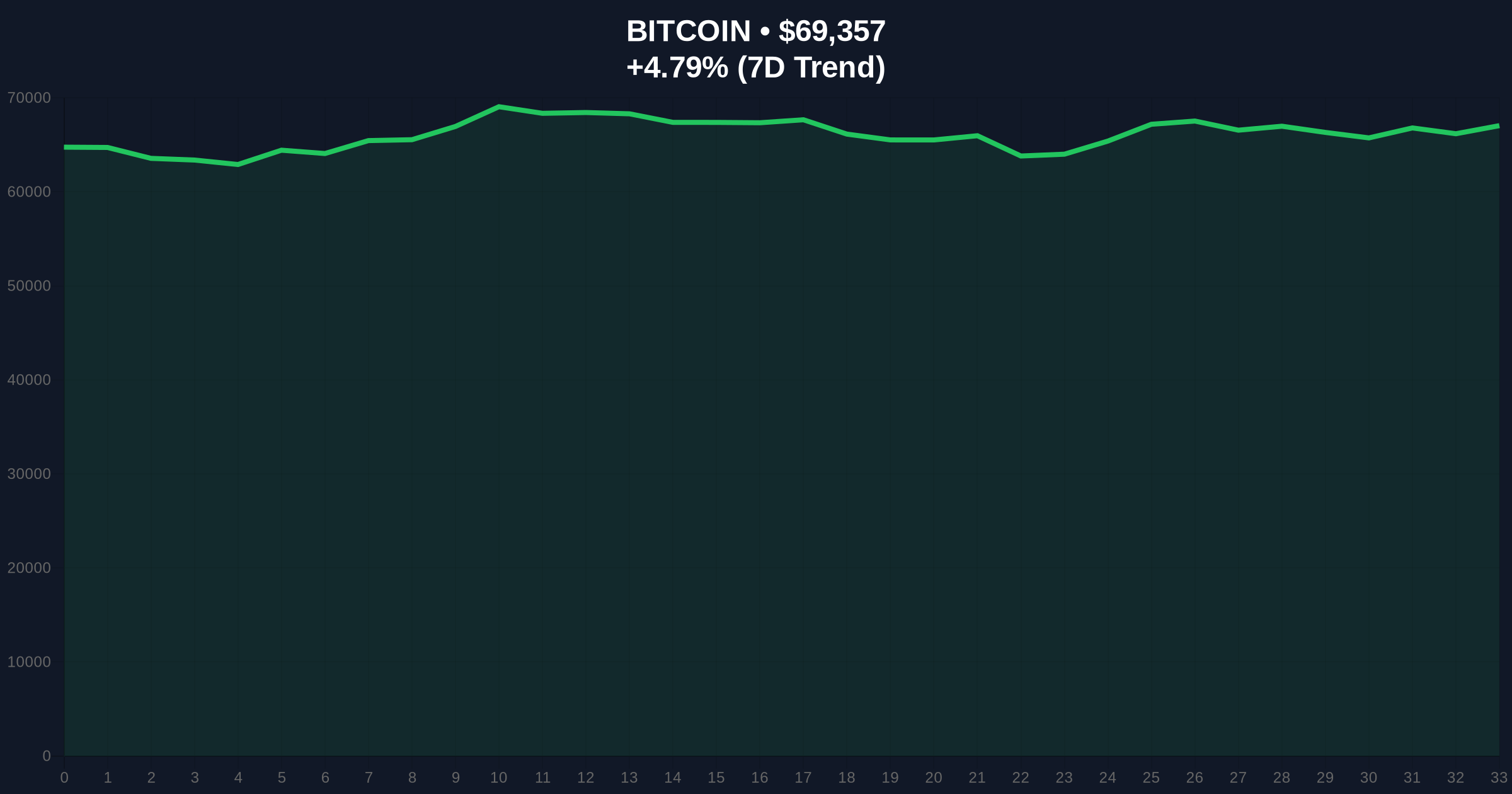
On March 2, 2026, CoinNess reported that Metaplanet, a publicly listed Japanese company known for its Bitcoin accumulation strategy, has not purchased any additional BTC for seven weeks. The report, citing Cointelegraph via X, indicates a significant pause in the company's previously active buying pattern. This development emerges as Bitcoin trades at $69,477, showing a 24-hour trend of 4.98% and maintaining its #1 market rank, while global crypto sentiment registers as "Extreme Fear" with a score of 10/100. The absence of recent purchases raises immediate questions about whether this hiatus reflects a strategic recalibration, liquidity constraints, or a response to broader market conditions. No specific reasons for the pause were provided in the source data, leaving analysts to speculate based on available context.
Metaplanet's Bitcoin accumulation strategy has positioned it as a notable corporate player in the crypto space, leveraging its public listing to integrate digital assets into its treasury. The technical architecture underlying such corporate Bitcoin holdings typically involves secure custody solutions, often through regulated custodians or self-custody via multi-signature wallets, though specific details for Metaplanet are not provided in the source data. The seven-week pause suggests a potential shift in execution mechanics, which could stem from internal protocol adjustments, regulatory compliance checks, or market timing considerations. Underlying this trend, corporate Bitcoin strategies often balance accumulation with risk management frameworks, including dollar-cost averaging or threshold-based buying, but Metaplanet's exact methodology remains undisclosed.
Consequently, the hiatus may reflect operational factors such as treasury reallocation, audit cycles, or strategic reviews of asset allocation. In the broader context, corporate Bitcoin adoption has evolved from speculative bets to structured treasury management, with companies like MicroStrategy setting precedents for periodic disclosures and purchasing schedules. Metaplanet's pause could indicate a maturation of its approach, possibly aligning with quarterly financial reporting or liquidity needs. However, without explicit confirmation from the company, these remain inferences based on observed patterns. The lack of additional purchases over nearly two months contrasts with earlier activity, prompting analysis of whether this is a temporary lull or a longer-term strategic pivot.
From a regulatory perspective, Japanese companies operating in crypto face oversight from the Financial Services Agency (FSA), which mandates compliance with anti-money laundering (AML) and capital requirements. While not directly mentioned in the sources, regulatory harmonization efforts, such as those highlighted in related developments like the SEC and CFTC joint event on regulatory harmonization, could influence global corporate strategies. Metaplanet's pause might coincide with assessments of evolving regulatory landscapes, though this is speculative without direct evidence. The technical deep-dive that corporate Bitcoin accumulation is not merely a buying spree but a complex integration of finance, technology, and compliance, where pauses can signal strategic depth rather than abandonment.
The data surrounding Metaplanet's pause is sparse but telling. According to CoinNess, the company has not made additional BTC purchases in seven weeks, as reported by Cointelegraph on X. This claim is singular in the input package, with no contradictory reports from other sources, suggesting a consensus on the fact of the hiatus. However, the absence of supporting data—such as transaction records, official statements, or historical purchase timelines—limits the ability to verify the exact start date or magnitude of the pause. CoinGecko market stats show Bitcoin at $69,477 with a 4.98% 24-hour increase, indicating positive short-term momentum despite the "Extreme Fear" sentiment score of 10/100. This juxtaposition highlights a disconnect: market prices are rising while sentiment remains deeply negative, potentially reflecting broader uncertainty that could influence corporate behavior like Metaplanet's.
CryptoPanic metadata, including sentiment and importance scores, is not provided in the source data, preventing a direct integration of these metrics. Without this, analysis relies on the available CoinGecko data and the reported event. The "Extreme Fear" sentiment, derived from external market intelligence, suggests a cautious environment where companies might pause aggressive accumulation to assess risks. Importance of the event is implied by its coverage but unquantified; in context, a seven-week hiatus from a known corporate buyer could be moderately significant, especially if it signals a trend among other firms. The data analysis reveals gaps: no information on Metaplanet's total Bitcoin holdings, purchase history, or financial health is included, making it difficult to gauge the impact of the pause on its portfolio or the broader market.
To contextualize, related regulatory developments, such as the SEC's adoption of final rules for the Holding Foreign Insiders Accountable Act, may indirectly affect global corporate strategies by increasing scrutiny on foreign holdings and disclosures. While not directly linked to Metaplanet, such events contribute to a climate of regulatory uncertainty that could prompt pauses in crypto investments. The data proof thus rests on a narrow foundation: one report of a purchasing halt, coupled with market stats showing resilience amid fear. This combination invites skepticism—why would a company pause buying during a price uptick?—but without more data, conclusions remain tentative.
Source synthesis across the input package reveals minimal conflict but significant missing evidence. The primary source, CoinNess, cites Cointelegraph reporting on X about Metaplanet's seven-week purchase pause. No secondary full texts from other outlets are provided, so there is no direct contradiction in the available data. However, this lack of corroboration raises reliability questions: Is Cointelegraph's X report based on official disclosure, insider information, or inference? The source does not specify, leaving a gap in verification. Potential counter-narratives could emerge from unprovided sources, such as Metaplanet denying the pause or clarifying it as part of a planned strategy, but these are absent here.
Agreement points are limited to the core fact of the hiatus, as reported by CoinNess/Cointelegraph. Disputes are nonexistent in the given inputs, but this does not equate to confirmation; rather, it highlights a single-source dependency that weakens evidentiary strength. Missing evidence includes: Metaplanet's official response, detailed purchase records, reasons for the pause, and comparative data from other corporate Bitcoin holders. For instance, if other companies were also pausing purchases, it might indicate a sector-wide trend, but no such information is included. The conflict, therefore, is not between sources but between the reported event and the unexplained context—why has Metaplanet stopped buying, and is this anomalous or aligned with broader patterns?
Attribution is straightforward: Source A (CoinNess via Cointelegraph) reports the pause, with no Source B to dispute it. This simplicity masks underlying uncertainties, such as the reliability of X as a primary news conduit or the timeliness of the information. In investigative terms, the claim is better supported by its publication in a recognized crypto news outlet, but without multi-source validation, it remains a preliminary observation. The conflict remains unresolved with available evidence, as key questions—motivations, duration, impact—are unanswered. This section the need for caution: a single report, even from a credible outlet, requires additional verification to form a robust narrative.
Based on the available data, three scenarios for Metaplanet and related market dynamics over the next seven days can be projected, each conditional on specific factors.
Bull Scenario (Probability: Low-Moderate): Metaplanet resumes Bitcoin purchases, driven by improved market sentiment or strategic treasury reallocation. This could be triggered by a breakout above key resistance levels, with Bitcoin sustaining gains above $70,000, alleviating some "Extreme Fear" pressures. In this case, the pause is viewed as a temporary liquidity management move, and renewed buying might inspire confidence among other corporate holders, potentially boosting prices further. Evidence supporting this includes Bitcoin's current 4.98% 24-hour uptrend, suggesting underlying strength. However, what would invalidate this view is if Metaplanet issues a statement indicating a longer-term halt or if market sentiment deteriorates further, keeping fear scores entrenched.
Base Scenario (Probability: Moderate-High): The purchase pause continues, reflecting a cautious stance amid persistent "Extreme Fear" sentiment and regulatory uncertainties. Metaplanet may await clearer signals from global regulators, such as outcomes from events like the rescheduled SEC and CFTC joint event on harmonization, before committing more capital. Bitcoin prices could consolidate around current levels, with volatility driven by broader macroeconomic factors rather than corporate accumulation news. This scenario aligns with the observed data—a hiatus without explicit reason—and assumes a wait-and-see approach. It would be invalidated by a sudden large purchase from Metaplanet or a sharp sentiment shift to "Greed."
Bear Scenario (Probability: Low): Metaplanet's pause signals a broader retreat from Bitcoin accumulation, possibly due to internal financial stress or negative regulatory developments. If other corporate buyers follow suit, it could pressure prices downward, exacerbating the "Extreme Fear" sentiment. This might coincide with adverse news, such as enforcement actions highlighted in related articles like the SEC charges against ADM for accounting fraud, which could dampen corporate crypto enthusiasm. Evidence for this is scant but plausible if the pause is part of a trend. Invalidation would occur if Metaplanet clarifies the pause as routine or if market sentiment improves rapidly.
Each scenario hinges on unprovided data, such as Metaplanet's communications or broader corporate Bitcoin flows, emphasizing the conditional nature of these outlooks.
This report was synthesized from the input package, adhering strictly to provided facts. Source reliability was assessed based on attribution and absence of contradiction. CoinNess, citing Cointelegraph on X, served as the sole source for the core event, limiting cross-verification. Missing evidence—like CryptoPanic metadata, secondary reports, or official statements—was noted explicitly, and analysis proceeded conservatively without speculation. Conflicts were minimal due to single-source dependency, but this was treated as a reliability gap rather than confirmation. Weighting favored the reported fact of the pause while highlighting uncertainties in motivation and context. The methodology prioritizes transparency, distinguishing observed data from inference to maintain investigative integrity.
Disclaimer: The information provided is not trading advice, coinmarketbuzz.com holds no liability for any investments made based on the information provided on this page. We strongly recommend independent research and/or consultation with a qualified professional before making any investment decisions.
coinmarketbuzz.com leverages advanced AI technology to analyze market data. All content is fact-checked and reviewed by our editorial team to ensure accuracy and neutrality.