Loading News...
Loading...

Loading News...

VADODARA, April 15, 2026. The following report is based on currently available verified source material and market data.
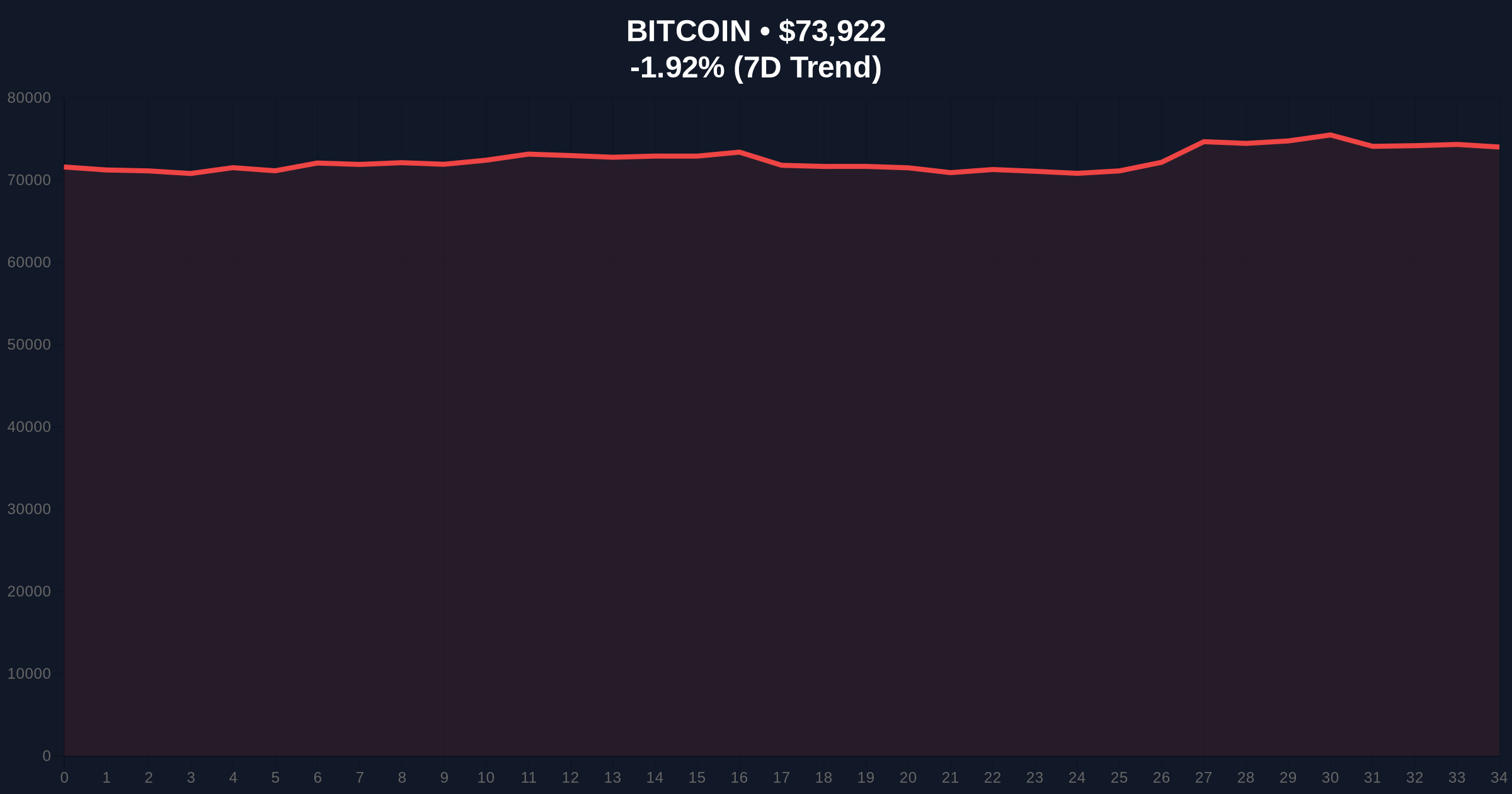
On April 15, 2026, major financial institutions including Goldman Sachs and BlackRock are seeking to launch Bitcoin options-based ETFs designed to generate income while potentially damping the cryptocurrency's price volatility. This development comes as Bitcoin has pulled back to around $74,000, struggling to break above its 100-day moving average amid a market sentiment of "Extreme Fear" with a score of 23/100. The proposed ETFs could fundamentally alter Bitcoin's market structure by introducing large-scale options selling and associated dealer hedging, which may extend the multiyear decline in both implied and realized volatility that has already been observed.
The current market data reveals a cryptocurrency in consolidation with significant technical and sentiment indicators. Bitcoin's price has retreated from recent highs, creating a critical juncture for traders and investors.
| Metric | Value | Source |
|---|---|---|
| Current Bitcoin Price | $73,961 | Source: CoinGecko |
| 24-Hour Trend | -1.67% | Source: CoinGecko |
| Recent High | ~$76,000 | Source: public statement |
| Global Crypto Sentiment | Extreme Fear (23/100) | Source: CoinGecko |
| CoinDesk 20 Index 24h Change | -1% | Source: public statement |
Not provided in source data: Specific trading volumes for the proposed ETFs, exact launch timelines, or regulatory approval probabilities.
Why now? Bitcoin's volatility has been declining for three years, primarily due to the growing popularity of options-selling strategies. The current market environment, characterized by "Extreme Fear" sentiment and price consolidation around $74,000, creates an opportune moment for institutions to introduce yield-generating products that appeal to risk-averse investors seeking exposure without extreme price swings.
Who benefits? Institutional investors and risk-averse retail participants stand to gain from potentially calmer market conditions and income generation. However, volatility traders and speculators who profit from Bitcoin's wild price swings may face diminished opportunities. Market makers and dealers could benefit from increased options trading volume and associated hedging activities.
Time horizons: In the short-term (days/weeks), approval and launch of these ETFs could provide immediate price support through dealer hedging activities. Over the longer term (months/years), sustained options selling could structurally reduce Bitcoin's volatility, potentially making it more attractive to conservative institutional capital but less appealing to volatility-focused traders.
Causal chain: ETF approval → large-scale options selling → dealers accumulate long positions → dynamic hedging (buying on declines, selling on rallies) → reduced price swings → lower realized volatility → capital shifts from speculative bets to yield products → further volatility reduction.
The proposed Bitcoin Premium Income ETFs would employ covered options strategies, where fund managers sell (write) options tied to bitcoin-linked exchange-traded products while holding the underlying assets or ETFs to partially offset risk. This options selling is essentially writing insurance against price swings, with writers collecting premiums in exchange for providing protection.
When options are sold in large volumes, dealers or market makers who take the other side of these trades end up with long positions. To manage their risk exposure, these entities then engage in dynamic hedging, buying the underlying asset on price declines and selling on rallies. This process, known as hedging positive gamma exposure, creates a mechanical dampening effect on volatility by adding counter-pressure to price movements.
The availability of yield-generating institutional-grade products may also redirect capital away from pure speculative positions, further contributing to lower realized volatility over time through reduced leverage and directional betting.
The development of income-focused Bitcoin ETFs represents a maturation of cryptocurrency financial products, following the earlier approval of spot Bitcoin ETFs. This trend mirrors traditional finance where income-generating products often follow basic exposure vehicles.
The bullish narrative around volatility-reducing ETFs faces several significant challenges and uncertainties that warrant skeptical examination.
Failure Conditions: The volatility-reduction mechanism would break down if: 1) Options volumes remain insufficient for meaningful market impact, 2) Dealers cannot effectively hedge due to liquidity constraints, or 3) External shocks (macro events, regulatory actions) overwhelm the damping effect.
If successfully implemented, these income ETFs could accelerate Bitcoin's transition toward a more stable asset class, potentially increasing its appeal to pension funds, endowments, and other conservative institutional investors. However, this stability may come at the cost of reduced trading opportunities for volatility-focused market participants.
The development also raises questions about Bitcoin's evolving identity, whether it will maintain its characteristics as a high-volatility alternative asset or transform into a more conventional income-generating instrument within diversified portfolios.
Bitcoin's implied volatility has been declining for three years, primarily due to the growing popularity of options-selling strategies among institutional and sophisticated traders. This trend represents a natural maturation of cryptocurrency markets as they develop more sophisticated financial instruments and attract more risk-managed capital.
The current technical situation finds Bitcoin struggling to rise past its 100-day simple moving average, a pattern reminiscent of mid-January when sellers regained control at this level and stalled recovery. This creates a critical technical juncture against which the potential volatility-dampening effects of new ETFs will be tested.
Beyond the specific ETF proposals, several related developments provide context for Bitcoin's evolving market structure:
The proposed Bitcoin income ETFs represent a significant potential shift in market structure that could mechanically reduce volatility through large-scale options selling and dealer hedging. However, their effectiveness remains contingent on regulatory approval, sufficient market depth, and the ability to overcome current "Extreme Fear" sentiment. The development highlights Bitcoin's ongoing evolution from a speculative asset toward a more integrated financial instrument, though this transformation faces substantial implementation challenges.
Q1: How exactly would these ETFs reduce Bitcoin's volatility?The ETFs would sell options in large volumes, causing dealers to dynamically hedge by buying Bitcoin on declines and selling on rallies, creating counter-pressure to price movements.
Q2: What is the current market sentiment toward Bitcoin?Global crypto sentiment shows "Extreme Fear" with a score of 23/100, indicating high risk aversion among market participants.
Q3: Which institutions are proposing these income ETFs?Goldman Sachs has filed for a Bitcoin Premium Income ETF, and BlackRock is looking to launch a similar product.
Q4: What are the main risks to this volatility-reduction narrative?Key risks include regulatory hurdles, insufficient options market depth, and external shocks that could overwhelm the damping mechanism.
Q5: How has Bitcoin's volatility trended recently?Bitcoin's implied volatility has been declining for three years due to growing options-selling activity.
Q6: What technical level is Bitcoin currently struggling with?Bitcoin is facing resistance at its 100-day simple moving average, trading around $74,000 after recently hitting highs near $76,000.
Traders and analysts are closely watching whether Bitcoin can break above its 100-day moving average and how regulatory decisions on the proposed income ETFs might alter market dynamics in the coming weeks.
What to watch next: Crypto Daybook Americas Share Share this article Copy linkX (Twitter)LinkedInFacebookEmail Income ETFs could be bitcoin’s volatility kill switch What you need to know for April 15, 2026 By Omkar Godbole|Edited by Sheldon Reback Apr 15, 2026, 11:43 a.m.; Today bitcoin BTC$73,956.83 has pulled back to $74,000 after hitting highs near $76,000 on Tuesday..
Evidence & Sources
Primary source: https://www.coindesk.com/daybook-us/2026/04/15/income-etfs-could-be-bitcoin-s-volatility-kill-switch
Updated at: Apr 15, 2026, 03:51 PM
Data window: Apr 15, 2026, 01:43 PM → Apr 15, 2026, 03:50 PM
Evidence stats: 9 metrics, 5 timeline points.
Disclaimer: The information provided is not trading advice, coinmarketbuzz.com holds no liability for any investments made based on the information provided on this page. We strongly recommend independent research and/or consultation with a qualified professional before making any investment decisions.
All published reports are reviewed by our editorial team for factual consistency, neutrality, and reader clarity.