Loading News...
Loading...

Loading News...

VADODARA, April 8, 2026. The following report is based on currently available verified source material and market data.
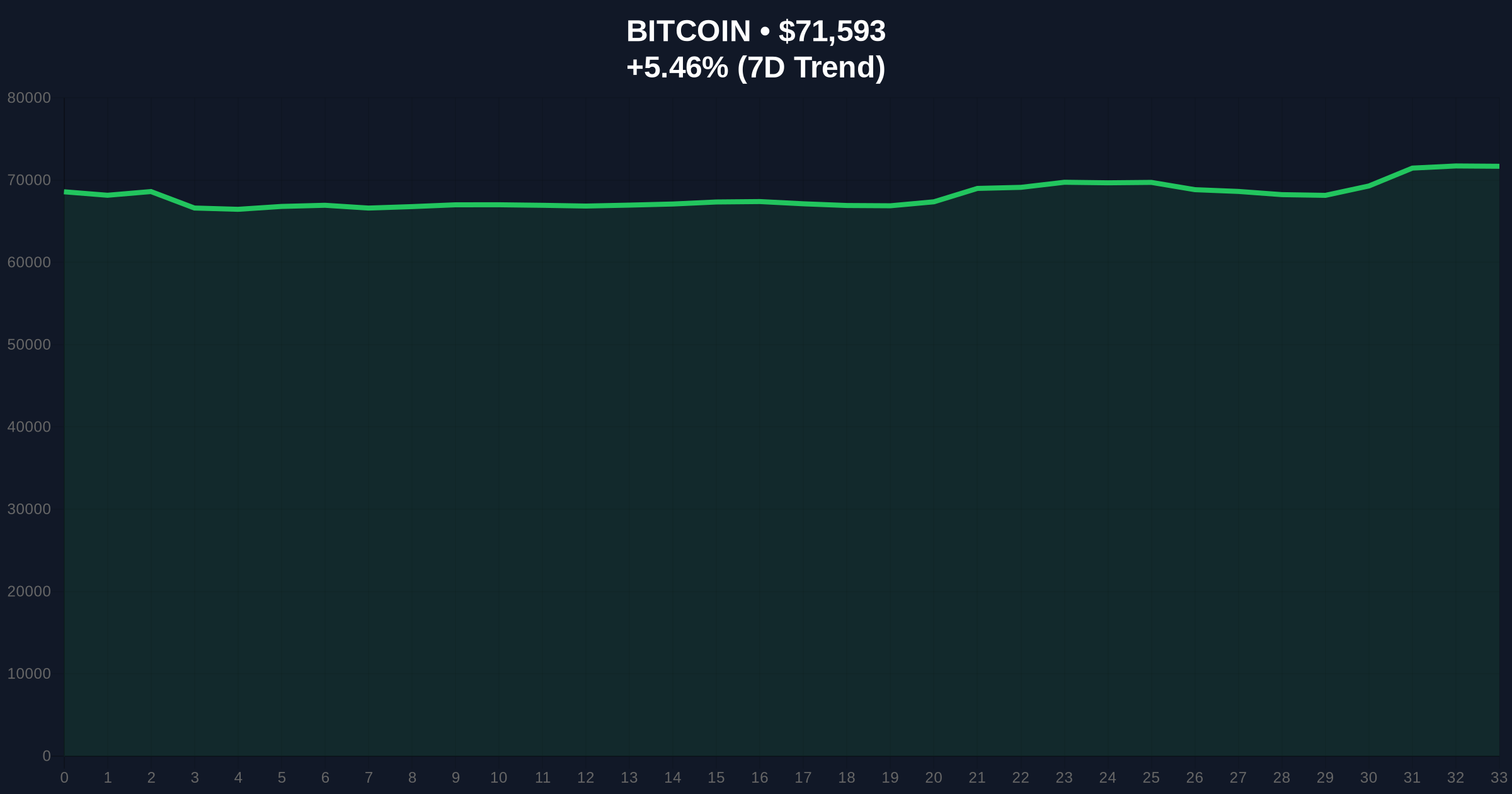
On April 8, 2026, crypto markets are entering a phase as Bitcoin shows early signs of a technical breakout, pushing above important levels after a period of heavy bearish sentiment. According to analyst Gareth Soloway, the next immediate test sits around the $75,000, $76,000 range, with a successful move potentially opening the door toward $80,000, $85,000 in the near term. This matters because, unlike earlier crypto cycles driven largely by internal narratives, the current environment is deeply tied to macro forces, particularly oil prices and geopolitical stability, creating a two-layered market where short-term momentum clashes with medium-term macro dependency.
Bitcoin's current price is $71,586, with a 24-hour trend of 5.45%, indicating upward momentum. The global crypto sentiment is "Extreme Fear" with a score of 17/100, suggesting retail bearishness that historically triggers moves in the opposite direction. Key resistance levels identified by analysts include $75,000, $76,000 as the immediate test, with potential targets of $80,000, $85,000 if broken. Source: CoinGecko for price and sentiment data; Source: public statement for resistance levels.
| Metric | Value | Source |
|---|---|---|
| Bitcoin Price | $71,586 | CoinGecko |
| 24h Trend | 5.45% | CoinGecko |
| Global Sentiment | Extreme Fear (17/100) | CoinGecko |
| Resistance Range | $75,000, $76,000 | Public statement |
| Potential Target | $80,000, $85,000 | Public statement |
Why now? The significance lies in the divergence between technical breakout signals and persistent macro uncertainty, with Bitcoin's move occurring amid "Extreme Fear" sentiment that often precedes reversals. Who benefits? Short-term momentum traders may gain from a positioning squeeze, while longer-term investors face risks if macro conditions reverse. Time horizons: In the short term (days/weeks), upside is fueled by momentum and sentiment shifts; in the medium term (months), gains depend on oil trends and rate expectations. Causal chain: Bearish retail positioning → reduced selling pressure → technical breakout above resistance → potential momentum cascade toward higher targets, but this is contingent on macro factors like oil declines stabilizing the environment.
The mechanism involves a feedback loop between sentiment, positioning, and macro drivers. Initially, heavy bearish sentiment across retail markets leads to crowded short positions or reduced buying. This thin sell-side liquidity means that even moderate buying pressure can trigger a breakout above key levels like $75,000, $76,000. Once resistance is breached, algorithmic and momentum traders may enter, creating a cascade that pushes prices toward $80,000, $85,000. However, this technical move is mechanically dependent on macro conditions: if oil prices decline, it reduces inflationary pressures and supports risk assets like Bitcoin; if oil spikes, it could stall the rally by increasing macro uncertainty.
While Bitcoin sets the tone, Ethereum and XRP are following rather than leading. Ethereum, as a proxy for crypto risk appetite, could benefit from improving liquidity if macro pressure eases, but its upside remains tied to Bitcoin's trajectory without clear independent catalysts. XRP trades within a narrative-driven framework influenced by regulatory developments, moving in line with broader market sentiment. This highlights a market where altcoins lack breakout independence, contrasting with earlier cycles driven by internal narratives.
The bearish scenario questions whether the breakout is sustainable. Key risks include:
Practically, traders should watch oil price movements and Bitcoin's ability to hold above $75,000, $76,000. If the breakout holds, it could attract institutional interest and improve market structure, but continued macro dependency means volatility may remain elevated. Regulatory developments for XRP and Ethereum upgrades could later provide independent momentum, but in the near term, the market remains Bitcoin-centric.
Historically, crypto cycles were driven by internal factors like adoption and technological innovation. The current shift to macro-driven markets reflects broader financial integration, where Bitcoin's price action is increasingly correlated with traditional assets like oil and influenced by global economic signals.
Amid this macro-sensitive environment, institutional products like Morgan Stanley's Bitcoin ETF are launching, potentially adding liquidity but also tying crypto closer to traditional finance. Additionally, analyst predictions for ETF volumes highlight growing institutional engagement, while reports on Bitcoin miners underscore infrastructure ties to broader tech trends like AI.
Bitcoin's technical breakout faces a critical test from macro forces, with short-term momentum conflicting with medium-term dependency on oil and rates. Ethereum and XRP are likely followers, emphasizing the need for cautious optimism amid high uncertainty.
What to watch next: Crypto Market Today: What Comes Next For Bitcoin, Ethereum and XRP; A Breakout With a Macro Twist?; Macro Still Driving the Market Unlike earlier crypto cycles driven largely by internal narratives, the current environment is deeply tied to macro forces..
Evidence & Sources
Primary source: https://coinpedia.org/news/crypto-market-today-what-comes-next-for-bitcoin-ethereum-and-xrp-a-breakout-with-a-macro-twist
Updated at: Apr 08, 2026, 06:21 PM
Data window: Apr 08, 2026, 04:10 PM → Apr 08, 2026, 04:18 PM
Evidence stats: 6 metrics, 2 timeline points.
Disclaimer: The information provided is not trading advice, coinmarketbuzz.com holds no liability for any investments made based on the information provided on this page. We strongly recommend independent research and/or consultation with a qualified professional before making any investment decisions.
All published reports are reviewed by our editorial team for factual consistency, neutrality, and reader clarity.