Loading News...
Loading...

Loading News...
Evidence & Sources
Primary source: https://coinness.com/news/1154297
Updated at: Apr 13, 2026, 02:04 AM
Data window: Apr 13, 2026, 02:02 AM → Apr 13, 2026, 02:03 AM
Evidence stats: 5 metrics, 2 timeline points.
Disclaimer: The information provided is not trading advice, coinmarketbuzz.com holds no liability for any investments made based on the information provided on this page. We strongly recommend independent research and/or consultation with a qualified professional before making any investment decisions.
All published reports are reviewed by our editorial team for factual consistency, neutrality, and reader clarity.
VADODARA, April 13, 2026. The following report is based on currently available verified source material and market data.
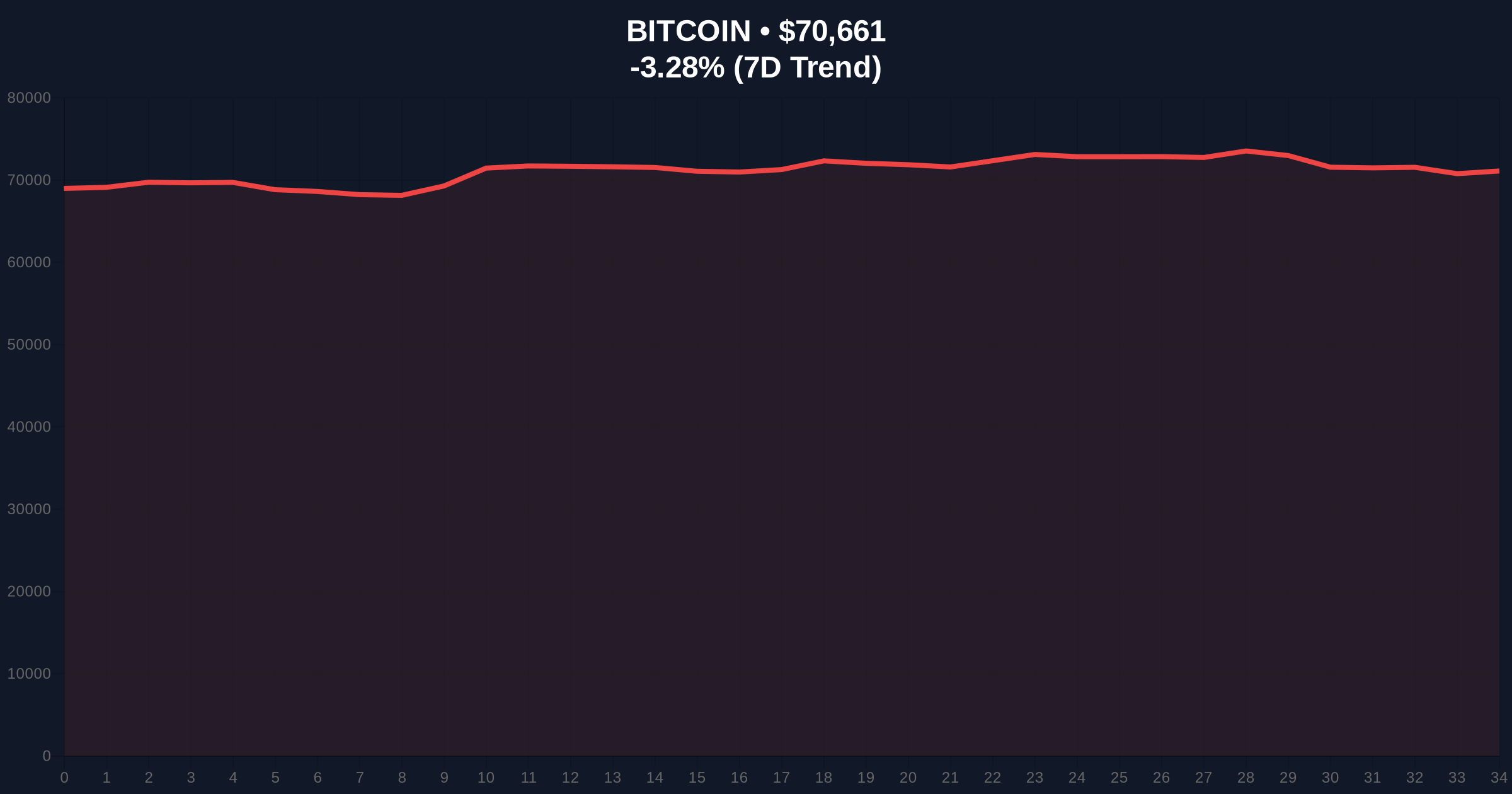
On April 13, 2026, the Crypto Fear & Greed Index, a widely tracked sentiment gauge, rose one point to 16, maintaining the market in a state of extreme fear. This development matters because it signals persistent negative investor psychology despite a slight numerical improvement, coinciding with Bitcoin's price decline to $70,738, down 3.18% over 24 hours. The index's extreme fear reading reflects ongoing market stress, potentially influencing trading behavior and liquidity dynamics across the crypto sector.
The Fear & Greed Index increased from 15 to 16, remaining deep in the extreme fear zone (0-24). Concurrently, Bitcoin's price stood at $70,738, reflecting a 3.18% drop over the past 24 hours. The index is calculated based on multiple weighted factors: volatility (25%), trading volume (25%), social media mentions (15%), surveys (15%), Bitcoin's market cap dominance (10%), and Google search volume (10%). Source: public statement. Source: CoinGecko.
| Metric | Value | Source |
|---|---|---|
| Fear & Greed Index | 16 (Extreme Fear) | Alternative |
| Bitcoin Price | $70,738 | CoinGecko |
| Bitcoin 24h Change | -3.18% | CoinGecko |
| Volatility Weight in Index | 25% | Public statement |
Why now? The index's persistence in extreme fear occurs amid Bitcoin's price decline, suggesting that negative sentiment is reinforcing selling pressure rather than abating. This is significant as it contrasts with historical patterns where fear often precedes market bottoms, yet current conditions show no clear reversal signal. Who benefits? Contrarian investors and accumulation-focused whales may benefit from depressed prices and fearful retail exits, while short-term traders face heightened volatility risks. Time horizons: Short-term, extreme fear can exacerbate price drops through panic selling; longer-term, it may set the stage for a sentiment-driven rebound if fundamentals improve. Causal chain: The index rise to 16 reflects slight improvements in underlying metrics like volatility or volume, but the extreme fear classification triggers retail caution → reduced buying pressure → liquidity thinness → amplified price declines from sell-offs.
The Fear & Greed Index operates as a composite indicator derived from six weighted components: volatility (25%), trading volume (25%), social media sentiment (15%), survey data (15%), Bitcoin dominance (10%), and Google Trends (10%). A score of 16 indicates that most inputs signal fear, with volatility and volume metrics likely showing elevated stress. Mechanically, high volatility (25% weight) and low volume (25% weight) in a downtrend contribute to fear readings, which can become self-reinforcing as traders react to the index itself, creating feedback loops that dampen market participation and liquidity.
Similar to the 2021 correction, extreme fear readings have historically correlated with market bottoms, but current conditions differ due to geopolitical and macroeconomic headwinds. Key comparisons include:
The bearish scenario hinges on several uncertainties:
Practically, traders should monitor for divergences between the index and price action; a sustained fear reading alongside price stabilization could signal accumulation phases. In the near term, extreme fear may keep retail investors sidelined, reducing buy-side liquidity and increasing volatility. Institutions might use this as a gauge for entry points, but without clearer catalysts, sentiment alone is unlikely to drive a rapid reversal.
The Crypto Fear & Greed Index, launched by Alternative, has become a benchmark for market psychology since its inception, often cited during volatile periods. It ranges from 0 (extreme fear) to 100 (extreme greed), with historical extremes marking key market turning points, such as the greed peaks in 2021 and fear troughs in 2022.
Amid recent geopolitical tensions, articles discuss how events like oil price surges and U.S.-Iran negotiations are impacting crypto markets, highlighting the interplay between external shocks and sentiment indicators like the Fear & Greed Index.
The Fear & Greed Index's rise to 16 a crypto market stuck in extreme fear, with Bitcoin's price decline reinforcing negative sentiment. While historical parallels suggest potential for future rebounds, current risks and data limitations caution against overreliance on this single metric for market timing.
Q1: What does a Fear & Greed Index score of 16 mean?A score of 16 places the market in the extreme fear zone (0-24), indicating widespread negative sentiment among investors based on metrics like volatility and social media.
Q2: How is the Fear & Greed Index calculated?It uses six weighted factors: volatility (25%), trading volume (25%), social media mentions (15%), surveys (15%), Bitcoin's market cap dominance (10%), and Google search volume (10%).
Q3: Why is the index still in extreme fear if it rose?The one-point increase to 16 reflects minor improvements, but the score remains below 25, keeping it in extreme fear territory due to overall negative inputs.
Q4: How does this compare to past market cycles?Similar to corrections in 2021, extreme fear has preceded rebounds, but current conditions involve unique geopolitical and economic factors that may alter typical patterns.
Q5: Can the index predict market turns?While it signals sentiment extremes, it should not be used in isolation; combining it with price action and fundamental analysis is for accurate predictions.
Q6: What are the risks of relying on this index?Risks include data lag, manipulation of social metrics, and external shocks that can override sentiment indicators, reducing its reliability.
Traders and analysts are watching for a sustained break above 25 in the Fear & Greed Index alongside Bitcoin price stabilization as potential signals of sentiment recovery.
What to watch next: Crypto 'Fear & Greed Index' rises to 16, still in extreme fear The 'Fear & Greed Index' from cryptocurrency data provider Alternative rose one point from yesterday to 16, keeping the market in a state of extre...; The 'Fear & Greed Index' from cryptocurrency data provider Alternative rose one point from yesterday to 16, keeping the market in a state of extreme fear..