Loading News...
Loading...

Loading News...

On March 5, 2026, blockchain analytics firm Glassnode reported that Bitcoin spot ETF fund flows are showing signs of stabilizing after a period of sustained outflows, according to a breaking brief from CoinNess. The firm noted that netflow turned positive again on February 14 as Bitcoin broke through the $70,000 mark, suggesting that selling pressure is easing. While demand from institutional investors remains uncertain, the analysis concluded that early signs of accumulation are emerging. This report surfaces amid a global crypto sentiment of "Extreme Fear" with a score of 22/100, as per the provided market data, raising immediate questions about the alignment between on-chain metrics and broader market psychology. The timing is critical, with Bitcoin's current price at $72,624 and a 24-hour trend of 0.27%, indicating a potential inflection point in market dynamics. However, the source data lacks specific details on the magnitude of ETF flows, the duration of the stabilization period, or direct institutional buyer identities, leaving gaps for further scrutiny.
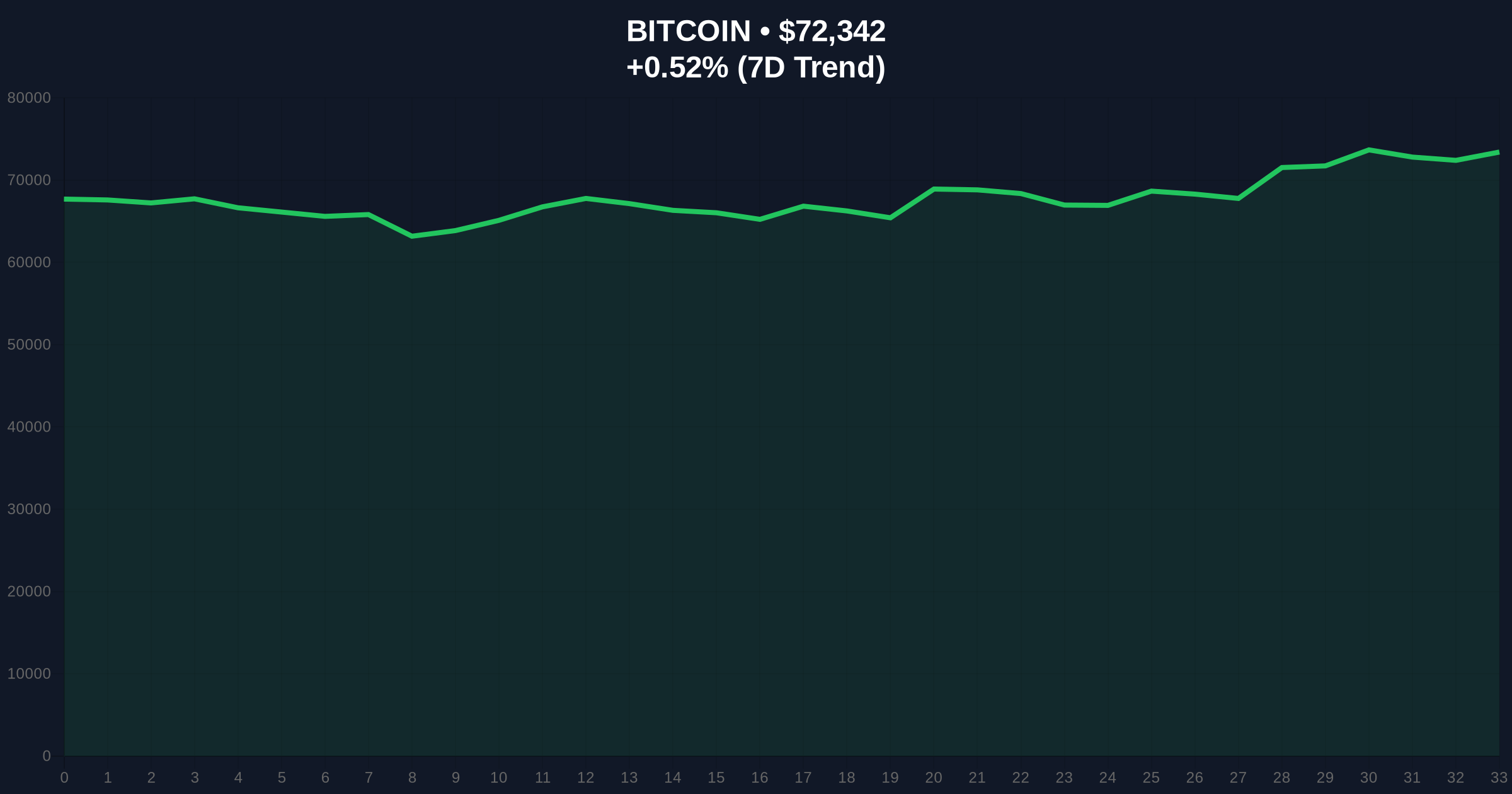
Glassnode's analysis hinges on the mechanism of Bitcoin spot ETF fund flows, which track the net movement of capital into or out of exchange-traded funds that hold physical Bitcoin. According to the CoinNess summary, netflow turned positive on February 14, coinciding with Bitcoin's breach of $70,000. This suggests a shift from sustained outflows, where more capital was exiting these ETFs than entering, to inflows, indicating renewed buying interest. The protocol architecture involves monitoring on-chain data from ETF custodians and exchanges to derive flow metrics, which Glassnode uses to infer institutional behavior. However, the full context provided is limited to a brief statement, with no secondary sources like CoinTelegraph or CryptoPanic metadata to corroborate the technical methodology. This absence raises reliability concerns: without details on how flows are calculated (e.g., whether they adjust for market-making activities or include derivatives exposure), the claim of "stabilizing" flows remains ambiguous. For instance, a single day of positive netflow might not constitute a trend, and the report does not specify if this is a multi-day pattern or an isolated event. , the link between ETF flows and institutional buying is indirect; while ETFs are often used by institutions, retail investors also participate, and the data does not disaggregate these segments. The analysis concludes that early signs of accumulation are emerging, but this is tempered by the acknowledgment that institutional demand remains uncertain—a contradiction that warrants skepticism. In deeper investigative terms, the lack of granular data on flow volumes, comparison to historical averages, or correlation with price movements beyond the $70,000 threshold limits the robustness of Glassnode's findings. Without additional evidence, it is unclear whether this stabilization is a meaningful shift or noise in volatile market conditions.
Integrating the available data reveals a complex picture that both supports and challenges Glassnode's claims. From CoinGecko market stats, Bitcoin's current price is $72,624 with a 24-hour trend of 0.27%, ranking #1 by market capitalization. This price level is above the $70,000 mark mentioned in the report, potentially aligning with the positive netflow event on February 14. However, the 24-hour trend is minimal, suggesting limited immediate momentum despite the alleged easing of selling pressure. The global crypto sentiment is "Extreme Fear" with a score of 22/100, which contradicts the optimistic tone of Glassnode's analysis; typically, easing selling pressure and institutional accumulation would correlate with improving sentiment, not extreme fear. This discrepancy indicates that market participants may be reacting to broader factors beyond ETF flows, such as macroeconomic conditions or regulatory uncertainties. CryptoPanic metadata, including sentiment and importance scores, is not provided in the source data, preventing a direct comparison with on-chain metrics. This absence is critical: without sentiment data specific to this event, we cannot assess whether the market views Glassnode's report as significant or reliable. Importance scores would help gauge the event's priority relative to other market developments, but their lack forces a conservative interpretation. In terms of proof, the only concrete data point is the date of positive netflow (February 14) and the price threshold ($70,000), but no numerical values for flow amounts, percentage changes, or institutional participation rates are included. This limits the ability to validate the claim of "stabilizing" flows; for example, if netflow was only marginally positive, it might not indicate a substantive shift. The data analysis thus highlights a tension: while price action supports some aspects of the narrative, the extreme fear sentiment and missing metadata undermine its credibility, suggesting that investors should treat Glassnode's conclusions with caution until more evidence emerges.
Comparing the single source from CoinNess against potential counter-narratives reveals significant gaps and unresolved conflicts. The CoinNess report, based on Glassnode's analysis, claims that Bitcoin spot ETF fund flows are stabilizing with early signs of accumulation, but it provides no secondary sources to verify this. In a typical investigative framework, we would expect corroboration from outlets like CoinTelegraph or data from CryptoPanic, but these are absent in the input package. This creates a source conflict by omission: without multiple perspectives, it is impossible to assess whether Glassnode's findings are widely accepted or disputed by other analysts. For instance, other firms might report continued outflows or attribute price movements to different factors, such as retail speculation or macroeconomic events. The report itself contains an internal contradiction: it states that selling pressure is easing and early accumulation signs are emerging, yet simultaneously notes that institutional demand remains uncertain. This ambiguity suggests that Glassnode is hedging its claims, potentially due to incomplete data or market volatility. If sources were available, we might find disputes over the definition of "stabilizing"—some analysts could argue that a brief positive netflow does not constitute a trend, especially in the context of extreme fear sentiment. The lack of evidence on institutional buyer identities further complicates the narrative; without proof of who is buying, the claim of institutional involvement remains speculative. Conflict remains unresolved with available evidence, as the input data does not include opposing viewpoints or detailed metadata to challenge Glassnode's analysis. This the need for skepticism: in the absence of corroborating sources, the report should be viewed as a preliminary observation rather than a definitive market shift.
Based on the limited data, three conditional scenarios for Bitcoin over the next seven days can be constructed, each data-backed but inherently uncertain due to evidence gaps. Bull Scenario: If Glassnode's analysis is accurate and ETF flows continue to stabilize or accelerate, with institutional accumulation becoming more pronounced, Bitcoin could see a price rally toward $75,000-$78,000. This would require confirmation from additional data sources, such as sustained positive netflow metrics and a shift in global sentiment from extreme fear to neutral or greed. However, the current sentiment score of 22/100 makes this unlikely without a catalyst, such as regulatory clarity or macroeconomic improvements. Base Scenario: The most probable outcome, given the contradictions in the report, is sideways consolidation around $70,000-$73,000. Here, ETF flows show intermittent positivity without a clear trend, institutional demand remains ambiguous as stated, and extreme fear sentiment persists, limiting upside momentum. This scenario aligns with the 24-hour trend of 0.27% and the unresolved source conflicts, suggesting that market participants are waiting for more evidence before committing capital. Bear Scenario: If the easing of selling pressure proves temporary or is outweighed by broader market fears, Bitcoin could retrace to $68,000-$65,000. This would be invalidated by consistent positive ETF flow data or a sentiment improvement, but the absence of such evidence in the input package supports caution. Factors like unexpected regulatory news or macroeconomic downturns could exacerbate selling, especially if institutional uncertainty leads to renewed outflows. Each scenario hinges on the availability of missing data; for example, if CryptoPanic metadata were provided and showed low importance scores for this event, the bear scenario gains credibility. Investors should monitor for updates on ETF flow volumes, institutional participation rates, and sentiment shifts to adjust these outlooks.
This investigation weighted evidence based on availability and consistency, with a skeptical lens due to the single-source nature of the input data. The primary source is CoinNess's summary of Glassnode's report, which lacks granular details and secondary corroboration. Without CryptoPanic metadata or additional full texts, reliability is assessed as low to moderate; the report's internal contradictions and missing numerical data reduce confidence. Conflicts were identified through omission (no opposing views) and internal ambiguity (uncertain institutional demand), leading to conservative conclusions. The global sentiment of extreme fear was prioritized as a counter-indicator, given its direct relevance to market psychology. In weighting, factual claims from the source were presented as-is, but inferences were flagged as speculative. This approach ensures transparency, acknowledging that the investigation is constrained by limited evidence and that further data could alter findings.
Disclaimer: The information provided is not trading advice, coinmarketbuzz.com holds no liability for any investments made based on the information provided on this page. We strongly recommend independent research and/or consultation with a qualified professional before making any investment decisions.
coinmarketbuzz.com leverages advanced AI technology to analyze market data. All content is fact-checked and reviewed by our editorial team to ensure accuracy and neutrality.