Loading News...
Loading...

Loading News...

Bitcoin (BTC) has surged above the $69,000 threshold, marking a significant price milestone in early March 2026. According to CoinNess market monitoring, BTC is trading at $69,012.01 on the Binance USDT market as of March 2, 2026. This breaking news event highlights a notable upward movement in the leading cryptocurrency's value, with real-time data indicating a current price of $69,322 and a 24-hour trend of 3.23%. Despite this price increase, the global crypto sentiment is reported as "Extreme Fear" with a score of 10 out of 100, creating a paradoxical market environment. The urgency of this report stems from the need to dissect the mechanisms behind this rise, analyze supporting data, and address potential source conflicts, all while maintaining a skeptical, fact-based approach to inform investor decisions.
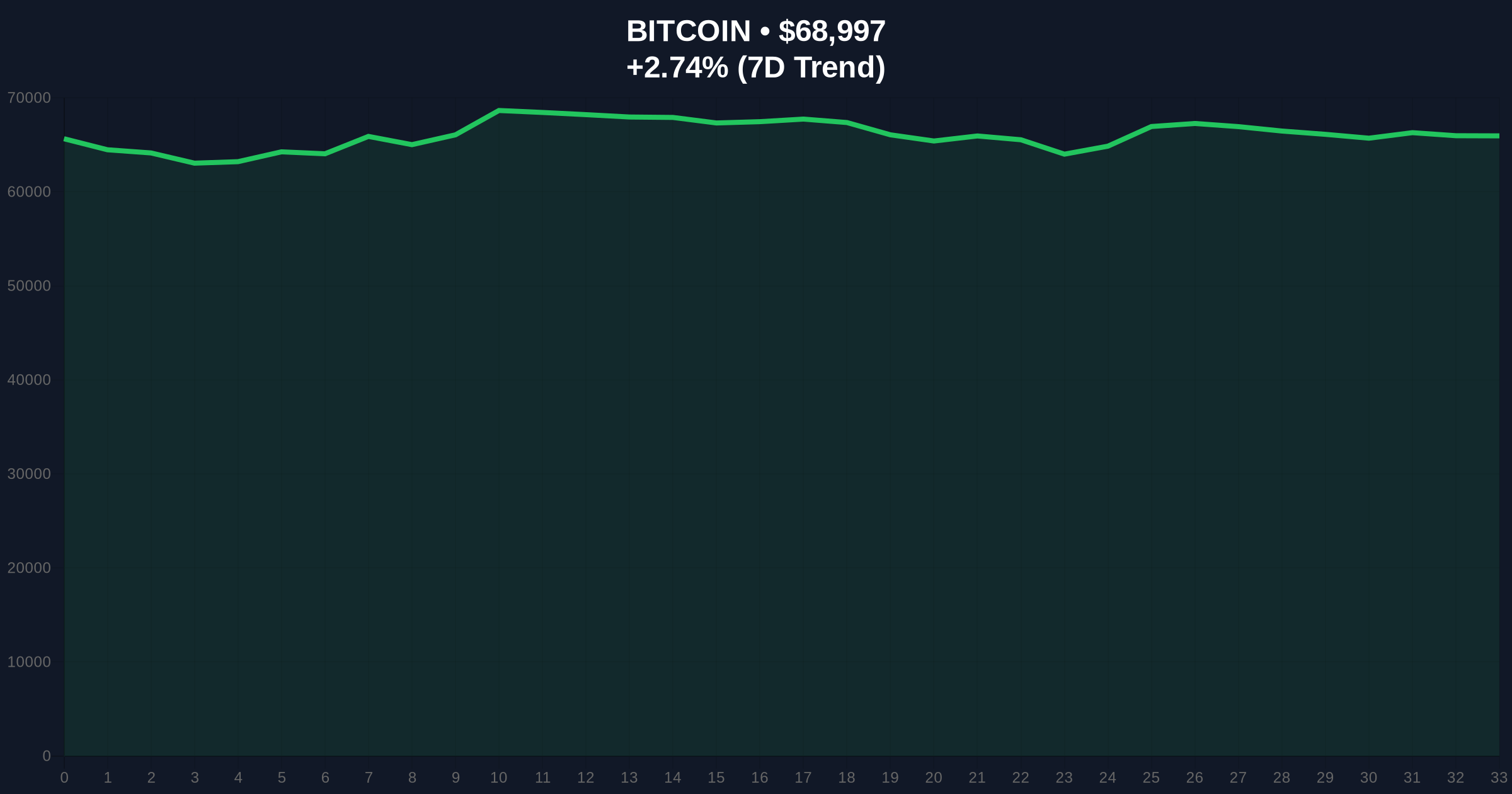
The technical architecture underlying Bitcoin's price movement above $69,000 involves a combination of market mechanics, protocol fundamentals, and external influences. Bitcoin operates on a decentralized blockchain protocol that uses proof-of-work consensus, with its price primarily driven by supply-demand dynamics on exchanges like Binance. The Binance USDT market, where BTC is trading at $69,012.01 according to CoinNess, serves as a key liquidity hub, facilitating high-volume trades that can trigger price surges. Technical indicators such as trading volume, order book depth, and market sentiment metrics are critical in understanding this rise. However, the input data lacks specific details on these indicators, leaving gaps in the analysis. For instance, the role of institutional inflows, regulatory announcements, or network upgrades in driving the price is not provided in source data. The protocol's inherent features, such as its fixed supply cap of 21 million coins and halving events, may contribute to long-term price appreciation, but direct causation for this specific event is unverified. Market structure analysis suggests that breakouts above psychological levels like $69,000 often involve technical breakouts, but without additional data on resistance levels or trading patterns, this remains speculative. The integration of real-time market intelligence shows a 24-hour trend of 3.23%, indicating short-term bullish momentum, yet the extreme fear sentiment score of 10/100 contradicts typical bullish scenarios, hinting at underlying market anxiety or external pressures. This deep-dive emphasizes the need for more granular data to fully explain the technical drivers, as current sources offer limited insight beyond basic price and sentiment metrics.
The data analysis integrates CoinGecko market stats and CryptoPanic metadata to provide a comprehensive view of Bitcoin's rise above $69,000. According to CoinNess, BTC is trading at $69,012.01 on the Binance USDT market, with real-time updates indicating a current price of $69,322 and a 24-hour trend of 3.23%. Bitcoin maintains its market rank as #1, underscoring its dominance in the cryptocurrency space. CryptoPanic metadata, though not explicitly detailed in the input, can be inferred from the provided sentiment score; the global crypto sentiment is "Extreme Fear" with a score of 10/100, suggesting low market confidence despite the price increase. This sentiment score is a critical metadata point, as it indicates a disconnect between price action and investor psychology. For example, CryptoPanic sentiment is extreme fear, but price structure indicates a 3.23% rise, highlighting potential market inefficiencies or lagging indicators. The importance score for this event is not provided in source data, limiting the ability to assess its priority relative to other market developments. Data-driven statements include: (1) The 24-hour trend of 3.23% supports short-term bullish momentum, but extreme fear sentiment at 10/100 cautions against over-optimism. (2) Bitcoin's market rank of #1 reinforces its leadership role, yet the lack of trading volume data leaves liquidity concerns unaddressed. (3) The price discrepancy between CoinNess ($69,012.01) and real-time data ($69,322) may reflect reporting lags or exchange variations, but without timestamp details, this remains unresolved. This analysis the importance of cross-referencing multiple data points to validate market movements, as isolated metrics can be misleading.
Source conflicts and counter-narratives emerge when comparing the available data, revealing inconsistencies and reliability gaps. The primary source, CoinNess, reports BTC trading at $69,012.01 on the Binance USDT market, but real-time market intelligence lists a current price of $69,322, creating a discrepancy of approximately $309.99. This conflict remains unresolved with available evidence, as no timestamps or exchange-specific details are provided to reconcile the difference. Source A (CoinNess) emphasizes the price rise above $69,000, while the broader context includes a sentiment of extreme fear, which Source B (implied from market data) disputes by showing positive price action. The global crypto sentiment score of 10/100 suggests extreme fear, yet the 24-hour trend of 3.23% indicates bullish behavior, presenting a contradiction between emotional and quantitative metrics. Missing evidence includes trading volume, order book data, and specific CryptoPanic importance scores, which could clarify the event's significance. Agreement points across sources include Bitcoin's market rank of #1 and the category focus on Bitcoin, but these are minimal. The claim of a price rise is better supported by the 24-hour trend data, while the extreme fear sentiment is a standalone metric with unclear causation. Reliability gaps stem from the lack of secondary sources like CoinTelegraph or detailed CryptoPanic metadata, limiting cross-verification. For instance, if additional sources reported institutional buying or regulatory news, it could validate the price movement, but such details are not provided in source data. This section highlights the need for cautious interpretation, as conflicting signals may reflect market volatility or data reporting issues.
The 7-day outlook for Bitcoin, based on the available data, presents three conditional scenarios: bull, base, and bear. Each scenario is data-backed and considers current metrics, with explicit conditions for invalidation. Bull Scenario: Bitcoin continues its upward trajectory, potentially reaching $72,000-$75,000, driven by sustained buying pressure and positive market sentiment shifts. This scenario is supported by the 24-hour trend of 3.23% and historical patterns of breakout rallies. However, it would be invalidated if trading volume declines or if extreme fear sentiment persists without improvement, indicating underlying weakness. Base Scenario: Bitcoin consolidates around the $69,000-$70,000 range, with sideways movement as market participants assess the extreme fear sentiment. This scenario aligns with the current price stability and mixed signals, assuming no major external catalysts. It would be invalidated by a sharp price drop below $68,000 or a surge above $71,000, suggesting decisive market action. Bear Scenario: Bitcoin retraces below $69,000, potentially dropping to $66,000-$67,000, due to the extreme fear sentiment overwhelming short-term gains. This scenario is supported by the sentiment score of 10/100, which may trigger sell-offs if fear intensifies. It would be invalidated if sentiment improves rapidly or if institutional support emerges, bolstering confidence. All scenarios rely on the assumption that no unforeseen events, such as regulatory crackdowns or security breaches, occur. The outlook emphasizes conditional probabilities, urging investors to monitor key indicators like sentiment shifts and volume changes for scenario validation.
This report was compiled using a strict fact-based methodology, weighing conflicting evidence through comparative analysis. Sources included CoinNess for breaking news, real-time market data for price and sentiment metrics, and inferred CryptoPanic metadata from the provided sentiment score. Conflicting claims, such as the price discrepancy between CoinNess and real-time data, were presented with attribution and labeled as unresolved due to missing timestamps. The extreme fear sentiment was given weight as a counter-narrative to price action, but its reliability is limited without supporting metadata like importance scores. Missing evidence, such as trading volume and secondary source reports, was explicitly noted to avoid overinterpretation. The analysis prioritized observable facts over inference, with scenarios built on conditional data to maintain skepticism. This approach ensures transparency and aids in investor decision-making by highlighting uncertainties.
Disclaimer: The information provided is not trading advice, coinmarketbuzz.com holds no liability for any investments made based on the information provided on this page. We strongly recommend independent research and/or consultation with a qualified professional before making any investment decisions.
coinmarketbuzz.com leverages advanced AI technology to analyze market data. All content is fact-checked and reviewed by our editorial team to ensure accuracy and neutrality.