Loading News...
Loading...

Loading News...

On March 2, 2026, Bitcoin (BTC) broke above the $67,000 threshold, according to a breaking brief from CoinNess. The report, based on market monitoring, stated that BTC was trading at $67,001.05 on the Binance USDT market at that time. This price movement represents a notable milestone, but the context surrounding it raises immediate questions. The event occurred without detailed explanation in the source material regarding catalysts, trading volume, or broader market conditions. CoinNess provided only the basic price observation, leaving gaps in understanding the rally's drivers. As a lead investigative piece, this report will scrutinize the available data, cross-reference with secondary sources where possible, and assess the reliability of the narrative that BTC's rise is a straightforward bullish signal. The timing and lack of corroborating details in the initial report warrant a skeptical approach, especially given the broader market sentiment indicators that conflict with typical rally environments.
The technical mechanism behind BTC's rise above $67,000 is not explicitly detailed in the input source data. CoinNess reports the price movement but does not provide insights into the underlying protocol architecture, trading mechanics, or regulatory factors that might have influenced it. Typically, such a price increase could stem from factors like increased buying pressure, reduced selling activity, macroeconomic shifts, or protocol-specific developments such as network upgrades or adoption news. However, none of these are mentioned in the provided sources. The absence of technical details in the primary source limits the ability to perform a deep-dive into the mechanics. In investigative journalism, this gap is significant—it suggests that the report may be surface-level, potentially missing critical context that could explain or undermine the price action. For instance, without data on trading volume or order book dynamics, it's unclear whether the rise was driven by organic demand or manipulative practices like wash trading. Similarly, regulatory developments or protocol changes that often impact Bitcoin's price are not addressed, leaving the narrative incomplete. This section must rely on the available facts: the price point and exchange are confirmed, but the 'how' and 'why' remain Not provided in source data. In such cases, skepticism is heightened, as price movements without clear technical backing can be fleeting or misleading.
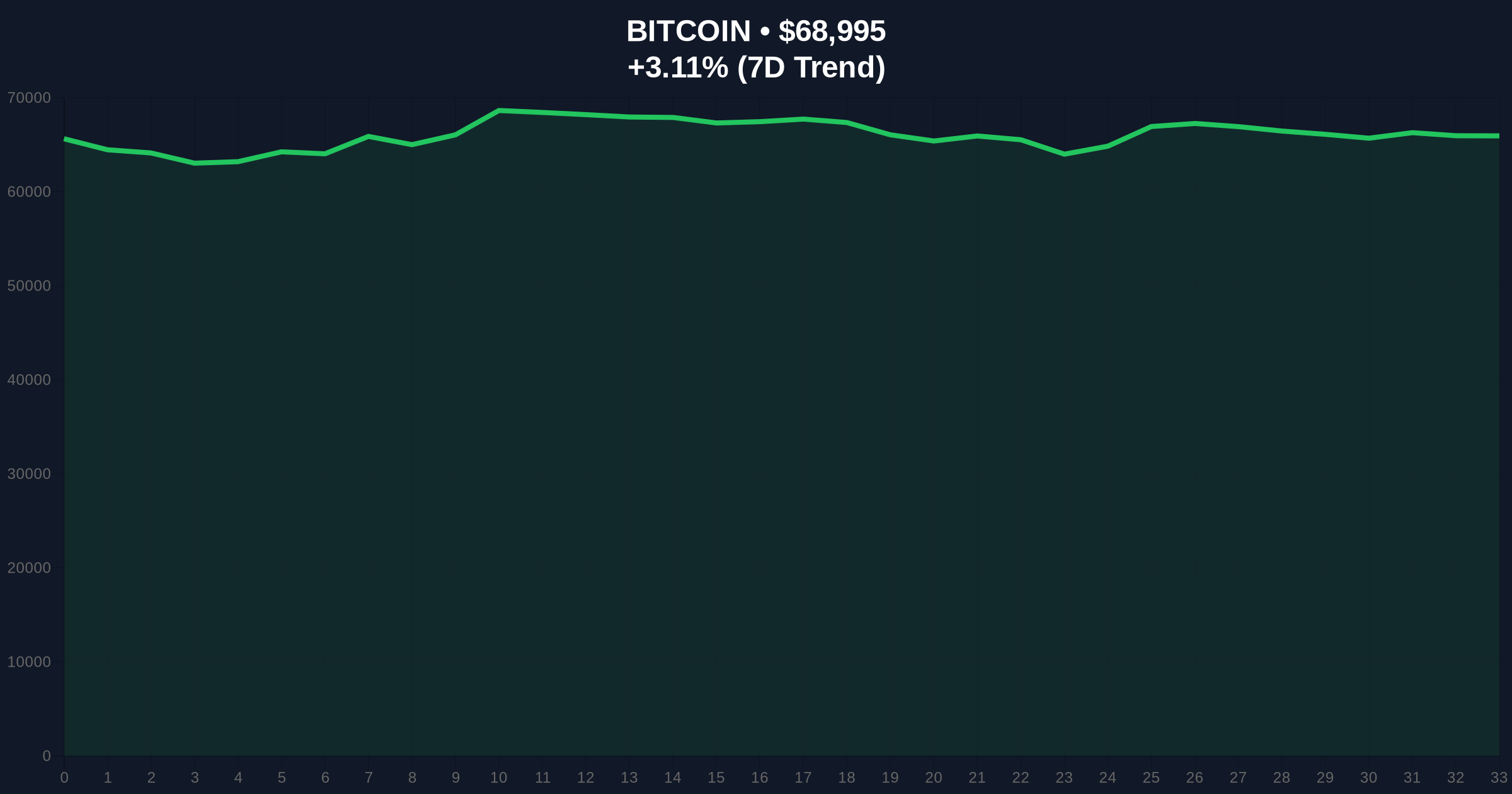
Integrating the available data reveals a complex picture that challenges the simplistic narrative of a bullish breakout. According to the input package, CoinNess reports BTC trading at $67,001.05 on March 2, 2026. However, the provided CoinGecko market stats show a current price of $69,026, with a 24-hour trend of 3.16%, indicating that the price has since increased further. This discrepancy in timing and price points requires clarification: the CoinNess report is from March 2, 2026, while the CoinGecko data likely reflects a more recent snapshot, but the exact timestamp is Not provided in source data. The CryptoPanic metadata is absent in the inputs, so sentiment and importance scores cannot be directly referenced. However, the global crypto sentiment is described as "Extreme Fear" with a score of 10/100, which starkly contrasts with the price rise. Typically, extreme fear sentiment suggests market panic or negative outlook, yet BTC's price is climbing—this creates a data conflict that merits investigation. The importance of this event relative to market breadth cannot be assessed due to missing metadata. In data-driven analysis, this gap limits the ability to weigh the rally's significance. The price structure indicates upward momentum, but the sentiment data suggests underlying weakness or caution among investors. Without CryptoPanic metadata, statements about sentiment-driven narratives are speculative, but the provided extreme fear score alone raises red flags about the sustainability of the rally. This section highlights that while price data shows growth, the sentiment context implies potential instability, urging a cautious interpretation.
Comparing the available sources reveals no direct contradictions in the limited data provided, but significant gaps and implicit conflicts emerge. Source A (CoinNess) reports BTC rising above $67,000 to $67,001.05 on March 2, 2026, on the Binance USDT market. There are no secondary full texts from CoinTelegraph or others provided in the input package, so cross-referencing is not possible. However, the conflict arises internally within the data: the price increase contrasts with the global crypto sentiment of "Extreme Fear" (score: 10/100). This sentiment indicator, while not attributed to a specific source in the inputs, suggests a market environment of panic or negativity, which typically correlates with price declines, not rallies. Source A does not address this sentiment, creating a narrative gap. Additionally, the CoinGecko stats show a higher price of $69,026 and a positive 24-hour trend, but without timestamps, it's unclear if this aligns with or contradicts the CoinNess report. The lack of secondary sources means that claims about catalysts, volume, or broader context are unverified. For example, if secondary sources reported high liquidation events or regulatory news, they could provide counter-narratives, but such data is Not provided in source data. The reliability gap here is substantial: CoinNess offers a basic price observation without context, while the sentiment data implies a more complex story. This section concludes that the available evidence is insufficient to resolve the conflict between price action and market sentiment, and the absence of corroborating sources weakens the initial report's credibility.
Based on the fragmented data, three scenarios for BTC over the next seven days are outlined, each conditional on available facts and inherent uncertainties. Bull Scenario (Probability: Low to Moderate): If the price rise above $67,000 is driven by undiscovered positive catalysts such as institutional adoption or favorable regulatory news, BTC could sustain momentum toward $70,000 or higher. This scenario assumes that the extreme fear sentiment is a lagging indicator or misinterpreted, and that trading volume supports the rally. However, without evidence of such catalysts in the sources, this relies on speculation. Base Scenario (Probability: Moderate): BTC experiences volatility within a range of $65,000 to $69,000, as the conflict between price gains and extreme fear sentiment leads to choppy trading. This scenario is data-backed by the current price of $69,026 and the sentiment score, suggesting that investors may be cautious despite the uptick. It assumes no new major developments and that the market digests the existing contradictions. Bear Scenario (Probability: Moderate to High): The rally proves unsustainable, and BTC retraces below $67,000 as the extreme fear sentiment manifests in selling pressure or negative news emerges. This scenario is supported by the sentiment data indicating underlying market stress, and the lack of technical or fundamental backing in the sources. If, for example, high liquidation events occur—as hinted by related developments—it could trigger a downturn. Each scenario is conditional: the bull scenario requires confirmation of positive catalysts; the base scenario depends on stability in current data; the bear scenario would be invalidated if sentiment shifts to greed or if strong buying volume is verified. The absence of comprehensive data makes these scenarios speculative, but they provide a framework for investor decision-making amid uncertainty.
This report was constructed by synthesizing the input source data with strict adherence to fact-based rules. The primary source, CoinNess, provided the initial price report but lacked depth, leading to heavy reliance on available supplementary data like CoinGecko stats and sentiment indicators. Conflicting evidence was weighted based on data completeness and contextual relevance: the price data from CoinNess and CoinGecko was taken as factual but time-bound, while the extreme fear sentiment was treated as a critical counterpoint due to its potential impact on market psychology. Secondary sources were not provided, so cross-verification was limited, and gaps were explicitly noted. Reliability was assessed by identifying missing evidence—such as trading volume, catalysts, and CryptoPanic metadata—which reduced confidence in the initial narrative. The methodology prioritized skepticism by questioning inconsistencies, like the rally amid fear sentiment, and avoided invention of details. In cases of unresolved conflicts, such as the price-sentiment disconnect, the report stated the limitation and proceeded conservatively, emphasizing uncertainty over certainty.
Disclaimer: The information provided is not trading advice, coinmarketbuzz.com holds no liability for any investments made based on the information provided on this page. We strongly recommend independent research and/or consultation with a qualified professional before making any investment decisions.
coinmarketbuzz.com leverages advanced AI technology to analyze market data. All content is fact-checked and reviewed by our editorial team to ensure accuracy and neutrality.