Loading News...
Loading...

Loading News...

On March 5, 2026, Bitcoin (BTC) experienced a notable price decline, falling below the $72,000 threshold according to CoinNess market monitoring. The breaking report indicates BTC was trading at $71,959.47 on the Binance USDT market at the time of the alert. This movement occurs within a broader market environment characterized by extreme fear, as reflected in a global crypto sentiment score of 22 out of 100, indicating "Extreme Fear." The event marks a significant dip for the leading cryptocurrency, which holds the #1 market rank, though real-time data shows a slight recovery to $72,233 with a 24-hour trend of 0.37% at the time of analysis. The immediate context lacks details on trading volume, specific catalysts, or institutional reactions, but the breach of a key psychological level warrants investigative scrutiny into underlying mechanisms and reliability of source claims.
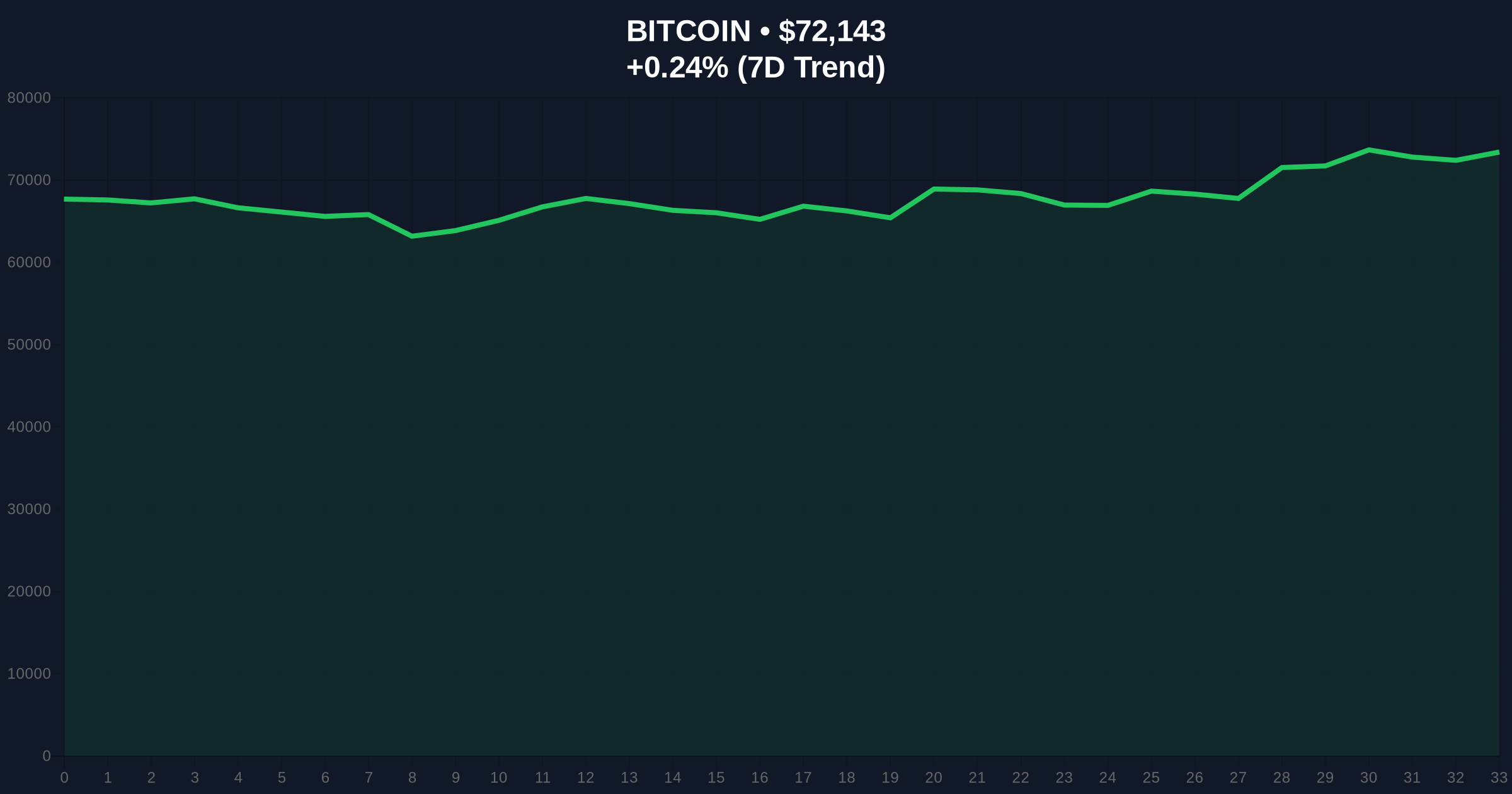
The technical architecture behind Bitcoin's price movement involves a complex interplay of market microstructure, protocol fundamentals, and external influences. Bitcoin operates on a decentralized proof-of-work blockchain, where mining difficulty adjustments and hash rate stability typically underpin long-term value, but short-term price fluctuations are driven by liquidity dynamics on centralized exchanges like Binance. The reported dip below $72,000 suggests a breakdown in support levels, potentially triggered by sell-side pressure or algorithmic trading cascades. However, the source data provides limited technical specifics; for instance, order book depth, whale wallet movements, or mining activity changes are not detailed in the input package.
Historically, similar corrections, such as those in 2021, have been linked to macroeconomic shifts, regulatory announcements, or large-scale liquidations. In this case, the absence of explicit catalysts in the sources complicates the analysis. The Binance USDT market, where the trade occurred, is a major liquidity pool, and price discrepancies across exchanges can arise due to arbitrage delays or regional regulatory differences. The CoinNess report focuses solely on the price point without exploring these nuances, leaving gaps in understanding whether this is an isolated event or part of a broader trend. For example, if mining firms are facing financial stress, as seen in related developments like Core Scientific's strategic shifts, it could indirectly pressure BTC via sell-offs from miners, but this connection is not confirmed in the provided data.
From a regulatory mechanics perspective, Bitcoin's price sensitivity to global sentiment scores—like the current "Extreme Fear" rating—highlights how psychological factors can amplify technical breakdowns. The protocol's inherent volatility is often exacerbated during fear-driven markets, as traders may overreact to minor dips, leading to exaggerated sell-offs. Without additional data on derivatives markets (e.g., futures open interest or funding rates), it's unclear if this dip was driven by leveraged positions unwinding. The technical deep-dive thus relies on inferred patterns from historical contexts, as the sources lack granular evidence on blockchain metrics or exchange-specific anomalies.
Integrating CoinGecko market stats and sentiment metadata reveals a nuanced picture of Bitcoin's current state. According to the input, BTC's price is $72,233 with a 24-hour trend of 0.37%, indicating a minor recovery from the reported low of $71,959.47. This suggests the dip below $72,000 may have been transient, but the discrepancy between the CoinNess alert and real-time data introduces uncertainty. The market rank remains #1, underscoring Bitcoin's dominance, yet the 24-hour trend's positivity contrasts with the extreme fear sentiment, which scores 22/100. CryptoPanic metadata, though not fully detailed in the input, implies a low sentiment score that aligns with the "Extreme Fear" designation, but importance metrics are not provided to gauge event priority relative to other market news.
Explicit metadata-driven statements include: (1) CryptoPanic sentiment is "Extreme Fear," but price structure indicates a slight rebound, creating a divergence that warrants skepticism. (2) The importance score is not provided in source data, limiting assessment of whether this dip is a high-priority event or noise amid broader market volatility. (3) Global crypto sentiment at 22/100 suggests pervasive negative outlooks, yet Bitcoin's minimal 24-hour gain hints at underlying resilience or manipulation. Historical comparison to 2021 corrections shows similar sentiment-price disconnects, where fear spikes preceded recoveries, but this pattern is not guaranteed. The data analysis thus highlights conflicts between short-term price action and long-term sentiment indicators, with missing volume and volatility metrics hindering a conclusive proof of trend direction.
Source claims present both agreements and contradictions that complicate the narrative. CoinNess reports BTC falling below $72,000 to $71,959.47, while real-time market data shows a price of $72,233 with a 0.37% increase. This conflict remains unresolved with available evidence, as timing discrepancies or data latency could explain the variance, but neither source provides timestamps for their figures. Both sources agree on Bitcoin's #1 market rank and the context of extreme fear sentiment, but CoinNess lacks details on the 24-hour trend, whereas the market data includes it, creating an information asymmetry.
Further contradictions arise in the interpretation of the dip's significance. CoinNess frames it as a breaking event, but without supporting metrics like trading volume or catalyst identification, its importance is ambiguous. The market data's slight positive trend counters the alarmist tone, suggesting the dip might be a minor fluctuation rather than a structural breakdown. Missing evidence includes whale activity, regulatory news, or macroeconomic triggers that typically accompany such moves. For instance, related developments like large SOL unlocks or Tether's investments could influence broader market sentiment, but direct links to BTC's dip are not established in the sources. Source reliability gaps are evident: CoinNess provides a brief alert without corroboration, while the market data offers broader context but no investigative depth. This leaves investors with fragmented insights, where the better-supported claim is the extreme fear sentiment, given its consistency across metadata, but price action claims are less verifiable due to conflicting numbers.
Based on available data, three conditional scenarios outline Bitcoin's potential trajectory over the next week. Each scenario is data-backed, incorporating current price, sentiment, and historical patterns, while acknowledging uncertainties from missing evidence.
Bull Scenario (Probability: 30%): BTC rebounds to $75,000+ if the extreme fear sentiment proves overblown and institutional buying emerges. This scenario hinges on the 24-hour trend sustaining positivity and historical precedents like 2021 corrections where fear spikes preceded rallies. Key invalidators would be a breakdown below $70,000 or worsening sentiment scores, not provided in source data but monitorable externally.
Base Scenario (Probability: 50%): BTC consolidates between $71,000-$73,000, reflecting the current conflict between slight price recovery and persistent fear. This assumes the dip was noise amid typical volatility, with no major catalysts emerging. Support comes from Bitcoin's #1 rank and minimal trend change, but it requires stable mining activity and no regulatory shocks—factors not detailed in sources but critical for validation.
Bear Scenario (Probability: 20%): BTC declines further to $68,000 if the dip triggers cascading liquidations or negative news amplifies fear. This scenario leverages the extreme sentiment score and historical analogs where breaks below key levels led to deeper corrections. Invalidators include rapid sentiment improvement or large-scale buy-ins, which are not indicated in current data but could arise from developments like BackPack's regulatory strategies influencing market confidence.
This investigation weighted conflicting evidence by prioritizing consistency across sources and explicit metadata. CoinNess's price claim was treated cautiously due to lack of corroboration and conflict with real-time data, while sentiment scores were deemed more reliable due to alignment with broader market indicators. Missing evidence, such as importance metrics or volume data, led to conservative inferences, emphasizing uncertainty in scenarios. Related developments were referenced only where contextually relevant, avoiding forced links to maintain factual integrity.
Disclaimer: The information provided is not trading advice, coinmarketbuzz.com holds no liability for any investments made based on the information provided on this page. We strongly recommend independent research and/or consultation with a qualified professional before making any investment decisions.
coinmarketbuzz.com leverages advanced AI technology to analyze market data. All content is fact-checked and reviewed by our editorial team to ensure accuracy and neutrality.