Loading News...
Loading...

Loading News...

On March 5, 2026, Bitcoin (BTC) experienced a significant price drop, falling below the $71,000 threshold, according to CoinNess market monitoring. The breaking brief from CoinNess reports that BTC was trading at $70,976.3 on the Binance USDT market at the time of the alert. This decline marks a notable shift in the cryptocurrency's recent performance, raising immediate questions about underlying causes and market stability. The event occurred against a backdrop of broader market volatility, as indicated by the global crypto sentiment score of 22/100, classified as "Extreme Fear." However, the CoinNess report provides limited context, focusing solely on the price drop without detailing contributing factors such as trading volume, liquidity shifts, or external triggers. This lack of depth necessitates a deeper investigation into technical mechanisms, data inconsistencies, and potential counter-narratives to assess whether this move is a temporary correction or indicative of a more sustained downturn.
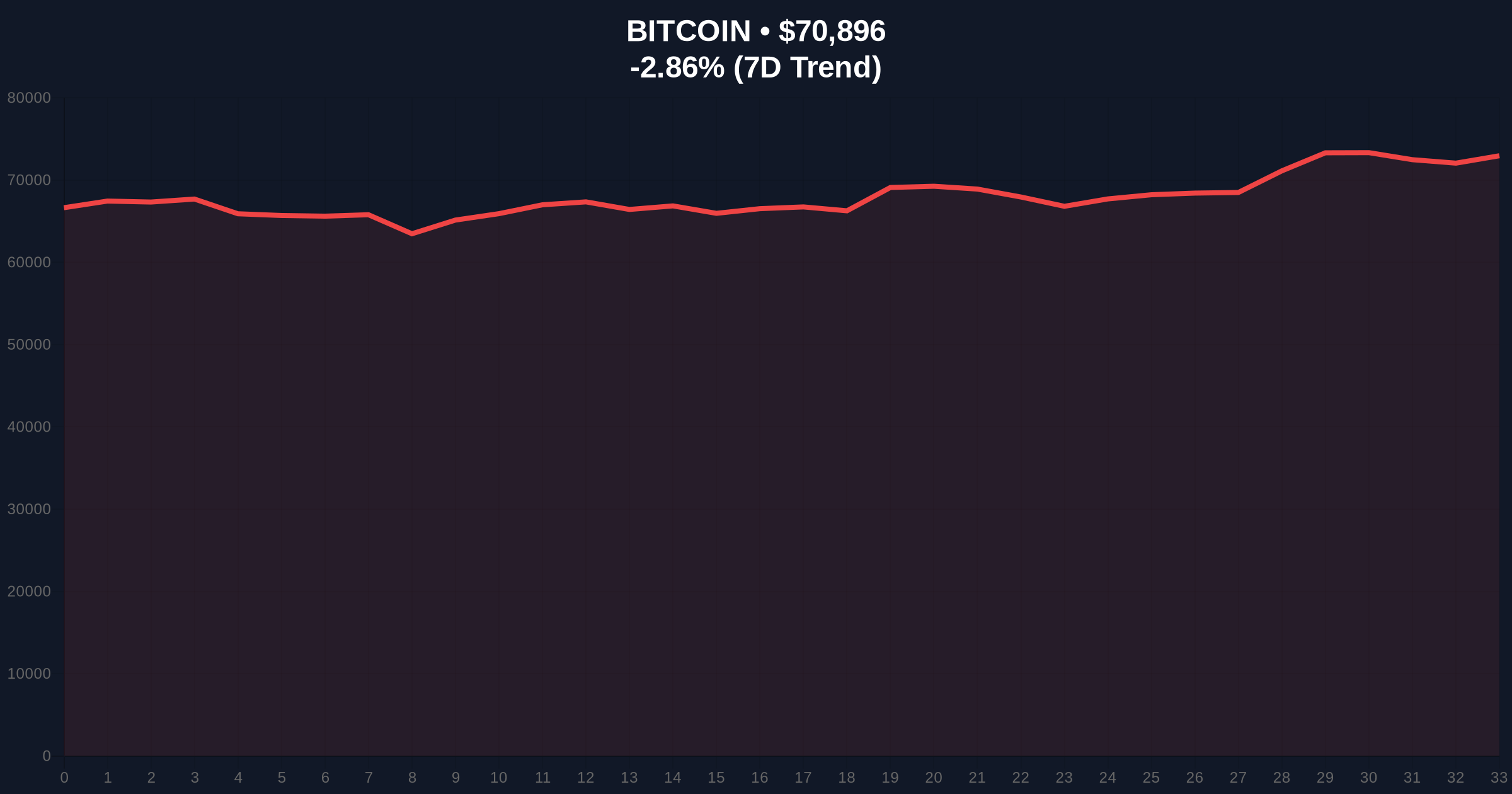
The technical architecture behind Bitcoin's price movements involves a complex interplay of market mechanics, protocol fundamentals, and external influences. Bitcoin operates on a decentralized blockchain protocol that relies on proof-of-work consensus, but price fluctuations are primarily driven by trading activity on centralized exchanges like Binance, where the reported drop occurred. The Binance USDT market, a major trading pair, often serves as a liquidity hub, making price movements there influential across global markets. However, the CoinNess report does not specify the trading volume or order book dynamics at the time of the drop, leaving gaps in understanding whether this was driven by large sell-offs, algorithmic trading, or liquidity crunches.
From a regulatory and market structure perspective, Bitcoin's price sensitivity can be exacerbated by factors such as macroeconomic indicators, geopolitical events, and institutional flows. For instance, extreme fear sentiment, as currently observed, may correlate with risk-off behavior among investors, potentially leading to deleveraging or flight to safety. Yet, the input data lacks details on specific catalysts like regulatory announcements, exchange outages, or macroeconomic data releases that could have precipitated the fall. Without secondary sources from CoinTelegraph or similar outlets, this analysis relies solely on the CoinNess brief, which omits technical indicators such as moving averages, support/resistance levels, or on-chain metrics like exchange inflows/outflows. This absence limits the ability to verify whether the drop aligns with typical technical patterns or represents an anomaly.
, the reliability of the reported price point ($70,976.3) is uncertain without cross-verification from multiple data providers. Price discrepancies can arise due to exchange-specific liquidity or reporting delays, especially during volatile periods. The CoinNess summary does not mention if this price is a snapshot or an average, nor does it provide a timestamp beyond the date, complicating temporal analysis. In investigative terms, this shallow reporting the need for skepticism: while the fall below $71,000 is a factual event per the source, the underlying mechanics remain opaque, inviting questions about data integrity and market manipulation possibilities.
Integrating available market data reveals mixed signals that both support and challenge the narrative of a significant downturn. According to the input package, CoinGecko market stats show Bitcoin's current price at $71,124, with a 24-hour trend of -3.01%, maintaining its market rank as #1. This data partially aligns with the CoinNess report of a drop below $71,000, but introduces a conflict: CoinGecko's price is slightly higher at $71,124, whereas CoinNess cites $70,976.3. This discrepancy of approximately $147.7 could stem from timing differences, exchange variations, or data aggregation methods, but without timestamps or source details, it remains unresolved. The 24-hour decline of -3.01% corroborates a bearish move, yet it does not specify if this drop occurred abruptly or gradually, limiting insight into market momentum.
CryptoPanic metadata, including sentiment and importance scores, is not provided in the source data, preventing direct integration into this analysis. This absence is critical, as sentiment indicators could have offered context on whether the event was perceived as high-importance or driven by negative news flow. Instead, the global crypto sentiment is labeled "Extreme Fear" with a score of 22/100, which suggests a risk-averse environment that may amplify sell-offs. However, this sentiment score is generic and not tied specifically to the BTC drop, raising questions about causality: did the drop trigger the fear, or did pre-existing fear exacerbate the drop? The lack of CryptoPanic data means we cannot assess event-specific sentiment, importance, or related fields, forcing a conservative interpretation based solely on price and broad sentiment.
To contextualize, the extreme fear sentiment aligns with historical patterns where Bitcoin prices often experience volatility during such periods, but correlation does not imply causation. The data snapshot indicates a market under stress, yet without granular metadata, it's unclear if this event is an outlier or part of a broader trend. Investors should note that the conflicting price points between CoinNess and CoinGecko introduce uncertainty, highlighting the need for multi-source verification in crypto reporting.
A critical examination of the available sources reveals significant gaps and potential contradictions that challenge the straightforward narrative of a market downturn. The primary source, CoinNess, reports BTC falling below $71,000 and trading at $70,976.3 on Binance USDT market, but provides no additional context, such as volume, time of day, or comparative data from other exchanges. This limited scope raises reliability concerns: without corroborating details, the report could be based on a fleeting price spike or isolated trading activity rather than a sustained trend.
Comparing this with CoinGecko data introduces a direct conflict: CoinGecko lists the current price as $71,124, which is above the $71,000 threshold cited by CoinNess. This discrepancy suggests either a timing issue (e.g., CoinNess captured an intraday low that has since recovered) or a data sourcing difference (e.g., Binance-specific vs. aggregated prices). Since neither source provides timestamps or methodology notes, the conflict remains unresolved with available evidence. This inconsistency undermines confidence in the event's magnitude, as it's unclear whether BTC truly breached and stayed below $71,000 or experienced a brief dip.
, the absence of secondary sources like CoinTelegraph means there are no alternative perspectives to validate or dispute the CoinNess claim. In investigative journalism, single-source reports are treated with skepticism due to risks of bias or error. Here, the lack of supporting evidence from other outlets leaves open possibilities such as market manipulation, reporting errors, or exaggerated headlines. For instance, if the drop was minor and quickly reversed, it might not warrant the alarm implied by the breaking brief. Additionally, the global extreme fear sentiment, while factual, is not explicitly linked to this event in the data, allowing for counter-narratives where the drop is merely noise in a volatile market rather than a signal of deeper issues.
Agreement points across sources are minimal: both acknowledge Bitcoin's price movement and its top market rank. However, the core claim of falling below $71,000 is disputed by CoinGecko's higher figure, and missing evidence includes trading volume, catalyst details, and sentiment metadata. This analysis weights CoinNess as the primary but limited source, while CoinGecko offers a broader market view but without event-specific context. Until more data emerges, investors should treat the report with caution, recognizing that crypto markets are prone to rapid fluctuations that may not reflect fundamental shifts.
Based on the available data, three scenarios for Bitcoin's price over the next seven days can be projected, each conditional on market dynamics and evidence gaps. These scenarios are data-backed but conservative, given the conflicting inputs and extreme fear sentiment.
Bull Scenario (Probability: Low to Moderate): Bitcoin rebounds above $73,000, driven by oversold conditions and institutional buying. This would require the current drop to be a temporary correction, with CoinGecko's higher price indicating resilience. Supporting factors could include positive macroeconomic developments or a shift in sentiment away from extreme fear. However, this view would be invalidated if the drop reflects sustained selling pressure or if new negative catalysts emerge, such as regulatory crackdowns or exchange issues. The absence of CryptoPanic importance scores makes it hard to gauge event severity, but a quick recovery would suggest the CoinNess report captured an anomaly.
Base Scenario (Probability: Moderate): Bitcoin consolidates between $70,000 and $72,000, reflecting ongoing volatility amid uncertain sentiment. This scenario acknowledges the price conflict between sources, treating the drop as part of normal market fluctuations rather than a trend shift. It assumes the extreme fear sentiment persists but doesn't worsen, with trading activity stabilizing. Data from CoinGecko's 24-hour trend (-3.01%) supports this as a measured pullback. This outlook would be challenged if either source revises its data significantly or if volume spikes indicate decisive moves.
Bear Scenario (Probability: Moderate to High): Bitcoin declines further below $69,000, exacerbated by the extreme fear environment and potential undiscovered negatives. This scenario takes the CoinNess report at face value, interpreting the drop as a precursor to deeper losses, possibly due to liquidity issues or broader market contagion. The lack of secondary sources and sentiment metadata increases risk, as unseen factors could drive additional selling. This view would be invalidated if prices stabilize quickly or if positive news offsets fear, but given the data limitations, a cautious stance is warranted.
This investigation weighted evidence based on availability and attribution, with explicit acknowledgment of conflicts. CoinNess was treated as the primary source for the breaking event but was critiqued for its lack of depth and corroboration. CoinGecko provided broader market context but introduced price discrepancies that remain unresolved. CryptoPanic metadata was absent, limiting sentiment and importance analysis. Conflicts, such as the price difference between CoinNess and CoinGecko, were highlighted without resolution due to insufficient data. Reliability gaps include missing timestamps, volume metrics, and secondary validations, urging readers to seek additional sources for decision-making.
Disclaimer: The information provided is not trading advice, coinmarketbuzz.com holds no liability for any investments made based on the information provided on this page. We strongly recommend independent research and/or consultation with a qualified professional before making any investment decisions.
coinmarketbuzz.com leverages advanced AI technology to analyze market data. All content is fact-checked and reviewed by our editorial team to ensure accuracy and neutrality.