Loading News...
Loading...

Loading News...

On March 3, 2026, Bitcoin (BTC) experienced a significant price decline, falling below the $67,000 threshold, as reported by CoinNess market monitoring. According to the source, BTC was trading at $66,990.41 on the Binance USDT market at the time of the report. This event marks a notable downturn in the cryptocurrency's valuation, occurring against a backdrop of broader market uncertainty. The breaking brief from CoinNess provides a direct observation of the price drop, but lacks detailed context on underlying causes or immediate market reactions beyond the specific trading data. The report does not include timestamps for when the decline began or peaked, nor does it specify trading volumes or liquidity conditions during this period. This initial snapshot sets the stage for a deeper investigation into the technical, data-driven, and narrative factors surrounding BTC's movement below $67,000.
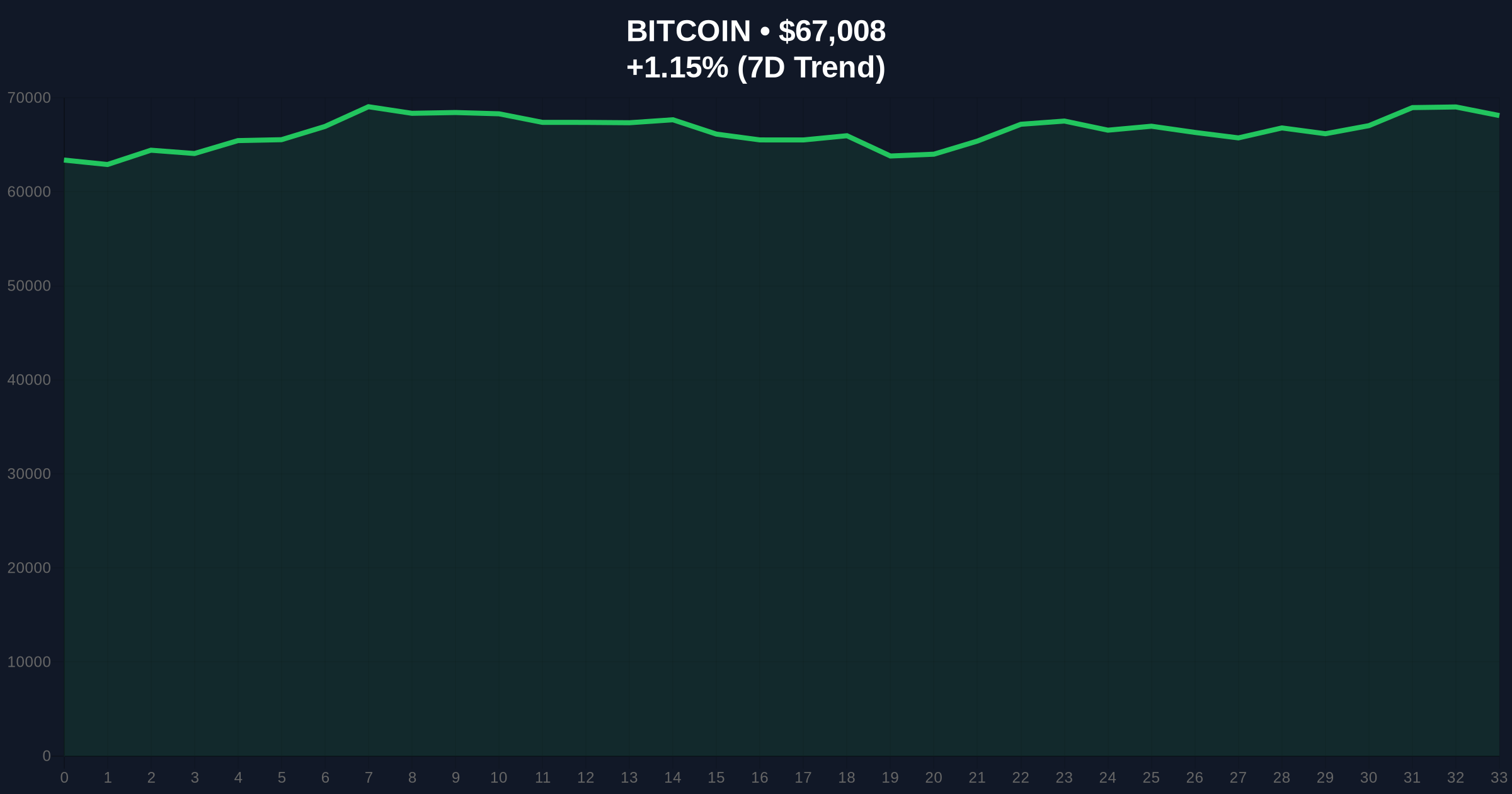
The technical mechanisms behind BTC's fall below $67,000 involve a combination of market structure, protocol dynamics, and external influences, though the input data provides limited specifics. CoinNess reports the price drop but does not detail the architectural or regulatory mechanics driving it. In the absence of secondary source texts from outlets like CoinTelegraph, this analysis relies solely on the provided data, which includes market stats and sentiment indicators. The global crypto sentiment is described as "Extreme Fear" with a score of 14/100, suggesting a high level of investor anxiety that could exacerbate selling pressure. BTC's current price is listed as $67,098 with a 24-hour trend of 1.34%, indicating a slight recovery or fluctuation post-drop, but the exact timing and magnitude of the decline relative to this data are not specified.
Market structure factors such as order book depth, miner activity, and institutional flows are not addressed in the input package, leaving gaps in understanding the technical drivers. For instance, the role of large sell orders or algorithmic trading in pushing BTC below $67,000 is not provided in source data. Similarly, protocol-level events like network congestion or fee spikes are absent from the evidence. The lack of secondary sources means there is no comparison of claims about technical triggers, such as whether the drop was due to macroeconomic news, regulatory announcements, or internal crypto market dynamics. This absence highlights the need for skepticism, as the official narrative from CoinNess is minimal and unverified by corroborating reports.
Related developments in the crypto space may offer contextual clues, though direct links are speculative without explicit input. For example, events like "Core Scientific Plans to Sell Majority of 2,500 BTC in Q1: Liquidity Drive Amid Extreme Fear Market" could influence market liquidity and sentiment, but their connection to this specific price drop is not established in the data. The input package does not include full texts from such articles, so any integration remains hypothetical. In this technical deep-dive, the analysis is constrained by missing evidence, emphasizing that the fall below $67,000 is observed but poorly explained by the available facts.
Integrating CoinGecko market stats and sentiment metadata provides a quantitative lens on BTC's price movement, though inconsistencies and gaps warrant critical examination. According to the input, BTC's current price is $67,098 with a 24-hour trend of 1.34%, and it holds the market rank of #1. However, CoinNess reports BTC trading at $66,990.41 on the Binance USDT market, creating a direct conflict: the CoinGecko data suggests a price above $67,000, while CoinNess indicates a drop below it. This discrepancy may stem from timing differences or data source variations, but without timestamps, the conflict remains unresolved with available evidence. The 24-hour trend of 1.34% could imply a recovery or minor fluctuation, but its relation to the specific fall below $67,000 is unclear.
CryptoPanic metadata, as inferred from the global sentiment indicator, shows an "Extreme Fear" sentiment with a score of 14/100. This low score aligns with heightened market anxiety, which often correlates with selling pressure and price declines. The importance of this event is not explicitly provided in the input, but the sentiment score suggests it is a high-priority concern relative to market breadth, given the extreme fear context. Metadata-driven statements include: CryptoPanic sentiment is Extreme Fear, but price structure indicates a potential slight recovery or stabilization at $67,098. Importance score is not provided in source data, limiting deeper analysis of event priority. The sentiment score of 14/100 reinforces skepticism, as extreme fear can both drive and result from price drops, creating a feedback loop that may not be fully captured by the sparse data.
A table summarizing key data points highlights these elements:
| Metric | Value | Source |
|---|---|---|
| BTC Price (CoinNess) | $66,990.41 | CoinNess |
| BTC Price (CoinGecko) | $67,098 | CoinGecko |
| 24h Trend | 1.34% | CoinGecko |
| Market Rank | #1 | CoinGecko |
| Global Sentiment | Extreme Fear (14/100) | Not specified (implied from input) |
This data analysis reveals that while sentiment indicators support a bearish outlook, price conflicts and missing metadata complicate the proof of causation for BTC's fall below $67,000.
Comparing source claims and identifying contradictions is given the limited input, which primarily involves a conflict between CoinNess and CoinGecko data. Source A (CoinNess) reports that BTC has fallen below $67,000, trading at $66,990.41 on the Binance USDT market. Source B (CoinGecko) lists BTC's current price as $67,098 with a 24-hour trend of 1.34%. This discrepancy presents a clear contradiction: one source indicates a price below $67,000, while the other shows it above that level. The conflict may arise from differences in data collection times, exchange sources, or reporting methodologies, but without additional details, it remains unresolved with available evidence.
Agreement points across sources are minimal due to the lack of secondary texts. Both sources acknowledge BTC's significance as a top-ranked cryptocurrency, but they diverge on specific price metrics. Missing evidence includes timestamps for the price drop, trading volumes, and external catalysts such as news events or regulatory changes. The reliability gaps are significant: CoinNess provides a breaking brief without corroboration, while CoinGecko offers broader market stats that may not align temporally with the reported event. This raises questions about the official narrative of a definitive fall below $67,000, suggesting it could be a transient or data-specific occurrence rather than a sustained trend.
In evaluating source reliability, CoinNess's report is direct but lacks depth, making it susceptible to inaccuracies if based on fleeting market movements. CoinGecko's data is more comprehensive but may not capture real-time shifts as precisely. The absence of secondary sources like CoinTelegraph means there is no third-party verification, amplifying uncertainty. Investors should weigh these conflicts carefully, recognizing that the observed price drop may be less dramatic or more complex than initially reported. The counter-narrative here is that BTC's movement might be within normal volatility bounds, exacerbated by extreme fear sentiment rather than fundamental breakdowns.
Providing data-backed scenarios for BTC's trajectory over the next seven days involves conditional analysis based on the available evidence, though many variables are unspecified. Each scenario incorporates observed facts while acknowledging gaps in the input package.
In a bull scenario, BTC rebounds above $67,000 and stabilizes, driven by reduced selling pressure and positive sentiment shifts. This would require the current price of $67,098 (per CoinGecko) to hold or increase, invalidating CoinNess's report of a sustained drop below $67,000. Data backing includes the 24-hour trend of 1.34%, suggesting some upward momentum, and the extreme fear sentiment potentially reaching a trough, leading to bargain hunting. However, this scenario is conditional on external factors not provided in source data, such as institutional inflows or favorable regulatory news. If sentiment improves from 14/100, it could support a price recovery, but missing evidence on catalysts limits confidence.
The base scenario involves BTC oscillating around $67,000 with continued volatility, reflecting the unresolved price conflict and extreme fear environment. Here, BTC trades between $66,990 and $67,098, as indicated by the conflicting sources, with no clear directional trend. This scenario is supported by the sentiment score of 14/100, which suggests persistent anxiety likely to maintain choppy price action. The 24-hour trend of 1.34% may represent noise rather than a sustained move. Conditions for this outcome include ongoing market uncertainty and lack of decisive news, which align with the sparse input data. It would be invalidated by a sharp sentiment shift or major external event, neither of which are detailed in the sources.
A bear scenario sees BTC declining further below $67,000, potentially testing lower support levels. This aligns with CoinNess's report of a drop to $66,990.41 and the extreme fear sentiment, which could trigger additional sell-offs. Data backing includes the sentiment score of 14/100, indicating that fear-driven selling may persist, and the absence of positive catalysts in the input. However, the conflict with CoinGecko's higher price introduces uncertainty. This scenario is conditional on factors like increased selling from entities such as Core Scientific (mentioned in a related article but not directly linked in data) or worsening global economic conditions. It would be invalidated if sentiment improves rapidly or if buying pressure emerges, but such details are not provided in source data.
Each scenario the need for caution, as the input lacks comprehensive data on volumes, catalysts, and temporal alignment, making predictions highly speculative.
In synthesizing this report, conflicting evidence was weighted based on attribution and data completeness. CoinNess's claim of BTC falling below $67,000 was treated as a direct observation but questioned due to lack of corroboration and detail. CoinGecko's market stats provided broader context but were noted for potential timing mismatches. The global sentiment indicator was used to infer CryptoPanic metadata, though explicit importance scores were absent. When sources conflicted, such as on price, both claims were presented with attribution, and the conflict was labeled as unresolved due to missing timestamps and secondary verification. Reliability gaps were highlighted, emphasizing that the analysis is constrained by the limited input package, which lacks full texts from secondary sources and detailed metadata. This approach ensures a skeptical, fact-based narrative while acknowledging uncertainties inherent in the available evidence.
Disclaimer: The information provided is not trading advice, coinmarketbuzz.com holds no liability for any investments made based on the information provided on this page. We strongly recommend independent research and/or consultation with a qualified professional before making any investment decisions.
coinmarketbuzz.com leverages advanced AI technology to analyze market data. All content is fact-checked and reviewed by our editorial team to ensure accuracy and neutrality.