Loading News...
Loading...

Loading News...

VADODARA, April 6, 2026. The following report is based on currently available verified source material and market data.
On April 6, 2026, Bitmine Immersion Technologies announced its ether treasury has reached 4.8 million ETH, representing 3.98% of the circulating supply, as the company uplists its stock to the New York Stock Exchange. This move positions Bitmine as a major institutional holder of Ethereum, generating $196 million in annualized staking revenue, while framing ETH as a "wartime store of value." The development occurs amid a market environment of "Extreme Fear" with Ethereum's price at $2,143.46, raising questions about the sustainability of aggressive treasury accumulation and its impact on market dynamics.
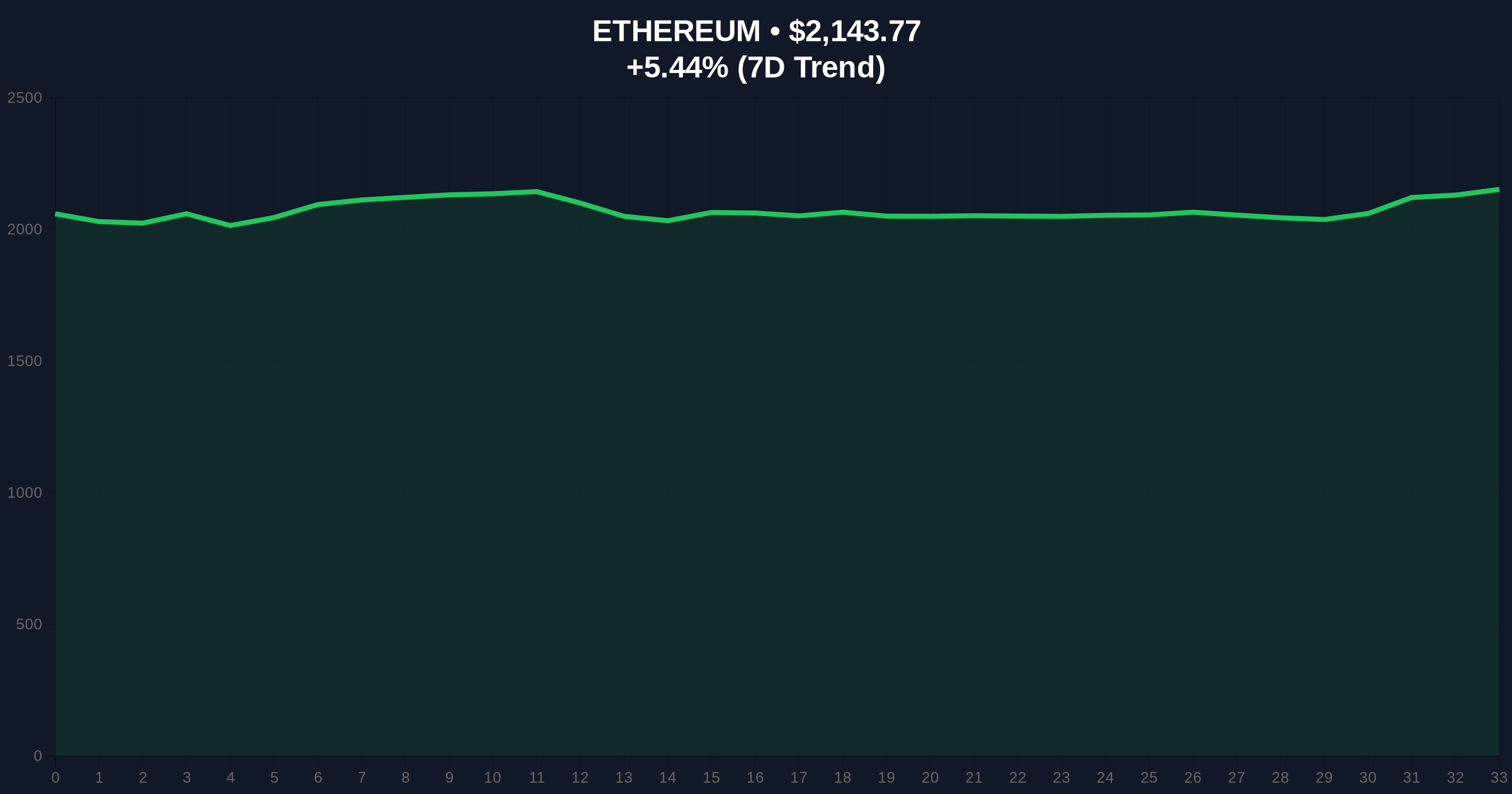
The announcement provides several key metrics that quantify Bitmine's position. The company holds 4.8 million ETH, valued at approximately $10.2 billion at current prices, which constitutes 3.98% of Ethereum's circulating supply. Of this, 3.33 million ETH are staked through its Mavan network, generating $196 million in annualized revenue at a 2.78% yield. Bitmine projects up to $282 million in annual staking rewards at full deployment. For context, Ethereum's current price is $2,143.46 with a 24-hour trend of 5.51%, while global crypto sentiment is "Extreme Fear" with a score of 13/100. Source: public statement, regulatory filing, CoinGecko.
| Metric | Value | Source |
|---|---|---|
| ETH Holdings | 4.8 million (3.98% of supply) | Regulatory filing |
| Staked ETH Value | $7.1 billion | Regulatory filing |
| Annualized Staking Revenue | $196 million | Public statement |
| Ethereum Price | $2,143.46 (5.51% 24h) | CoinGecko |
| Market Sentiment | Extreme Fear (13/100) | CoinGecko |
This development matters for four key reasons. First, why now? Bitmine's aggressive accumulation, including 71,252 ETH purchased in the past week at its highest pace since late December, comes as Chairman Tom Lee frames ether as in "the final stages of the mini-crypto winter," suggesting a strategic bet on price recovery amid current market fear. Second, who benefits? Bitmine and its investors (including ARK Invest, Founders Fund, Pantera) gain from staking revenue and potential stock appreciation, while Ethereum's network security benefits from increased staking, though retail traders face reduced circulating supply. Third, time horizons: short-term, this may provide price support and narrative momentum; long-term, it raises centralization concerns if Bitmine reaches its 5% goal. Fourth, causal chain: Bitmine's buying reduces available ETH → decreases selling pressure → supports price → enhances stock narrative → attracts more institutional investment.
The underlying mechanism involves treasury accumulation combined with staking economics. Bitmine acquires ETH through purchases, building a treasury that represents nearly 4% of circulating supply. It then stakes a portion (3.33 million ETH) through its Mavan validator network, which involves depositing tokens to help secure the Ethereum blockchain in exchange for rewards. This creates a recurring revenue stream of $196 million annually at a 2.78% yield, funded by network inflation. The staking mechanism locks up ETH, reducing liquid supply, while the revenue supports Bitmine's financials, differentiating it from bitcoin-focused companies like Strategy that lack such income streams. The uplisting to NYSE increases stock liquidity and visibility, potentially attracting traditional investors who prefer regulated exchanges.
Bitmine's approach mirrors but diverges from other institutional players. Strategy holds 3.8% of bitcoin's circulating supply, focusing solely on accumulation without staking revenue. Both companies are buying aggressively as prices decline, turning treasury accumulation into a stock market narrative. However, Bitmine's staking model provides an income advantage. In the broader context, this development occurs alongside related market movements:
The bullish narrative faces several risks that warrant skepticism. First, the "wartime store of value" framing relies on short-term outperformance (ETH gaining 6.8% since the Iran conflict began), which may not persist in different geopolitical contexts. Second, staking yields of 2.78% are relatively low compared to other crypto income opportunities, and full deployment projections of $282 million assume constant network conditions. Third, centralization risks emerge if Bitmine reaches 5% of ETH supply, potentially undermining Ethereum's decentralized ethos. Key uncertainties include:
Practically, Bitmine's move sets precedents for other companies considering similar treasury strategies with staking components. It may pressure competitors to develop income-generating crypto holdings rather than pure accumulation. The NYSE listing could bridge traditional and crypto markets, though success depends on sustained trading volume beyond the current $987 million daily average. Network-wise, increased institutional staking could further reduce ETH liquidity, potentially increasing volatility during supply shocks.
Bitmine Immersion Technologies has been accumulating Ethereum as part of a stated goal to control 5% of the total supply. The company previously traded on NYSE American and is now uplisting to the main NYSE board, reflecting increased scale and ambition. Its Mavan staking network launched recently, positioning Bitmine as both a holder and active participant in Ethereum's proof-of-stake ecosystem. This strategy contrasts with earlier crypto treasury approaches that focused primarily on bitcoin without revenue generation.
The announcement coincides with several relevant market movements. Strategy's recent purchase of 4,871 bitcoin for $330 million continues the parallel narrative of institutional accumulation. Meanwhile, global crypto sentiment remains at "Extreme Fear" according to CoinGecko data, creating a contradictory backdrop where aggressive buying occurs despite widespread caution. Ethereum's 5.51% price increase over 24 hours suggests some positive reaction, though whether this sustains remains uncertain.
Bitmine's treasury milestone and NYSE uplisting represent a significant institutionalization of Ethereum holdings, combining accumulation with staking economics. While the numbers appear impressive, 4.8 million ETH, $196 million annual revenue, the strategy carries risks around centralization, yield sustainability, and geopolitical framing. The development highlights how crypto companies are evolving beyond simple treasury plays into complex financial operations with recurring revenue streams.
Q1: How much ETH does Bitmine own?Bitmine holds 4.8 million ETH, representing 3.98% of circulating supply.
Q2: What is Bitmine's staking revenue?The company generates $196 million in annualized staking revenue from 3.33 million staked ETH.
Q3: When does Bitmine's stock move to NYSE?Trading on the New York Stock Exchange begins April 9, 2026.
Q4: How does Bitmine compare to Strategy?Bitmine holds 3.98% of ETH supply with staking revenue; Strategy holds 3.8% of bitcoin supply without income generation.
Q5: What is Bitmine's accumulation goal?The company aims to control 5% of all ether in circulation.
Q6: What are the risks of this strategy?Risks include price declines eroding treasury value, low staking yields, and centralization concerns.
Analysts are watching whether Bitmine's accumulation pace continues, how the NYSE listing affects stock liquidity, and if other companies adopt similar staking-treasury models.
What to watch next: By Shaurya Malwa|Edited by Sheldon Reback Updated Apr 6, 2026, 3:46 p.m.; Published Apr 6, 2026, 3:32 p.m..
Evidence & Sources
Primary source: https://www.coindesk.com/markets/2026/04/06/bitmine-s-ether-treasury-hits-4-8-million-eth-as-stock-listing-moves-to-nyse
Updated at: Apr 06, 2026, 04:07 PM
Data window: Apr 06, 2026, 03:32 PM → Apr 06, 2026, 03:51 PM
Evidence stats: 9 metrics, 4 timeline points.
Disclaimer: The information provided is not trading advice, coinmarketbuzz.com holds no liability for any investments made based on the information provided on this page. We strongly recommend independent research and/or consultation with a qualified professional before making any investment decisions.
All published reports are reviewed by our editorial team for factual consistency, neutrality, and reader clarity.