Loading News...
Loading...

Loading News...

VADODARA, April 2, 2026. The following report is based on currently available verified source material and market data.
Bitcoin Traders Chasing Trump's Iran Noise: Real Market Signals Point to Oil Supply Crisis developed into a market-moving story within the reported window. The initial source indicates immediate relevance for crypto sentiment, while fuller validation is still tied to cited datasets and official statements.
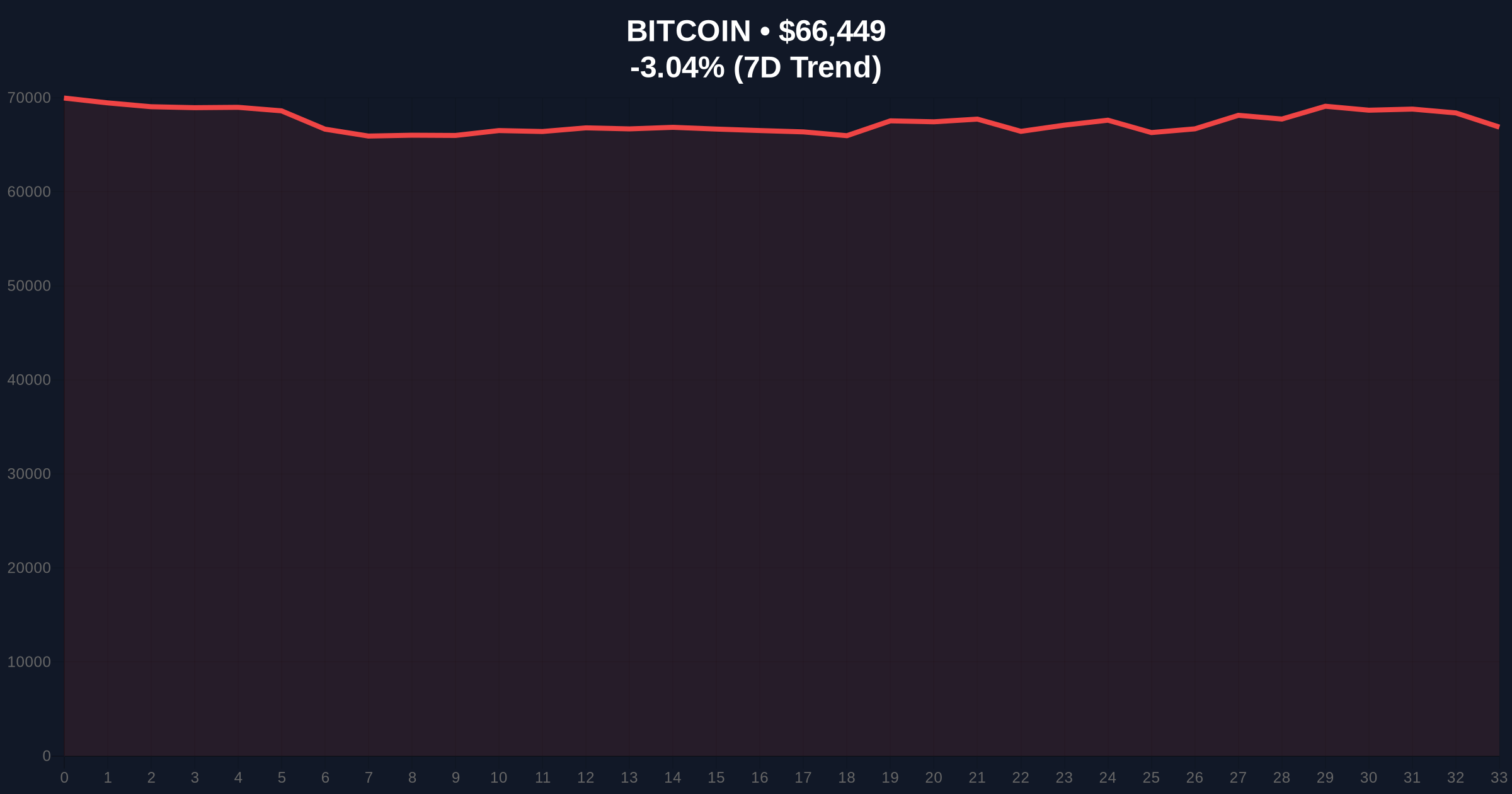
Bitcoin traders are being whipsawed by President Donald J. Trump's shifting rhetoric on Iran, but the real market signals lie in underlying oil-market fundamentals that are turning decisively negative. As of April 2, 2026, Bitcoin's price has been volatile, with the current price at $66,453, down 3.04% in 24 hours, amid a global crypto sentiment of "Extreme Fear" (Score: 12/100). The significance of this event stems from the potential for a massive oil supply shock within weeks, which could trigger widespread risk aversion across crypto and traditional financial markets, overshadowing short-term political noise.
Key metrics highlight the precarious situation. Bitcoin's price is $66,453, with a 24-hour decline of 3.04%, reflecting market instability. More critically, oil-market indicators show a looming crisis: the Strait of Hormuz handles roughly 20% of the world's seaborne oil trade, but tanker traffic has collapsed since the Iran war began on Feb. 28. Ship insurance premiums for Hormuz transits have surged from less than 1% of a ship's value before the war to as high as 7.5% per trip. For a $100 million ship, this means insurance costs now range from $2 million to $3 million, up from $250,000 pre-conflict. These figures underscore the severity of the disruption.
| Metric | Value | Source |
|---|---|---|
| Bitcoin Price | $66,453 | Source: CoinGecko |
| 24h Trend | -3.04% | Source: CoinGecko |
| Strait of Hormuz Oil Trade Share | 20% | Source: public statement |
| Ship Insurance Premium Increase | 1% to 7.5% | Source: public statement |
This matters now because the mid-April strategic petroleum reserve (SPR) cliff is approaching, with emergency releases expected to be exhausted within weeks. If oil supplies aren't materially restored, the supply deficit could double to 10-11 million barrels per day, triggering a shock of unprecedented scale. Who benefits? In the short term, no one gains as risk aversion spikes, but longer-term, traders who ignore political noise and focus on real indicators might avoid losses. The causal chain is clear: oil supply disruption → increased insurance costs and reduced tanker traffic → economic uncertainty → risk aversion → downward pressure on Bitcoin and other risk assets. Time horizons are critical: short-term volatility from Trump's comments may last days, but the oil crisis could impact markets for months if unresolved.
The mechanism linking Trump's Iran noise to Bitcoin price movements involves a multi-step process. Initially, Trump's shifting rhetoric on Iran acts as a trigger, causing immediate market reactions: hawkish comments drive oil prices up and Bitcoin down, while peace talks have the opposite effect. Underlying this, the real mechanism is the oil supply crisis. After the Iran war began, tanker traffic through the Strait of Hormuz collapsed, leading to a supply shortfall of 4.5-5 million barrels per day. Emergency SPR releases have offset this, but as reserves deplete, the deficit could double. Consequently, soaring ship insurance premiums and collapsed tanker traffic signal ongoing danger, embedding certainty in market prices that political statements cannot replicate. This creates a feedback loop where traders chase noise, but fundamentals dictate long-term trends.
Compared to other crypto developments, this event highlights how geopolitical factors can overshadow typical market drivers like ETF flows or regulatory news. For instance, while Bitcoin ETFs have seen recent inflows, Trump's Iran threats have reversed market rallies, showing that macro risks can dominate. In adjacent sectors, tokenized crude oil futures on exchanges like Hyperliquid have recorded significant liquidations, indicating cross-market stress. Key comparisons include:
The bearish scenario involves several risks that could invalidate the analysis. First, if Trump secures passage through the Strait of Hormuz and tanker traffic recovers quickly, the oil supply crisis might be averted, reducing risk aversion. Second, the data relies on public statements and estimates; actual SPR depletion rates or insurance premium changes could differ, leading to miscalibrated market impacts. Third, traders might continue to focus on political noise, causing prolonged volatility regardless of fundamentals. Uncertainty stems from missing data on exact SPR levels or real-time tanker counts. The failure condition would be a swift resolution of the Iran conflict, which would break the assumed mechanism of ongoing supply disruption.
Looking ahead, practical near-term implications include increased market volatility as the SPR cliff approaches. Traders should monitor ship insurance premiums and tanker traffic data for signs of improvement. If premiums drop below 2%, it could signal safer passage and a potential rally in risk assets. Otherwise, the risk of a broader market downturn remains high, affecting not just Bitcoin but also other cryptocurrencies and traditional financial instruments.
Historically, Bitcoin has shown correlation with risk assets during geopolitical tensions, but this event a deeper structural link to oil markets. The Strait of Hormuz has long been a chokepoint for global oil trade, and disruptions there have cascading effects on economies and financial markets. This context frames the current situation as part of a broader pattern where crypto markets are increasingly integrated with global macro trends.
Cross-market reactions are evident in related news. For example, Trump's Iran war escalation has previously sent Bitcoin below $67,000, while Ethereum held firmer in some instances. Additionally, tokenized crude oil futures have seen significant liquidations, rivaling Bitcoin in market impact. These developments highlight the interconnectedness of crypto and commodity markets amid geopolitical strife.
In summary, Bitcoin traders chasing Trump's Iran noise are missing the real signals in oil-market fundamentals. With a looming SPR cliff and critical indicators like ship insurance premiums and tanker traffic pointing to ongoing risk, the market faces potential for severe aversion. Traders should prioritize these tangible metrics over political rhetoric to navigate the choppy environment effectively.
What to watch next: By Omkar Godbole Apr 2, 2026, 5:24 a.m.; Bitcoin NewsDonald Trump More For You Encryption Supremacy: Zcash and Privacy in the Age of Scale By CoinDesk Research Mar 31, 2026 Commissioned byGenZcash Most crypto privacy models weaken as blockchain data grows..
Evidence & Sources
Primary source: https://www.coindesk.com/markets/2026/04/02/bitcoin-traders-keep-chasing-trump-s-iran-noise-the-real-signals-are-elsewhere
Updated at: Apr 02, 2026, 07:37 AM
Data window: Apr 02, 2026, 07:24 AM → Apr 02, 2026, 07:27 AM
Evidence stats: 9 metrics, 3 timeline points.
Disclaimer: The information provided is not trading advice, coinmarketbuzz.com holds no liability for any investments made based on the information provided on this page. We strongly recommend independent research and/or consultation with a qualified professional before making any investment decisions.
All published reports are reviewed by our editorial team for factual consistency, neutrality, and reader clarity.