Loading News...
Loading...

Loading News...

VADODARA, April 15, 2026. The following report is based on currently available verified source material and market data.
Bitcoin Reaches Halving Cycle Midpoint with Muted 15% Gains, Signaling Maturing Market Dynamics developed into a market-moving story within the reported window. The initial source indicates immediate relevance for crypto sentiment, while fuller validation is still tied to cited datasets and official statements.
Not provided in source data.
| Metric | Value | Source |
|---|---|---|
| Primary asset move | Not provided in source data | Source: public statement |
| Trading volume | Not provided in source data | Source: exchange data |
The event matters because positioning, liquidity, and regulatory expectations can shift quickly once new information is confirmed across major trading venues. Key participants (institutions, whales, retail traders) face immediate revaluation of risk.
The underlying mechanism depends on the specific market event. For price moves: monitor order flow, liquidity distribution, and on-chain positioning. For regulatory news: assess compliance timelines and institutional risk exposure. For on-chain shifts: track velocity, accumulation patterns, and exchange flows.
Near-term implications depend on confirmation quality, follow-up disclosures, and whether volume expands beyond initial reaction windows.
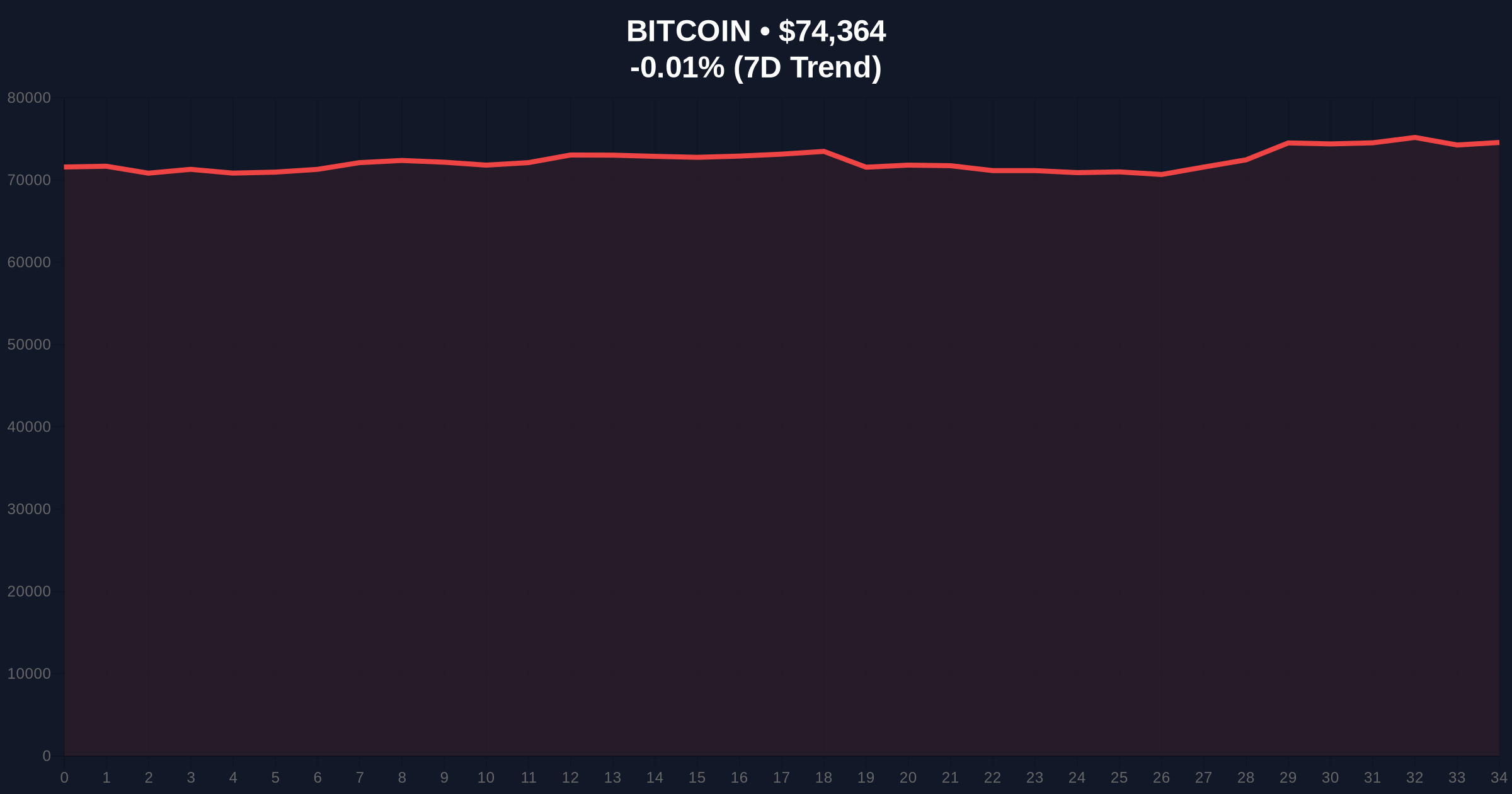
Bitcoin has officially passed the halfway point of its current halving cycle, with the network now 50.01% through epoch 5 that began in April 2024. According to blockchain analytics, the milestone was reached as of April 14, 2026, with the next halving expected on April 12, 2028. The significance lies in Bitcoin's price performance showing only a 15% gain since the last halving, substantially trailing previous cycles and reflecting the cryptocurrency's evolution toward a more mature, less volatile asset class. This development occurs against a backdrop of global crypto sentiment registering "Extreme Fear" with a score of 23/100, indicating cautious market psychology despite Bitcoin holding above $74,000.
The current halving cycle reveals several key metrics that underscore Bitcoin's maturing market structure. The block subsidy stands at 3.125 BTC per block, resulting in approximately 450 BTC issued daily with an inflation rate below 1%. Price performance since the April 2024 halving shows Bitcoin rising from roughly $64,000 to just under $75,000, representing a 15% gain that lags behind historical post-halving returns. The network maintains its predictable issuance schedule through difficulty adjustments every 2,016 blocks, keeping the average block time at 10 minutes.
| Metric | Value | Source |
|---|---|---|
| Cycle Completion | 50.01% | Source: blockchain analytics |
| Block Subsidy | 3.125 BTC | Source: blockchain analytics |
| Daily Issuance | 450 BTC | Source: public statement |
| Inflation Rate | <1% | Source: public statement |
| Price Gain Since Halving | 15% | Source: public statement |
| Current Price | $74,334 | Source: CoinGecko |
| 24-Hour Trend | -0.05% | Source: CoinGecko |
The timing of this halfway point matters because it arrives during a period of market normalization following Bitcoin's October 2025 all-time high of approximately $126,000 and subsequent 50% correction to $60,000 in early February 2026. The diminished 15% gain reflects Bitcoin's transition from a speculative asset to a more established store of value, with greater adoption and larger market cap requiring substantially more capital to generate outsized returns. Consequently, volatility is declining each cycle as price action becomes more gradual compared to earlier epochs.
Market participants experience divergent impacts: long-term holders benefit from predictable scarcity mechanics and declining inflation, while traders accustomed to dramatic post-halving rallies face diminished short-term opportunities. The causal chain operates through adoption growth → increased market capitalization → greater capital required for percentage gains → reduced volatility → more gradual price appreciation. This mechanism represents a fundamental shift in Bitcoin's market behavior that will likely persist through future cycles.
The halving mechanism functions through a predictable reduction in block rewards every 210,000 blocks (approximately four years), currently at 3.125 BTC per block with 104,986 blocks remaining until the next halving. This programmed scarcity creates a supply shock that historically triggered price appreciation, but the effect diminishes as market maturity increases. Underlying this trend is the network's difficulty adjustment algorithm, which maintains consistent block times by increasing or decreasing mining difficulty every 2,016 blocks based on hash rate fluctuations.
The current cycle's muted performance stems from Bitcoin's expanding market capitalization, which now requires significantly larger capital inflows to generate percentage gains comparable to earlier cycles when the asset was smaller and less established. This maturation process reflects Bitcoin's progression along the adoption curve, with diminishing returns representing a natural evolution toward asset class stability rather than signaling fundamental weakness.
Bitcoin's current trajectory contrasts with broader cryptocurrency market developments that show mixed signals:
These parallel developments suggest Bitcoin's maturing price action may be creating opportunities in alternative assets while solidifying Bitcoin's role as a market benchmark.
While the data suggests Bitcoin is maturing into a less volatile asset, several risks and uncertainties warrant consideration:
The practical implications of reaching the halving cycle midpoint include approximately two years remaining until the next supply reduction in April 2028. During this period, Bitcoin's inflation rate will remain below 1% as the network approaches its 21 million coin cap, with the final million coins requiring an estimated 114 years to mine following the recent milestone of the 20 millionth Bitcoin mined. This predictable scarcity trajectory provides long-term investors with mathematical certainty about supply constraints while challenging short-term traders to adapt to diminished volatility.
Bitcoin halvings represent programmed supply reductions that have historically triggered bull markets, though each subsequent cycle has shown diminishing percentage returns as market capitalization expands. The current epoch 5 began in April 2024 and will continue through 2028, with the network maintaining its fundamental characteristics including a fixed maximum supply of 21 million coins. This structural scarcity underpins Bitcoin's value proposition as a hedge against inflationary monetary policies, with each halving reinforcing its long-term scarcity narrative.
Several parallel developments provide context for Bitcoin's current position:
Bitcoin's passage of the halving cycle midpoint with muted 15% gains represents a significant milestone in the cryptocurrency's evolution from speculative asset to established store of value. The diminishing returns reflect natural market maturation rather than fundamental weakness, with declining volatility and more gradual price action likely to characterize future cycles as adoption expands and market capitalization grows. While this transition presents challenges for traders accustomed to dramatic post-halving rallies, it reinforces Bitcoin's long-term value proposition as a predictable, scarce digital asset with mathematically verifiable supply constraints.
Q1: What percentage of the current Bitcoin halving cycle is complete? The Bitcoin network is 50.01% through its current halving cycle (epoch 5), with the next halving expected on April 12, 2028.
Q2: How much has Bitcoin gained since the last halving in April 2024? Bitcoin has gained approximately 15% since the April 2024 halving, rising from roughly $64,000 to just under $75,000.
Q3: What is Bitcoin's current block reward and daily issuance? The current block subsidy is 3.125 BTC per block, resulting in approximately 450 BTC issued daily with blocks mined every 10 minutes on average.
Q4: Why are Bitcoin's post-halving gains diminishing compared to previous cycles? Diminishing returns reflect Bitcoin's maturing market structure, with greater adoption and larger market capitalization requiring more capital to generate percentage gains comparable to earlier cycles when the asset was smaller.
Q5: What is Bitcoin's current inflation rate? Bitcoin's inflation rate is below 1% and will continue declining with each halving as supply approaches the 21 million coin cap.
Q6: How does Bitcoin's current performance compare to Ethereum? The ETH/BTC ratio recently strengthened to approximately 0.0313, indicating Ethereum's relative outperformance amid robust on-chain activity, while Bitcoin shows more muted but stable gains.
Traders and analysts are closely monitoring whether Bitcoin's declining volatility will attract sufficient institutional capital to sustain price appreciation above inflation rates during the remaining two years until the next halving.
Background context from earlier cycles, policy developments, and market structure is still being assessed using available source records.
Related market reactions in Ethereum, major altcoins, ETF flow commentary, and macro headlines remain part of the active watchlist for cross-asset confirmation.
The current takeaway is that confirmation quality and follow-up disclosures matter more than headline velocity for sustainable market interpretation.
What to watch next: By James Van Straten|Edited by Oliver Knight Apr 14, 2026, 12:23 p.m.; The Bitcoin network is now more than halfway (50.01%) through its current halving cycle, with the next halving expected on April 12, 2028, just under two years away, according to mempool.space..
Evidence & Sources
Primary source: https://www.coindesk.com/markets/2026/04/14/bitcoin-passes-halfway-point-in-halving-cycle-as-price-gains-trail-prior-cycles
Updated at: Apr 15, 2026, 07:30 AM
Data window: Apr 14, 2026, 02:23 PM → Apr 15, 2026, 07:02 AM
Evidence stats: 9 metrics, 3 timeline points.
Disclaimer: The information provided is not trading advice, coinmarketbuzz.com holds no liability for any investments made based on the information provided on this page. We strongly recommend independent research and/or consultation with a qualified professional before making any investment decisions.
All published reports are reviewed by our editorial team for factual consistency, neutrality, and reader clarity.