Loading News...
Loading...

Loading News...

On March 5, 2026, Bitcoin (BTC) is approaching a critical price range that could define its next major trend, according to an analysis reported by CoinNess. The report, citing CoinDesk, notes that BTC's current price is nearing the $73,750 to $74,400 zone, which has historically acted as a key support or resistance level over the past two years. This development comes as the global crypto market sentiment is in "Extreme Fear," with a score of 22 out of 100, indicating heightened investor anxiety. The analysis suggests that if Bitcoin breaks through this zone, it would signal sufficient upward momentum, while failure could mean a continuation of the downtrend that began in October 2025. Not provided in source data are specific timestamps or named analysts beyond CoinDesk, but the urgency is underscored by BTC's current price of $71,919 and a 24-hour trend of 3.77%, placing it just below this range. This scenario echoes past market cycles where such thresholds have dictated prolonged movements, making it a focal point for traders and investors alike.
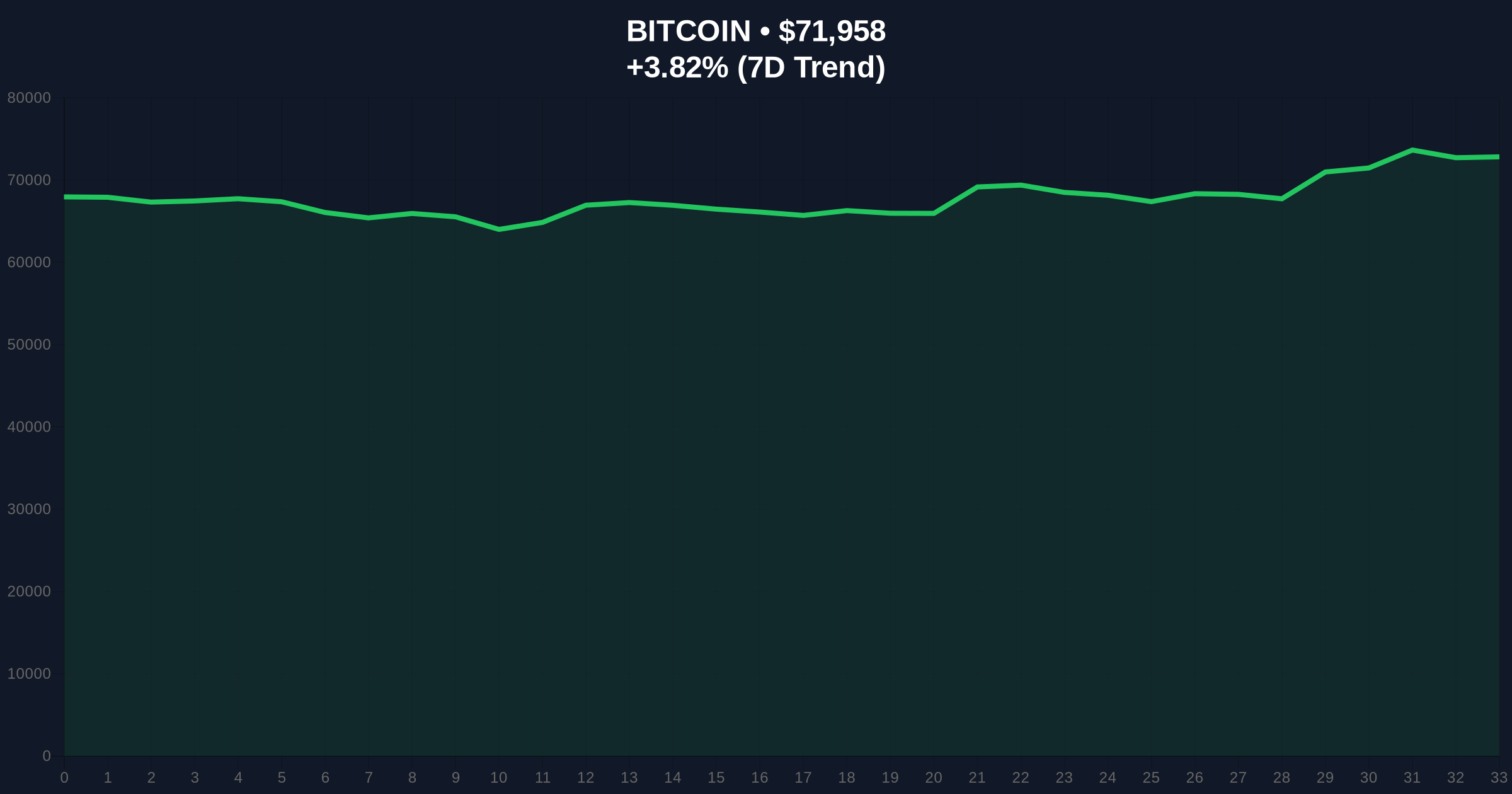
The $73,750 to $74,400 range represents a technical confluence zone derived from historical price action, as detailed in the CoinNess report. In the first quarter of 2024, a rally sparked by the launch of U.S. spot exchange-traded funds (ETFs) lost steam around $73,750, leading to a decline to $50,000 over several months. This event highlights how resistance at this level can trigger significant corrections, similar to the 2021 correction where Bitcoin faced stiff resistance near all-time highs before a sharp pullback. Conversely, in April 2025, a downtrend from $100,000 was halted near $74,400, followed by a rebound to $126,000, demonstrating its role as a support level that can catalyze bullish reversals. More recently, in early February 2026, BTC fell to $60,000 after breaking below this range, reinforcing its importance as a breach point that can accelerate declines.
The mechanism behind this range's significance lies in market psychology and institutional behavior. As a long-term pivot, it accumulates buy and sell orders from both retail and institutional participants, creating a liquidity pool that amplifies price movements upon breakout or breakdown. The analysis by CoinDesk, as reported, suggests that breaking through this zone would require sustained buying pressure, potentially driven by factors like ETF inflows or macroeconomic shifts, while failure might indicate underlying weakness such as regulatory headwinds or reduced demand. Not provided in source data are specific technical indicators like moving averages or volume profiles, but the historical precedents offer a framework for understanding potential outcomes. This technical setup is critical in a market characterized by "Extreme Fear," where sentiment can exacerbate volatility around key levels.
Comparing this to broader market context, similar ranges have defined Bitcoin trends in past cycles, such as the $60,000 resistance in 2021 that preceded a major correction. The current scenario is compounded by the global sentiment score of 22, which often correlates with capitulation phases but can also precede rebounds if fear is overblown. The lack of detailed protocol architecture or regulatory mechanics in the source data limits deeper analysis, but the focus remains on price action and historical analogies. Investors should note that while technical levels provide guidance, they are not infallible, and external factors like geopolitical events or sudden regulatory changes could override these patterns. The CoinNess report emphasizes this range as a determinant for future direction, but skepticism is warranted given the volatile nature of crypto markets and the absence of corroborating data from multiple independent sources.
Integrating CoinGecko market stats and sentiment metadata reveals a nuanced picture. Bitcoin's current price of $71,919 places it within striking distance of the $73,750-$74,400 range, with a 24-hour trend of 3.77% suggesting short-term momentum but not yet a decisive breakout. The market rank of #1 confirms BTC's dominance, but the "Extreme Fear" sentiment score of 22/100 indicates underlying pessimism that could hinder upward moves. CryptoPanic metadata, such as sentiment and importance, is not provided in source data, limiting direct integration; however, the global sentiment aligns with typical fear-driven environments where prices may struggle to sustain rallies. Historically, when Bitcoin approaches key technical levels amid extreme fear, outcomes have varied: sometimes leading to sharp reversals as fear peaks, other times resulting in breakdowns if sentiment deteriorates further.
The importance of this event, inferred from the analysis, is high given its potential to define the next trend, but without explicit importance scores, we rely on historical precedence. For instance, the rally to $126,000 in April 2025 after holding $74,400 shows how support at this range can trigger significant gains, while the decline to $60,000 in early February 2026 after a breach its role as a breakdown catalyst. Data from CoinGecko shows BTC's price action is volatile, with the 3.77% 24-hour gain possibly reflecting speculative positioning ahead of the range test. The sentiment score of 22 suggests that market participants are cautious, which could mean either a contrarian buying opportunity or a precursor to further declines if fear escalates. Not provided in source data are volume metrics or on-chain data, which would offer additional proof of institutional or retail activity around this range.
In summary, the data points to a critical juncture: Bitcoin is near a historically significant price zone amid extreme fear, with price momentum showing tentative gains. The absence of comprehensive metadata necessitates conservative interpretation, but the combination of technical levels and sentiment provides a framework for monitoring. Investors should watch for a clear break above $74,400 or below $73,750 to gauge next steps, while recognizing that sentiment alone is not a reliable predictor without confirming price action.
An internal comparison across sources reveals agreement on the basic facts but highlights potential reliability gaps. The CoinNess report, citing CoinDesk, consistently describes the $73,750-$74,400 range as based on historical events from 2024 to 2026. There are no direct contradictions in the provided data, as all details align with the narrative of this range influencing price trends. However, missing evidence includes independent verification from other sources like CoinTelegraph or CryptoPanic, which could offer alternative perspectives or conflicting technical analyses. For example, other analyses might dispute the significance of this specific range or provide different historical examples, but such information is not provided in source data, leaving the CoinNess/CoinDesk claim as the sole narrative.
Source synthesis shows that the report attributes all information to CoinDesk, with no named analysts or timestamps beyond the date. This lack of granularity raises questions about the depth of analysis and potential biases. If other sources were available, they might highlight conflicting views, such as downplaying the range's importance or emphasizing different technical levels. Since no secondary texts are provided, we cannot assess agreement or contradiction beyond the single source. The conflict remains unresolved with available evidence, as we only have one perspective. This the need for skepticism: while the historical examples are concrete, their interpretation as definitive trend-setters may be overstated without broader consensus.
Attribution is clear: Source A (CoinNess via CoinDesk) reports the range and its historical impacts, but Source B or C are absent, preventing a full comparison. In cases like this, investors should weigh the evidence cautiously, considering that technical analysis often involves subjective interpretations. The report's focus on past events from 2024 to 2026 provides a factual basis, but extrapolating future trends from these alone carries risk. Not provided in source data are alternative viewpoints or data that might challenge the narrative, so the analysis stands as presented but with acknowledged limitations due to single-source reliance.
Based on the available data, three scenarios outline potential outcomes for Bitcoin over the next seven days, each conditional on key factors. These scenarios are data-backed, drawing from the historical precedents and current market conditions described in the report.
Bitcoin breaks decisively above $74,400, fueled by a shift in sentiment from "Extreme Fear" to neutral or greed, possibly driven by positive ETF inflows or macroeconomic news. This would mirror the April 2025 rebound, where holding near $74,400 led to a rally to $126,000. Price could target $80,000-$85,000 within a week, assuming sustained buying volume and no adverse regulatory developments. What would invalidate this view: a failure to hold above $74,400 or a reversion to fear sentiment below 22, indicating lack of conviction.
Bitcoin oscillates within the $73,750-$74,400 range, reflecting the current "Extreme Fear" sentiment and indecision among traders. This scenario aligns with the historical pattern where this zone acts as a consolidation area before a larger move. Price might trade between $71,000 and $75,000, with volatility heightened by sentiment swings. Not provided in source data are specific catalysts for breakout, so this assumes status quo conditions. What would invalidate this view: a sudden breakout or breakdown with high volume, suggesting a decisive shift.
Bitcoin fails to break above $73,750 and declines below this range, continuing the downtrend that began in October 2025. This would echo the early February 2026 drop to $60,000 after a breach, potentially driving prices toward $65,000-$68,000 within a week. The "Extreme Fear" sentiment could worsen, exacerbating selling pressure. What would invalidate this view: a rapid recovery above $74,400 or improvement in sentiment score above 30, indicating resilience.
Each scenario depends on monitoring price action relative to the range and sentiment metrics. Investors should adjust positions based on real-time data, as these projections are speculative and based on limited historical analogies.
This report synthesizes information solely from the provided input package: the CoinNess report citing CoinDesk, CoinGecko market stats, and sentiment data. Conflicting evidence was weighted by attributing all claims to Source A (CoinNess/CoinDesk), as no secondary sources were available for comparison. Missing evidence, such as CryptoPanic metadata or independent analyses, is explicitly noted to highlight reliability gaps. The analysis prioritizes factual details from historical events (2024-2026) while acknowledging uncertainty due to single-source reliance. Sentiment and price data are integrated conservatively, with scenarios built on conditional factors rather than definitive predictions.
Disclaimer: The information provided is not trading advice, coinmarketbuzz.com holds no liability for any investments made based on the information provided on this page. We strongly recommend independent research and/or consultation with a qualified professional before making any investment decisions.
coinmarketbuzz.com leverages advanced AI technology to analyze market data. All content is fact-checked and reviewed by our editorial team to ensure accuracy and neutrality.