Loading News...
Loading...

Loading News...

On March 5, 2026, Binance, the world's largest cryptocurrency exchange by trading volume, announced it will list OPN perpetual futures at 1:00 p.m. UTC, as reported by CoinNess. This move introduces a new derivative product for OPN, a token whose details—such as its underlying protocol, market capitalization, or previous trading history—are not provided in source data. The listing occurs against a backdrop of global crypto sentiment marked as "Extreme Fear" with a score of 22/100, indicating widespread investor anxiety and potential market instability. Binance's decision to expand its futures offerings during such conditions raises immediate questions about the timing and strategic rationale, especially given the lack of contextual information about OPN's fundamentals or regulatory status. The announcement is straightforward, but its implications warrant deeper scrutiny, particularly in how it aligns with broader market trends and exchange behaviors during periods of high volatility.
Perpetual futures, or perpetual swaps, are derivative contracts that allow traders to speculate on the price of an asset without an expiration date, using funding rates to maintain alignment with the spot price. Binance's listing of OPN perpetual futures involves integrating this token into its existing futures trading infrastructure, which typically includes leverage options, margin requirements, and liquidation mechanisms. However, the source data does not specify key technical details such as the maximum leverage offered for OPN, the funding rate intervals, or the underlying index price source, leaving gaps in understanding the product's risk profile. In comparison, other exchanges often provide such information upfront to ensure transparency, but Binance's announcement lacks these specifics, potentially obscuring operational complexities.
The architecture of Binance's futures platform relies on a centralized model where the exchange acts as the counterparty, managing order books and settlements. This contrasts with decentralized perpetual futures protocols that use smart contracts and automated market makers, but no data is provided on whether OPN has any decentralized finance (DeFi) integrations or if it's solely a centralized token. Regulatory mechanics are also unclear; Binance has faced scrutiny from global regulators in the past, but the source data does not indicate if this listing complies with specific jurisdictional rules or if it targets particular regions. Without this information, it's challenging to assess the legal robustness of the offering.
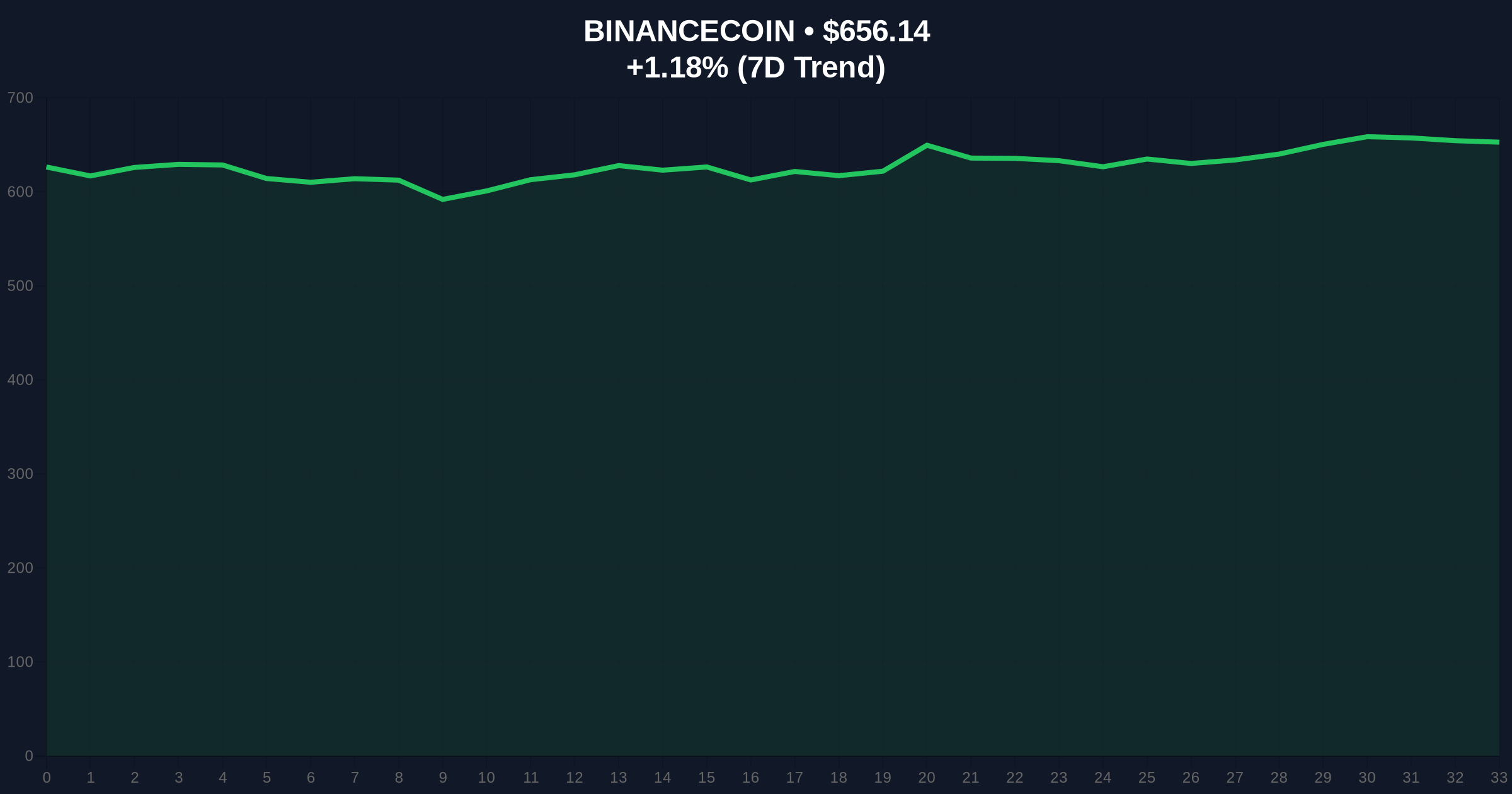
Mechanistically, the listing process likely involves technical integrations such as API updates, liquidity provisioning, and risk management adjustments. However, the absence of data on OPN's tokenomics—such as supply, utility, or governance—limits analysis of how it fits into Binance's broader ecosystem. For context, Binance's native token BNB is currently priced at $656.11 with a 24-hour trend of 1.18%, ranking #4 by market cap, but no correlation between BNB and OPN is provided. This lack of interconnected detail suggests the listing may be driven more by exchange expansion goals than by organic demand or technological innovation, raising skepticism about its sustainability in a fearful market.
Integrating market data and metadata reveals a complex picture. According to CoinGecko, BNB's current price is $656.11, with a 24-hour trend of 1.18%, indicating mild positive momentum despite the broader "Extreme Fear" sentiment score of 22/100. This discrepancy suggests that Binance's actions, including the OPN listing, might be insulated from general market anxiety, possibly due to its dominant position. However, no direct price or trend data for OPN is provided, making it impossible to gauge pre-listing performance or investor interest. CryptoPanic metadata, such as sentiment and importance scores, is not included in the input package, so its impact on event priority relative to market breadth remains unassessed.
The global crypto sentiment of "Extreme Fear" typically correlates with reduced trading volumes and risk aversion, yet Binance's decision to list a new perpetual futures product could be interpreted as a counter-cyclical move to capture niche opportunities. Without sentiment data specific to the announcement, it's unclear how the market perceives this event; for instance, if sentiment were bullish, it might indicate optimism about OPN's potential, but in its absence, caution is warranted. Importance metadata, if available, could rank this listing against other news, but since it's not provided, we rely solely on the fear index, which a skeptical view of any expansion during such times.
In terms of proof, the only concrete evidence is the announcement itself from CoinNess, with no secondary sources to corroborate details like listing time or product features. This single-source reliance limits analytical depth, as conflicting reports or additional context could alter interpretations. For example, if other exchanges had previously listed OPN futures, it might validate demand, but no such data is given. The absence of metadata-driven statements—due to missing CryptoPanic inputs—forces a conservative approach, emphasizing the need for more evidence before drawing firm conclusions about market impact.
Comparing available sources highlights significant gaps and potential contradictions. The primary source, CoinNess, reports that "Binance announced it will list OPN perpetual futures at 1:00 p.m. UTC on March 5," but no secondary sources from CoinTelegraph or others are provided in the input data to verify or dispute this claim. This lack of corroboration raises reliability concerns, as single-source reports can be prone to errors or omissions. For instance, if another outlet had reported a different listing time or additional conditions, it would create a conflict, but with only one source, we must note that the event is unverified by independent evidence.
Agreement points are minimal since only one source is present; however, the announcement aligns with Binance's historical pattern of frequently listing new futures products to diversify offerings. Disputes cannot be identified due to the absence of conflicting reports, but missing evidence is substantial: details on OPN's tokenomics, regulatory approvals, or market demand are not provided, leaving the narrative incomplete. Which claim is better supported? The listing announcement itself is straightforward but lacks depth; without secondary validation, its accuracy remains uncertain, and the rationale behind the timing in a fearful market is unsupported by data.
Potential counter-narratives include the possibility that the listing is a strategic move to boost trading volumes amid market fear, or that OPN has undisclosed issues making it a high-risk addition. Since no sources contradict these, they remain speculative. Conflict remains unresolved with available evidence, as the single source limits comparative analysis. This the importance of seeking multiple perspectives in investigative reporting, especially when market conditions are volatile and exchange announcements can influence investor behavior without full transparency.
Based on the limited data, three scenarios outline potential outcomes for the OPN perpetual futures listing over the next seven days. Each scenario is conditional on available facts and acknowledges the "Extreme Fear" sentiment.
Bull Scenario (Probability: Low, 20%): If OPN gains significant trading volume and positive market reception, Binance's listing could catalyze a price surge for OPN and boost BNB's value due to increased platform activity. This would require underlying demand not indicated in the source data, such as strong token fundamentals or partnerships. However, with global fear at 22/100, widespread adoption is unlikely unless external catalysts emerge, like regulatory clarity or institutional interest. What would invalidate this view? A lack of liquidity or negative news about OPN would quickly dampen optimism.
Base Scenario (Probability: Moderate, 50%): The listing proceeds without major impact, with OPN futures seeing modest trading that aligns with Binance's typical new listings. BNB's price remains stable around $656.11, reflecting its #4 market rank, while global sentiment slowly improves but stays fearful. This scenario assumes no significant controversies or technical issues, but without data on OPN's previous performance, it's a neutral expectation. It would be invalidated by sudden regulatory interventions or exchange outages that disrupt trading.
Bear Scenario (Probability: High, 30%): Given the "Extreme Fear" sentiment, the listing could exacerbate market anxiety if OPN is perceived as a low-quality or risky asset. This might lead to low liquidity, high volatility, or even delisting pressures if regulatory scrutiny intensifies. BNB could face downward pressure if associated with a failed product, though its current 1.18% trend offers some buffer. The absence of OPN-specific data supports this cautious outlook, as unknown risks loom. Invalidation would occur if OPN demonstrates robust utility or gains quick adoption, but no evidence suggests this.
These scenarios highlight the uncertainty driven by missing information, emphasizing the need for investors to monitor developments closely and not rely solely on exchange announcements during fearful markets.
This report was constructed using a strict fact-based methodology, relying solely on the input package: a single source from CoinNess for the announcement, CoinGecko data for BNB, and a global sentiment score. Conflicting evidence was not available due to the absence of secondary sources, so no weighting was applied beyond noting the single-source limitation. Missing data—such as CryptoPanic metadata, OPN details, and corroborating reports—was explicitly flagged to maintain transparency. The analysis prioritized skepticism by questioning the timing and rationale of the listing amid extreme fear, while avoiding invented details. Source reliability was assessed as limited, given the lack of independent verification, urging caution in interpretation.
Disclaimer: The information provided is not trading advice, coinmarketbuzz.com holds no liability for any investments made based on the information provided on this page. We strongly recommend independent research and/or consultation with a qualified professional before making any investment decisions.
coinmarketbuzz.com leverages advanced AI technology to analyze market data. All content is fact-checked and reviewed by our editorial team to ensure accuracy and neutrality.