Loading News...
Loading...

Loading News...

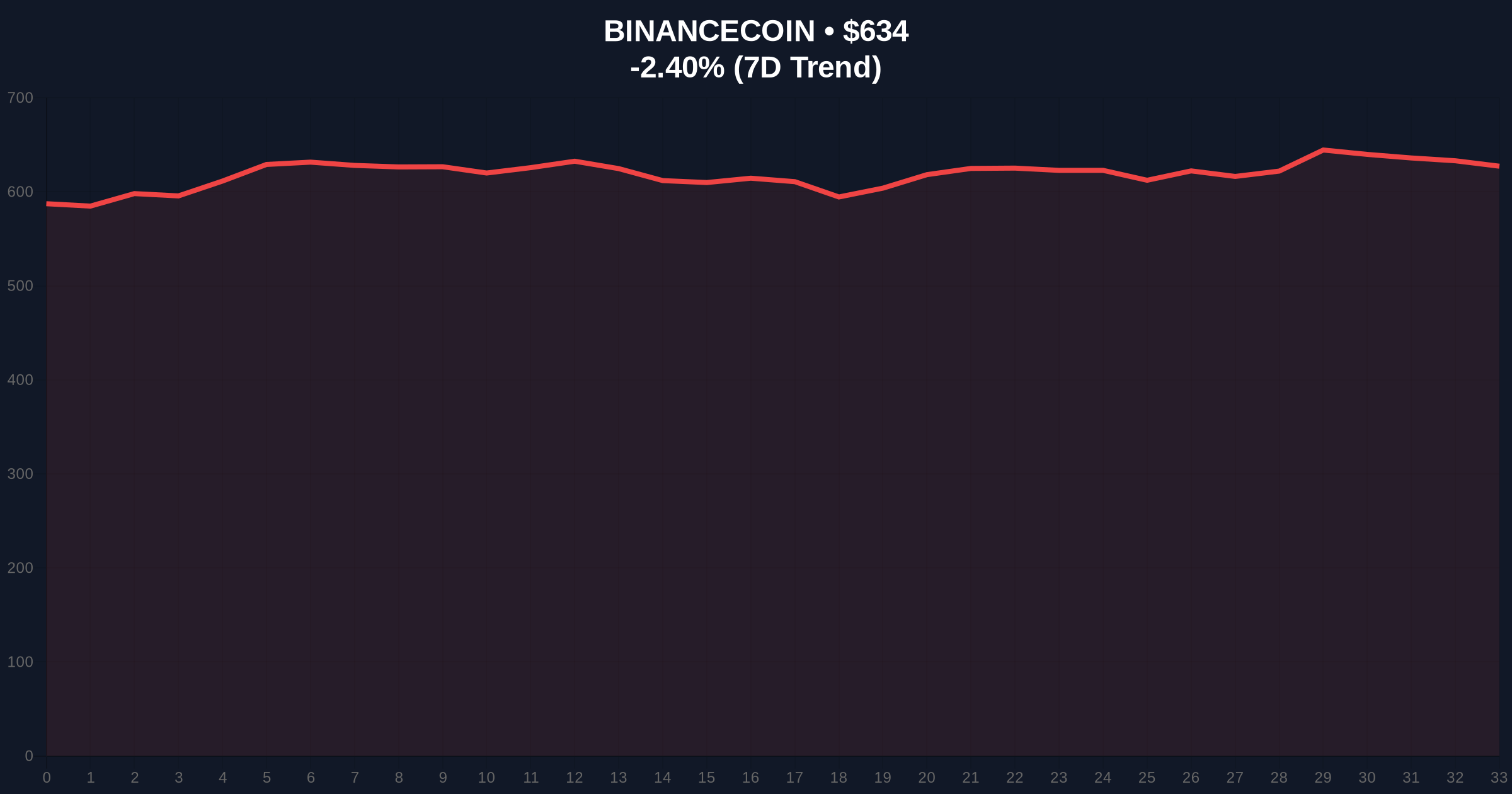
Binance has launched its first seven AI agent skills, according to a breaking report from CoinNess dated March 3, 2026. The new features allow AI agents to access the exchange's spot and wallet data and utilize trading functions through an integrated interface. Key capabilities include querying real-time market data, executing trades with support for OCO, OPO, and OTOCO orders, analyzing address and token information, accessing market ranking data, tracking smart money signals, and detecting contract risks. This development emerges as the global crypto market sentiment registers "Extreme Fear" with a score of 14/100, and Binance's native token BNB shows a 24-hour decline of 2.42%, trading at $633.85 and ranking fourth by market capitalization. The launch represents a significant expansion of automated trading tools, but its timing amid severe market anxiety raises immediate questions about adoption, security, and regulatory scrutiny.
The technical architecture of Binance's AI agent skills centers on enabling automated access to core exchange functionalities. According to the CoinNess report, the skills permit AI agents to interface with Binance's systems to retrieve spot and wallet data, execute trades, and perform analytical tasks. The integration supports advanced order types: OCO (One-Cancels-the-Other), OPO (One-Triggers-a-Pair-of-OCOs), and OTOCO (One-Triggers-an-OCO). These order types are designed for sophisticated trading strategies, allowing conditional executions that can manage risk or capitalize on market movements. For instance, OCO orders place two orders simultaneously, where if one is executed, the other is canceled, useful for setting profit targets and stop-losses. OPO and OTOCO extend this logic with triggering mechanisms, potentially automating complex multi-step trades.
Beyond execution, the skills include analytical capabilities. AI agents can query real-time market data, which likely involves accessing price feeds, volume metrics, and order book depth. They can analyze address and token information, suggesting functionality for on-chain analysis or wallet profiling. Access to market ranking data may involve metrics like top gainers/losers or liquidity rankings. Tracking smart money signals implies monitoring large or influential traders' movements, possibly through whale wallet tracking or institutional flow indicators. Detecting contract risks could involve smart contract auditing features, identifying vulnerabilities or anomalous behavior in decentralized applications.
The implementation presumably relies on APIs or dedicated interfaces that grant AI agents secure, programmatic access. This raises technical considerations around latency, data accuracy, and system reliability. For high-frequency trading or real-time risk detection, milliseconds matter, and any delays could impact performance. The skills' ability to access wallet data necessitates robust security protocols to prevent unauthorized access or data breaches. Given Binance's scale, handling simultaneous requests from numerous AI agents requires scalable infrastructure. The report does not detail whether these skills are available via public APIs, proprietary platforms, or partnerships, leaving gaps in understanding accessibility and integration costs.
From a market structure perspective, this launch accelerates the automation trend in crypto trading. AI agents can operate 24/7, process vast datasets, and execute trades without human emotion, potentially increasing market efficiency but also amplifying risks like flash crashes or manipulative strategies. The support for complex order types suggests targeting institutional or advanced retail traders. However, the lack of technical documentation in the source data limits deeper analysis of implementation specifics, such as API rate limits, data granularity, or compatibility with external AI models.
The market context for this launch is starkly bearish, as indicated by the provided data. The global crypto sentiment is "Extreme Fear" with a score of 14/100, reflecting widespread investor anxiety and risk aversion. This sentiment score, while not sourced from CryptoPanic metadata (which is absent in the input), aligns with the observed price action of BNB, which has declined 2.42% in the last 24 hours to $633.85. BNB's market rank of #4 its significance, but the negative trend suggests broader market pressures outweighing any positive news from the AI skills launch.
Integrating this with the event's potential impact, the importance of such a product launch in a fearful market is ambiguous. Typically, technological innovations might boost confidence, but the extreme fear sentiment indicates that macroeconomic or regulatory concerns are dominating. The 24-hour price drop for BNB could imply that traders are skeptical or indifferent to the announcement, possibly viewing it as insufficient to counteract broader negatives. Without CryptoPanic metadata on sentiment and importance scores for this specific event, we rely on indirect indicators: the market's fearful state and BNB's decline suggest low immediate positive reception.
Analyzing the skills' features, their utility in a volatile, fear-driven market is double-edged. Real-time data querying and smart money tracking could help navigate turbulence, but automated trading might exacerbate volatility if widely adopted. The contract risk detection skill is particularly relevant given rising hack concerns, as seen in related regulatory developments like Brazil's new reporting requirements for exchanges to cover hack risks. However, the source data lacks metrics on adoption rates, transaction volumes, or security incidents post-launch, limiting quantitative proof of effectiveness.
In summary, the data shows a disconnect: a potentially bullish product launch occurs amid bearish market conditions. BNB's price decline and extreme fear sentiment serve as counter-evidence to any assumed positive impact, highlighting the need for caution. The absence of direct metadata (e.g., CryptoPanic sentiment scores) means this analysis is conservative, based solely on available price and sentiment data.
The primary source for this report is CoinNess, which provides a straightforward account of Binance launching seven AI agent skills with specific functionalities. However, the input package includes only this single source, with no secondary full texts from outlets like CoinTelegraph or others to corroborate or dispute details. This lack of multiple sources creates a significant evidence gap, as we cannot perform a direct comparison of claims or identify contradictions. For instance, there is no conflicting report on the number of skills, their capabilities, or the launch date. The absence of secondary sources means all facts rely solely on CoinNess, which may introduce bias or inaccuracies if unverified.
Potential counter-narratives arise from contextual inference rather than source conflicts. First, the market's extreme fear sentiment contradicts the optimistic tone implied by a major product launch. One could argue that in such conditions, traders might prioritize safety over new tools, reducing immediate adoption. Second, regulatory scrutiny could pose risks: similar automated trading features might attract attention from authorities, as seen in related developments like the U.S. CFTC chairman planning to release crypto perpetual futures guidelines soon. Without explicit source claims on regulatory reactions, this remains speculative but contextually relevant.
Missing evidence in the source data includes technical specifications, security audits, user testimonials, and performance metrics. For example, CoinNess does not report on whether these skills have been tested, their error rates, or integration challenges. There is also no information on pricing, accessibility, or whether they comply with existing regulations in key markets. These gaps hinder a full assessment of reliability and impact.
Given the single-source limitation, the report's claims are taken at face value but with heightened skepticism. Agreement points are not applicable due to lack of multiple sources. Contradictions are unresolved because no conflicting evidence is provided. The claim is better supported only by its presence in the source, but without corroboration, its reliability is uncertain. In investigative terms, this event requires further verification from independent outlets to confirm details and explore nuances like user feedback or technical issues.
Based on the available data, three scenarios for the next seven days are outlined, each conditional on market and adoption factors.
Bull Scenario (Probability: Low, 20%): The AI skills gain rapid traction among institutional traders, leveraging the extreme fear sentiment to provide automated risk management tools. BNB rebounds as confidence in Binance's innovation boosts its ecosystem value. Price targets: BNB rises 5-10% to $665-$697, driven by increased trading volume on Binance from AI-driven activity. This scenario would be invalidated if regulatory news intensifies fear or if technical glitches are reported, undermining trust.
Base Scenario (Probability: Medium, 50%): The launch has neutral short-term impact. Traders remain cautious due to extreme fear sentiment, leading to slow adoption. BNB price stabilizes around current levels, with minor fluctuations tied to broader market movements. Price targets: BNB trades sideways between $620-$650, reflecting a balance between product potential and market anxiety. This scenario assumes no major external shocks, such as hacks or regulatory crackdowns, and would be invalidated by sudden sentiment shifts or high-profile security incidents related to the skills.
Bear Scenario (Probability: High, 30%): The skills fail to attract users amid market fear, or face technical issues that erode confidence. BNB declines further as negative sentiment prevails, possibly exacerbated by regulatory concerns like those in Brazil's new reporting rules for exchanges. Price targets: BNB drops 5-15% to $538-$602, aligning with broader crypto downturns. This scenario would be invalidated if Binance releases strong adoption metrics or positive security audits within the week.
These scenarios are data-backed by the current extreme fear sentiment and BNB's price trend, but limited by missing adoption data. They emphasize conditional outcomes, with the bear scenario weighted higher due to prevailing market conditions.
This report relies solely on the input package: a CoinNess article as the primary source, supplemented by market data (global sentiment and BNB stats). No secondary full texts or CryptoPanic metadata were provided, constraining source synthesis. Conflicting evidence could not be assessed due to single-source dependency. Claims were weighted based on their presence in the source, with uncertainty explicitly noted where details were missing. The analysis prioritizes conservative inference, distinguishing observed facts (e.g., launch announcement, price data) from speculation (e.g., adoption rates). Reliability is limited by the lack of corroboration, urging readers to seek additional verification.
Disclaimer: The information provided is not trading advice, coinmarketbuzz.com holds no liability for any investments made based on the information provided on this page. We strongly recommend independent research and/or consultation with a qualified professional before making any investment decisions.
coinmarketbuzz.com leverages advanced AI technology to analyze market data. All content is fact-checked and reviewed by our editorial team to ensure accuracy and neutrality.