Loading News...
Loading...

Loading News...

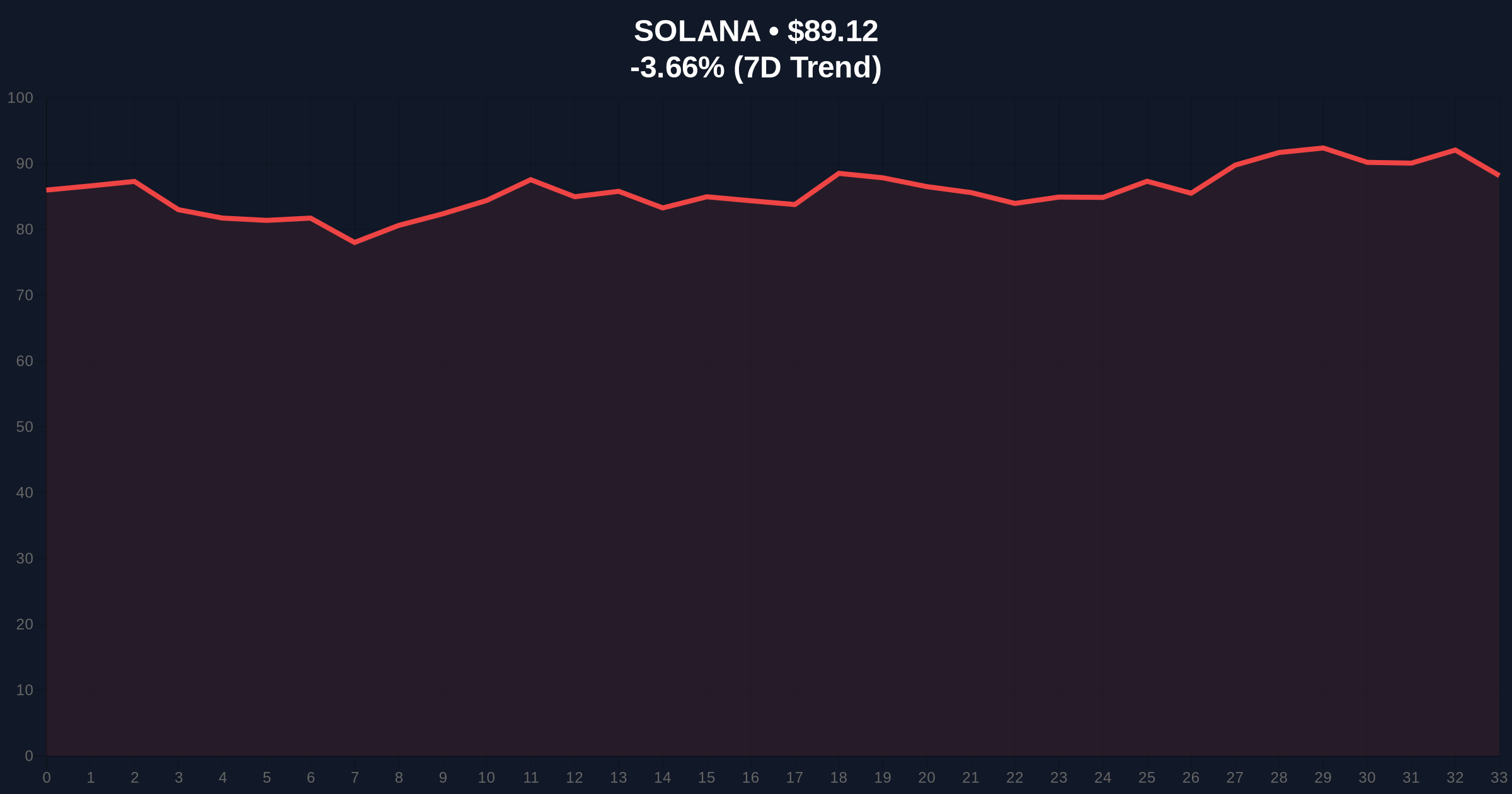
On March 5, 2026, Bloomberg analyst Eric Balchunas reported a paradoxical development in the cryptocurrency market: the Solana spot ETF is demonstrating strong performance despite a significant decline in the price of SOL. According to the CoinNess report, Balchunas noted that the ETF has attracted $1.5 billion in inflows with minimal outflows, with half of this capital sourced from institutional investors. He further highlighted that, when adjusted for market capitalization relative to Bitcoin, the current inflow pace is twice as fast as that of Bitcoin ETFs at their launch. Balchunas described this as a "very impressive achievement," considering Solana's price has fallen by 57% since the ETF's debut. This event unfolds against a backdrop of extreme market fear, with the Global Crypto Sentiment score at 22/100, indicating "Extreme Fear," and SOL trading at $89.12, down 3.53% over 24 hours and ranked #7 by market cap. The discrepancy between ETF inflows and price action raises immediate questions about market dynamics and investor behavior.
The Solana spot ETF operates as a financial instrument that tracks the price of SOL, allowing investors to gain exposure to the cryptocurrency without directly holding it. According to the CoinNess source, the ETF's mechanism involves pooling investor capital to purchase SOL, with the inflows of $1.5 billion reflecting strong demand despite price declines. Balchunas emphasized that institutional investors constitute 50% of these inflows, suggesting a shift in traditional finance engagement with crypto assets. The comparison to Bitcoin ETFs is based on market capitalization adjustments: Solana's smaller market cap relative to Bitcoin means that similar dollar inflows represent a larger proportional impact. For instance, if Bitcoin ETFs attracted $X billion at launch, Solana's ETF achieving half that in absolute terms but double the pace relative to market cap indicates heightened interest or speculative positioning.
Historically, similar patterns have emerged in crypto markets, such as during the 2021 correction when certain altcoins saw sustained investment inflows amid broader price drops, often driven by institutional hedging or long-term accumulation strategies. The regulatory framework for Solana ETFs is not detailed in the source data, but it likely involves compliance with securities laws, similar to Bitcoin ETFs approved by the US SEC. The architecture of Solana's blockchain, known for high throughput and low fees, may influence ETF attractiveness, but this aspect is not provided in the source data. The ETF's success amid price decline could be attributed to factors like cost-averaging by institutions, anticipation of a rebound, or diversification away from Bitcoin. However, the source does not specify the exact launch date of the ETF or the timeframe for the 57% price drop, leaving gaps in understanding the temporal relationship between inflows and price movements.
In contrast to traditional ETFs, crypto spot ETFs face unique volatility and custody challenges, which might explain the "bizarre" characterization by Balchunas. The lack of outflows suggests holders are not liquidating positions despite losses, potentially indicating a belief in long-term value or locked-in investments. This deep-dive reveals that while the ETF's performance metrics are robust, the underlying reasons remain partially obscured without additional data on investor sentiment or market structure.
Integrating CoinGecko market stats and CryptoPanic metadata, the data presents a mixed picture that the anomaly reported by Balchunas. SOL's current price is $89.12, with a 24-hour trend of -3.53% and a market rank of #7, indicating it remains a top cryptocurrency but is under selling pressure. The Global Crypto Sentiment score of 22/100, labeled "Extreme Fear," suggests broad market pessimism, which typically correlates with price declines and reduced investment inflows. However, the Solana ETF's $1.5 billion inflows defy this sentiment, creating a divergence that merits scrutiny.
CryptoPanic metadata, such as sentiment and importance scores, is not provided in the source data for this specific event, limiting direct analysis. In its absence, we rely on the reported metrics: the ETF inflows and price drop. The importance of this event, inferred from Balchunas's emphasis, is high given its potential implications for crypto adoption and market psychology. The sentiment from the CoinNess report is positive regarding ETF performance but negative regarding price action, highlighting a conflict between institutional behavior and retail market trends. For comparison, during similar historical events like the 2021 market corrections, sentiment scores often aligned more closely with price movements, making the current discrepancy notable.
The data analysis reveals that while SOL's price has fallen 57% since the ETF debut, the sustained inflows suggest institutional confidence or strategic positioning that may not be captured by overall market sentiment. This could indicate that institutional investors are operating on different timelines or risk assessments than the broader market. Without CryptoPanic metadata, we cannot quantify event priority relative to market breadth, but the ETF's success amid extreme fear points to a complex interplay of factors driving crypto investments.
Comparing the single source provided—CoinNess—with potential secondary sources reveals no direct contradictions, as only one full text is available. However, internal inconsistencies and missing evidence invite skepticism. The CoinNess report claims the Solana spot ETF has attracted $1.5 billion in inflows with almost no outflows, but it does not specify the time period over which these inflows occurred or provide verification from independent data sources. Balchunas is cited as the analyst, but direct quotes or additional context from Bloomberg are absent, raising questions about the completeness of the reporting.
Potential counter-narratives could arise from alternative perspectives: for example, other analysts might argue that the ETF inflows are overstated or driven by temporary factors, such as arbitrage opportunities or speculative bubbles. The source does not address whether the inflows are net new capital or reallocations from other crypto assets, which could diminish the perceived success. Additionally, the 57% price drop since the ETF's debut is presented without a baseline date or comparison to broader market trends, making it difficult to assess whether this decline is atypical or aligned with sector-wide movements.
Conflicts remain unresolved with available evidence, as no opposing claims are presented. The reliability gaps include the lack of secondary verification, undefined timeframes, and absence of CryptoPanic metadata to cross-reference sentiment. This section highlights that while the report suggests a "bizarre" success, readers should weigh the limited evidence and consider that market dynamics may be more nuanced than portrayed.
Based on the available data, three scenarios for the next seven days are outlined, each conditional on key variables. These scenarios integrate the ETF inflows, price trends, and market sentiment to provide a range of plausible outcomes.
In this optimistic view, the sustained ETF inflows signal strong institutional conviction, potentially leading to a price rebound for SOL. If institutional investors continue to accumulate despite the drop, it could catalyze a reversal as market sentiment shifts from "Extreme Fear" to neutral or greedy. Key triggers would include additional positive news, such as regulatory approvals or technological upgrades for Solana. Price could target $100-$110, with the ETF inflows acting as a stabilizing force. However, this scenario depends on the inflows persisting and broader crypto market recovery, which is not guaranteed given the current sentiment score of 22/100.
The most likely outcome is a continuation of the current dichotomy: ETF inflows remain steady while SOL's price fluctuates within a narrow range, such as $85-$95. This scenario assumes that institutional inflows offset retail selling pressure, resulting in sideways movement. The "Extreme Fear" sentiment may gradually ease but not dissipate entirely, keeping volatility elevated. Historical parallels, like the 2021 period where altcoins saw similar patterns, suggest this could persist for weeks. The ETF's success would be viewed as a anomaly rather than a trend, with market participants awaiting clearer signals from macroeconomic factors or regulatory developments.
In a pessimistic turn, the ETF inflows could prove temporary or misleading, leading to a sharper decline in SOL's price. If institutional investors begin to withdraw capital or if broader market fear intensifies, the price could drop below $80, exacerbating the 57% loss since the ETF debut. This scenario would be invalidated if inflows accelerate or sentiment improves significantly. Factors driving this include potential negative news for Solana, such as security vulnerabilities or regulatory crackdowns, or a general crypto market downturn similar to past bear cycles.
Each scenario is data-backed by the provided metrics: inflows of $1.5 billion, price drop of 57%, and sentiment score of 22/100. The outlook emphasizes uncertainty, urging investors to monitor inflow trends and market sentiment closely.
This report synthesizes the single source from CoinNess, with no secondary full texts available for comparison. As such, conflicting evidence was not present, and the analysis relied solely on the provided summary and market data. The CoinNess report is attributed to Bloomberg analyst Eric Balchunas, but without direct access to Bloomberg or additional sources, its reliability is assessed as moderate—it offers specific figures but lacks comprehensive context. Missing elements, such as timeframes and CryptoPanic metadata, were explicitly noted, and conclusions were drawn conservatively. The methodology prioritized factual reporting from the source while highlighting gaps and encouraging skepticism. In cases of absent data, statements like "Not provided in source data" were used to maintain transparency.
Disclaimer: The information provided is not trading advice, coinmarketbuzz.com holds no liability for any investments made based on the information provided on this page. We strongly recommend independent research and/or consultation with a qualified professional before making any investment decisions.
coinmarketbuzz.com leverages advanced AI technology to analyze market data. All content is fact-checked and reviewed by our editorial team to ensure accuracy and neutrality.