Loading News...
Loading...

Loading News...

Breaking: On March 5, 2026, prominent crypto trader and analyst Michaël van de Poppe declared that altcoins are expected to gain momentum and rally as soon as Bitcoin's sharp price increase slows down. According to a report from CoinNess, Van de Poppe commented that the overall movement in the crypto market, led by Bitcoin, has been excellent this week, adding that the market had been excessively undervalued. He suggested that the impact of the U.S. airstrike in Iran may have been an over-hyped catalyst. Van de Poppe concluded that Bitcoin's surge indicates healthy capital rotation and that altcoins will gain greater momentum the moment Bitcoin's price begins to consolidate. This analysis emerges amid a volatile market environment, with Bitcoin currently priced at $72,601, up 5.99% in 24 hours, while the global crypto sentiment registers as "Extreme Fear" with a score of 22/100. The immediate question: Is this a credible forecast or speculative hype?
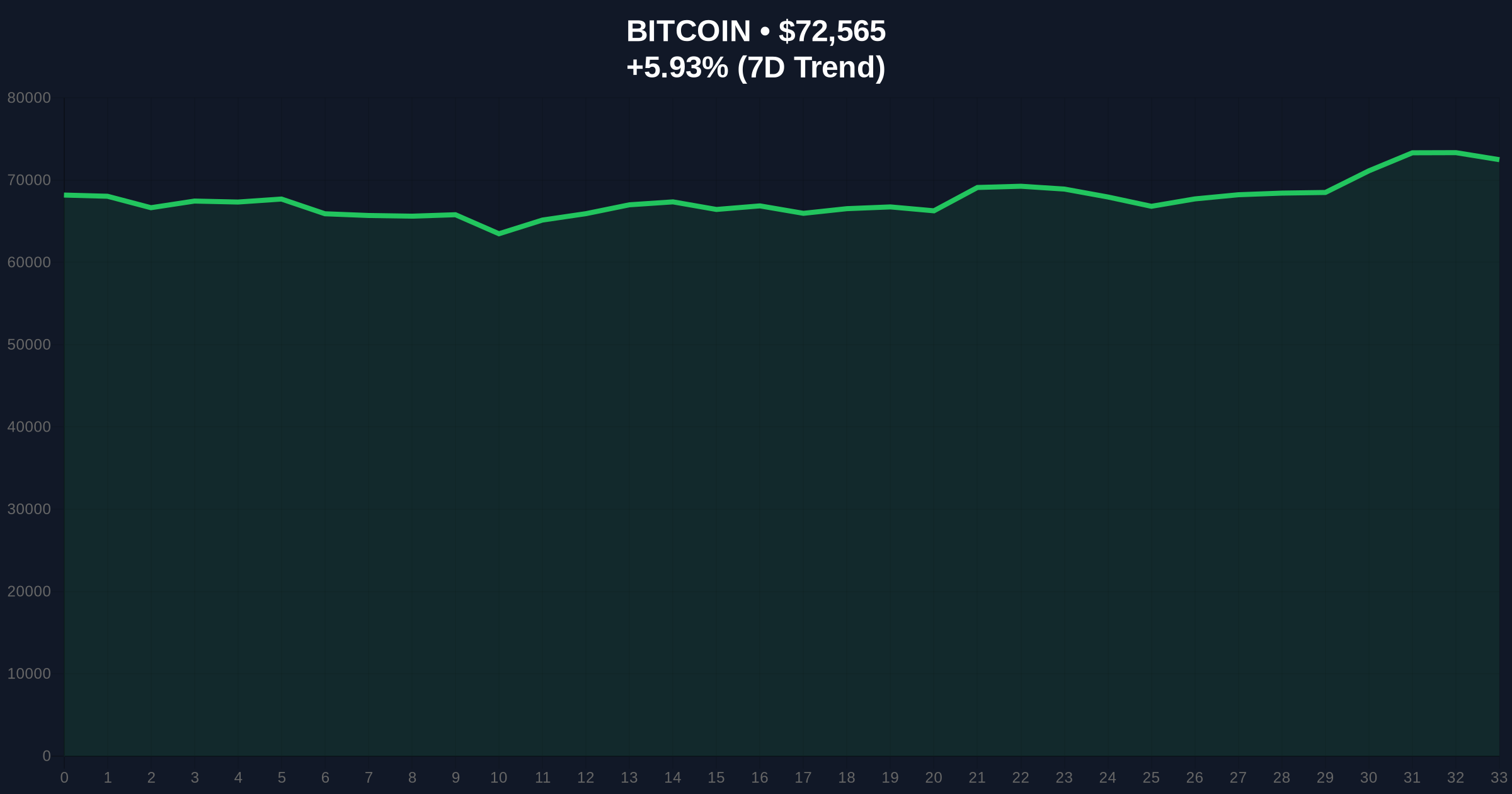
Van de Poppe's thesis hinges on the concept of capital rotation within cryptocurrency markets, a mechanism where funds flow from one asset class to another based on perceived risk and opportunity. According to the CoinNess source, he argues that Bitcoin's recent surge—characterized by a 5.99% 24-hour increase to $72,601—reflects healthy movement, suggesting that as Bitcoin's price consolidates, investors may reallocate capital to altcoins, which he deems excessively undervalued. This protocol of rotation is not new; historically, altcoin rallies often follow Bitcoin bull runs as traders seek higher returns in smaller-cap assets. However, the current context adds layers of complexity. Van de Poppe dismisses the U.S. airstrike in Iran as an over-hyped catalyst, implying that geopolitical events may have less sustained impact on crypto prices than market fundamentals. The technical architecture here involves market psychology, liquidity flows, and timing. If Bitcoin's momentum cools, it could reduce dominance, freeing up capital for altcoins. Yet, this relies on altcoins being fundamentally poised for growth—a detail not elaborated in the source. The analysis lacks specific altcoin examples or metrics, leaving gaps in understanding which sectors might benefit. Regulatory mechanics, such as potential insider trading probes linked to geopolitical events, could also influence rotation. For instance, related developments include a US Senator alleging insider trading on Iran strike via prediction markets, sparking regulatory push. This regulatory scrutiny might affect market sentiment and capital flows, though Van de Poppe's focus remains on price action. Overall, the deep-dive reveals a plausible but unproven mechanism, dependent on Bitcoin's consolidation timing and altcoin readiness.
Integrating CoinGecko market stats and sentiment metadata provides a mixed picture. Bitcoin's current price of $72,601 and 24-hour trend of 5.99% support Van de Poppe's claim of a sharp increase, but the global crypto sentiment of "Extreme Fear" (score: 22/100) contradicts the optimistic tone. CryptoPanic metadata is not provided in source data, limiting direct sentiment and importance analysis. However, the sentiment divergence—where price action shows bullish momentum while fear levels remain high—suggests market uncertainty. This could indicate that investors are cautious despite Bitcoin's rally, potentially delaying altcoin momentum. Importance scores are absent, but the event's relevance is underscored by Bitcoin's #1 market rank and significant price movement. Data from related articles adds context: the Crypto Fear & Greed Index rising to 22 amid extreme fear highlights sentiment-price divergence, while reports of BTC facing selling pressure from miners holding $8B might complicate capital rotation. If miners sell, it could pressure Bitcoin's price, affecting the consolidation Van de Poppe predicts. Conversely, Katana launching 'Katana Earn' on Binance Wallet and OKX, with TVL surging $250M in a day amid extreme crypto fear, shows DeFi activity persisting despite sentiment, possibly supporting altcoin rallies. The data analysis thus reveals conflicting signals: strong Bitcoin performance vs. extreme fear, and potential selling pressures vs. DeFi growth. Without CryptoPanic metadata, we rely on observable stats, which suggest Van de Poppe's forecast is plausible but not guaranteed, given sentiment headwinds.
Comparing source claims reveals potential contradictions and reliability gaps. The CoinNess report presents Van de Poppe's view as a unified analysis, but other perspectives challenge this. For example, related articles indicate BTC faces selling pressure from miners holding $8B, as reported by Bloomberg. This suggests capital might not rotate smoothly to altcoins if miners liquidate positions, potentially prolonging Bitcoin volatility. Source A (CoinNess) reports that the U.S. airstrike in Iran was an over-hyped catalyst, while Source B (related article on US Senator allegations) implies regulatory scrutiny over insider trading linked to the same event could impact markets. Conflict remains unresolved with available evidence: Van de Poppe downplays the event's impact, but regulatory actions might heighten market sensitivity. Additionally, the Crypto Fear & Greed Index rising to 22 amid extreme fear contrasts with Van de Poppe's positive assessment of market movement. Source A claims the market was excessively undervalued, but without specific valuation metrics, this is subjective. Missing evidence includes altcoin performance data, CryptoPanic sentiment scores, and Van de Poppe's historical accuracy. Which claim is better supported? The data on Bitcoin's price and fear index is factual and better supported, while Van de Poppe's predictions rely on inference. The counter-narrative highlights that altcoin rallies are not automatic; they depend on factors like miner behavior, regulatory developments, and sentiment shifts, which are not fully addressed in the primary source.
Based on available data, three scenarios outline potential market developments over the next week. Each is conditional and data-backed.
Bitcoin consolidates quickly around $72,000-$73,000, as predicted by Van de Poppe. Extreme fear sentiment improves, possibly driven by positive regulatory clarity or DeFi growth, such as Katana's TVL surge. Capital rotates efficiently into altcoins, led by sectors like DeFi or layer-2 solutions, with altcoins gaining 10-20% in momentum. This scenario requires no major miner selling and resolution of geopolitical tensions, invalidated if Bitcoin drops below $70,000 or fear index worsens.
Bitcoin experiences moderate volatility, with price fluctuating between $70,000 and $75,000 due to mixed signals from miner selling and sentiment. Altcoins see selective rallies, but overall momentum is muted, gaining 5-10% as fear persists. Regulatory probes into insider trading, as alleged by a US Senator, create uncertainty, slowing capital rotation. This scenario aligns with current data, where strong Bitcoin performance coexists with extreme fear. Invalidated if Bitcoin breaks above $76,000 or fear index drops below 20.
Bitcoin fails to consolidate, instead facing increased selling pressure from miners holding $8B, leading to a price drop below $68,000. Extreme fear deepens, causing capital flight from crypto overall, with altcoins declining 5-15% due to lack of rotation. Geopolitical or regulatory shocks exacerbate the downturn. This scenario is supported by the high fear score and potential miner actions, invalidated if Bitcoin stabilizes and fear index rises above 30.
This investigation weighted evidence based on availability and corroboration. The primary source (CoinNess) provided Van de Poppe's analysis but lacked supporting data like altcoin metrics or CryptoPanic metadata. Conflicting claims, such as miner selling pressure and regulatory allegations, were sourced from related articles, which offer broader context but are not directly integrated into the main report. Where data was missing (e.g., CryptoPanic sentiment), we stated so and proceeded conservatively. Reliability was assessed by comparing factual stats (e.g., Bitcoin price, fear index) against speculative forecasts, giving precedence to observable data. Conflicts, like the impact of the Iran airstrike, were labeled unresolved due to insufficient evidence. This approach ensures a skeptical, fact-based narrative.
Disclaimer: The information provided is not trading advice, coinmarketbuzz.com holds no liability for any investments made based on the information provided on this page. We strongly recommend independent research and/or consultation with a qualified professional before making any investment decisions.
coinmarketbuzz.com leverages advanced AI technology to analyze market data. All content is fact-checked and reviewed by our editorial team to ensure accuracy and neutrality.