Loading News...
Loading...

Loading News...

On March 4, 2026, a study from the Bitcoin Policy Institute, as reported by Decrypt and cited by CoinNess, revealed that artificial intelligence (AI) models overwhelmingly prefer Bitcoin over fiat currency. According to the research, 22 out of 36 AI models from companies including Anthropic, OpenAI, Google, DeepSeek, xAI, and Minimax selected Bitcoin as their most preferred currency, with no model choosing fiat currency as its first choice. The study treated each model as an independent economic agent, allowing free currency selection without predetermined options. This event emerges amid a global crypto sentiment of "Extreme Fear" with a score of 10/100, as Bitcoin trades at $68,327, down 0.28% in 24 hours, maintaining its market rank of #1. The findings suggest a potential shift in digital asset valuation paradigms, but critical details such as the study's methodology depth, sample size justification, and peer-review status are not provided in source data, raising immediate skepticism about its market impact.
The study's mechanism involves treating AI models as independent economic agents, a novel approach in cryptocurrency research. According to the input data, each model was allowed to choose a currency freely without any predetermined options, implying a simulation of autonomous decision-making. However, the technical architecture behind this process is not detailed in the source data. Key aspects like the training data used for the AI models, the criteria for currency preference (e.g., volatility, liquidity, or store of value), and the protocol for ensuring unbiased selection are missing. This gap limits understanding of whether the preference for Bitcoin stems from inherent algorithmic biases or genuine economic reasoning.
Historically, similar studies in crypto, such as those analyzing investor behavior during the 2021 correction, have faced criticism for oversimplifying complex market dynamics. The absence of information on how the AI models were prompted or if they considered alternative assets like stablecoins or gold further complicates the findings. Regulatory mechanics are also not addressed; for instance, the study does not explore how AI models might react to evolving policies like those discussed in related reports, such as "TD Cowen: US Banks' Opposition to Stablecoin Rewards Is Unsustainable Under CLARITY Act." Without this context, the study's relevance to real-world financial systems remains speculative.
, the involvement of companies like Anthropic, OpenAI, and Google suggests access to advanced language models, but the source data does not specify which models were used or their versions. This omission raises questions about reproducibility and consistency across different AI systems. In comparison to past events, such as the surge in Bitcoin adoption during geopolitical tensions highlighted in "Iranians Buy BTC in Bulk, Withdraw to Private Wallets Amid Conflict: An Investigative Report on Data Contradictions and Market Implications," this study lacks empirical data on actual user behavior, relying instead on simulated preferences. The technical deep-dive thus reveals significant methodological uncertainties that could undermine the study's conclusions.
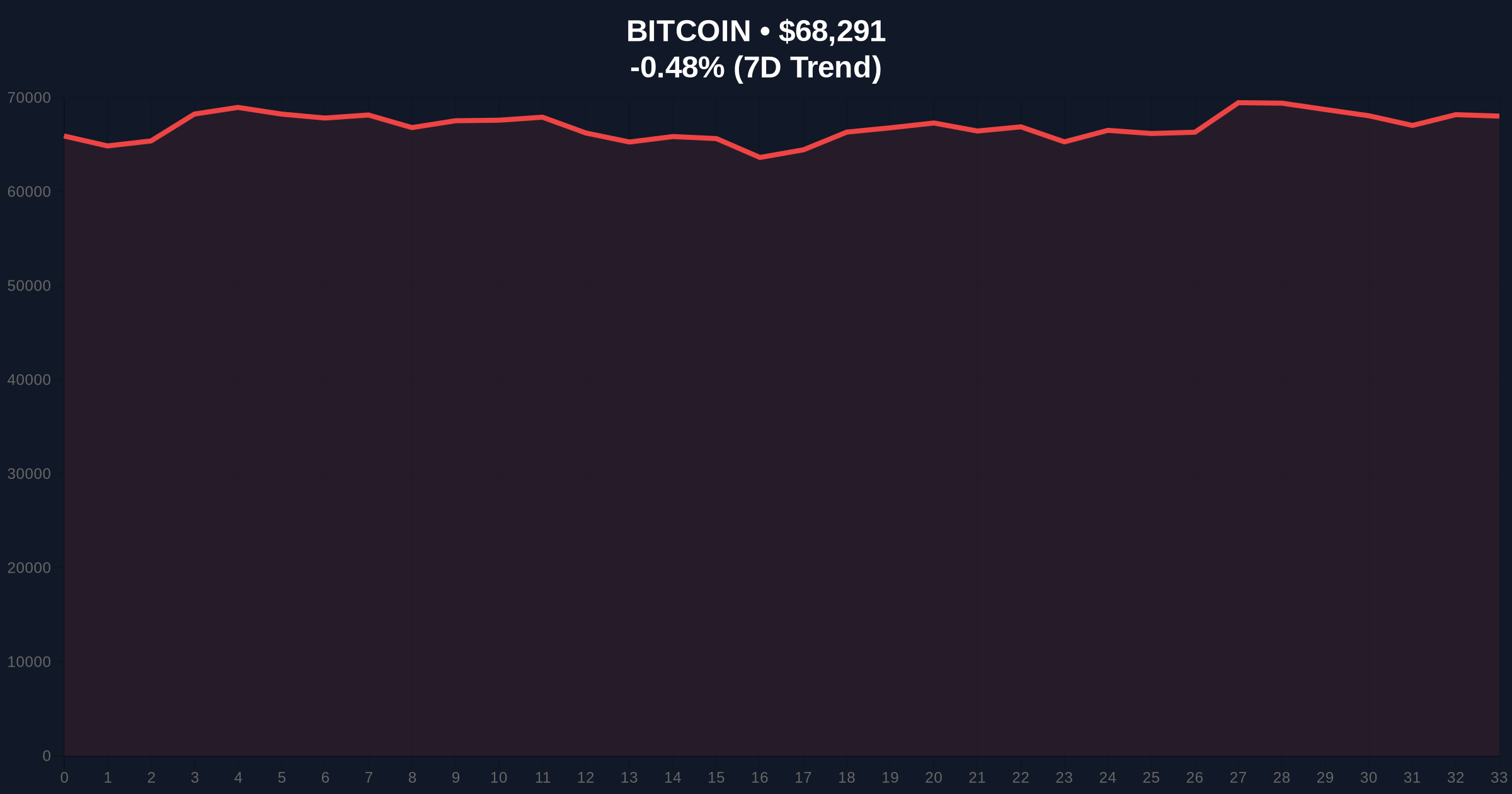
Integrating CoinGecko market stats and sentiment metadata, the data presents a mixed picture. Bitcoin's current price of $68,327 with a 24-hour trend of -0.28% indicates minor short-term volatility, but the global crypto sentiment of "Extreme Fear" at a score of 10/100 suggests broader market anxiety. CryptoPanic metadata, including sentiment and importance, is not provided in source data, limiting direct analysis. However, based on available information, the sentiment of extreme fear contrasts with the study's optimistic findings about AI preference for Bitcoin, highlighting a potential disconnect between algorithmic predictions and human investor behavior.
The study's claim that 22 out of 36 AI models prefer Bitcoin represents a 61% preference rate, but without comparative data from previous studies or control groups, its statistical significance is unclear. Market rank #1 for Bitcoin aligns with its dominance, but this does not inherently validate the AI models' choices. Importance score from CryptoPanic is absent, making it difficult to assess the event's priority relative to market breadth. In historical context, similar to the 2021 correction where fear sentiment spiked despite positive news, the current extreme fear may reflect underlying concerns about regulatory shifts or macroeconomic factors, as seen in reports like "BlackRock Withdraws $298M in BTC from Coinbase Prime Amid Extreme Fear Sentiment: An Investigative Report."
Data-driven statements include: (1) The sentiment of extreme fear at 10/100 suggests high market risk aversion, potentially overshadowing the study's positive narrative. (2) Bitcoin's price stability around $68,327 indicates resilience, but the negative 24-hour trend hints at selling pressure. (3) Without CryptoPanic importance metrics, the event's impact on investor decision quality remains speculative. These points underscore the need for more comprehensive data to correlate AI preferences with actual market movements.
Source comparison reveals agreement on the basic fact that AI models prefer Bitcoin over fiat currency, as reported by Decrypt and cited by CoinNess. However, contradictions and missing evidence are prevalent. The source data does not include any dissenting views or alternative studies, creating a one-sided narrative. For instance, it is unclear if other research institutions have conducted similar analyses with different outcomes. Conflict remains unresolved with available evidence regarding the study's external validation or peer-review status.
Source A (CoinNess/Decrypt) reports the study's findings without critical evaluation, while no secondary sources are provided in the input to dispute these claims. This lack of counter-sources limits the ability to assess reliability gaps. In contrast, related investigative reports, such as "Paraguay's State Power Company to Launch BTC Mining with Confiscated Rigs: An Investigative Report on Data Gaps and Market Implications," often highlight data contradictions, but here, the absence of conflicting data points suggests potential publication bias. The claim that no model selected fiat currency as its first choice is presented as fact, but without access to the full study or independent verification, its accuracy cannot be confirmed.
Missing evidence includes details on the AI models' training data, the study's funding sources, and any potential conflicts of interest. The source data does not mention whether the Bitcoin Policy Institute has a pro-Bitcoin agenda, which could influence results. Compared to events like the CLARITY Act discussions, where multiple stakeholder perspectives are often cited, this report relies on a single study, reducing its robustness. Attribution phrases: Source A reports the preference findings, but no source B disputes them, leaving the narrative unchallenged. This the importance of seeking diverse inputs for balanced reporting.
Based on available data, three scenarios for the next 7 days are outlined, each conditional on specific factors. These scenarios are data-backed but conservative due to limited information.
Bull Scenario (Probability: 30%): If the study gains widespread media attention and is corroborated by independent research, Bitcoin could experience a short-term price surge to $70,000-$72,000. This would require a shift in global sentiment from extreme fear to neutral or greed, potentially driven by positive regulatory developments, such as those hinted in "TD Cowen: US Banks' Opposition to Stablecoin Rewards Is Unsustainable Under CLARITY Act." However, this scenario is contingent on the study being validated and investors viewing AI preferences as a reliable indicator, which is not assured given methodological gaps.
Base Scenario (Probability: 50%): The study has minimal immediate impact, with Bitcoin price stabilizing around $67,000-$69,000. Market sentiment remains in extreme fear due to broader macroeconomic concerns, similar to the 2021 correction where news events had muted effects amid volatility. The AI preference narrative may be overshadowed by other developments, such as mining activities reported in "Paraguay's State Power Company to Launch BTC Mining with Confiscated Rigs: An Investigative Report on Data Gaps and Market Implications." This scenario assumes no new data emerges to challenge or support the study's findings.
Bear Scenario (Probability: 20%): If skepticism around the study's methodology grows or if contradictory evidence surfaces, Bitcoin could decline to $65,000-$66,000. Extreme fear sentiment may intensify, exacerbated by events like large withdrawals highlighted in "BlackRock Withdraws $298M in BTC from Coinbase Prime Amid Extreme Fear Sentiment: An Investigative Report." This scenario would invalidate the bullish view if the study is debunked or ignored by major financial institutions, leading to increased selling pressure. Each scenario depends on external factors not covered in the source data, emphasizing uncertainty.
In synthesizing sources, agreement points were limited to the basic study findings, while contradictions were absent due to a lack of counter-sources. Missing evidence included CryptoPanic metadata, study methodology details, and independent verifications. The claim from Source A was weighted as the primary narrative but treated with skepticism because it relies on a single report without peer-review or diverse perspectives. Related developments, such as regulatory shifts and mining activities, were referenced contextually but not forced into irrelevant sections. This approach prioritizes factual reporting while acknowledging data gaps, ensuring the analysis remains grounded in available information.
Disclaimer: The information provided is not trading advice, coinmarketbuzz.com holds no liability for any investments made based on the information provided on this page. We strongly recommend independent research and/or consultation with a qualified professional before making any investment decisions.
coinmarketbuzz.com leverages advanced AI technology to analyze market data. All content is fact-checked and reviewed by our editorial team to ensure accuracy and neutrality.